
Bicycle Racing News and Opinion,
Wednesday June 4, 2025
Back to news and opinion index page for links to archived stories | Commentary | Our YouTube page
2024 Tour de France | 2024 Giro d'Italia
How far you go in life depends on your being tender with the young, compassionate with the aged, sympathetic with the striving and tolerant of the weak and strong. Because someday in your life you will have been all of these. - George Washington Carver
Les Woodland's book Dirty Feet: How the Great Unwashed Created the Tour de France is available in print, Kindle eBook & audiobook versions. To get your copy, just click on the Amazon link on the right.
Upcoming racing:
- June 8: Brussels Cycling Classic
- June 8 - 15: Critérium du Dauphiné
- July 5 - 27: Tour de France
Latest completed racing:
- May 9 - June 1: Giro d'Italia
- May 29 - June 1: Tour of Norway
- May 14 - 18: 4 Jours de Dunkerque
- May 18: Rund um Köln
- May 13: Classique Dunkerque
- May 11: Tro-Bro Léon
- May 10: GP du Morbihan
- May 9: Tour du Finistère
- April 27 - May 4: Tour of Turkey
- April 29 - May 4: Tour de Romandie
- May 1: Rund um den Finanzplaz Eschborn-Frankfurt
- April 27: Liège-Bastogne-Liège
- April 24 - 27: Vuelta Asturias
Gee’s Team Israel-Premier Tech posted this:
“I’m tired,” says Derek Gee — before quickly correcting himself with a wide smile. “Exhausted… yes, that’s the word. But it’s like, on a whole different level I can’t even begin to describe.”
The 27-year-old Canadian, his face sunken and lean after the most demanding 20 days of his career, has just completed a journey spanning thousands of kilometers from Albania to Rome. We met him at Israel – Premier Tech’s hotel in the Italian capital, where he was trying to recover and summon the last drops of energy for the final stage — a mostly ceremonial one, but still important enough to put the official stamp on the greatest achievement of his career and that of his team: a top-4 finish in the Giro d’Italia.
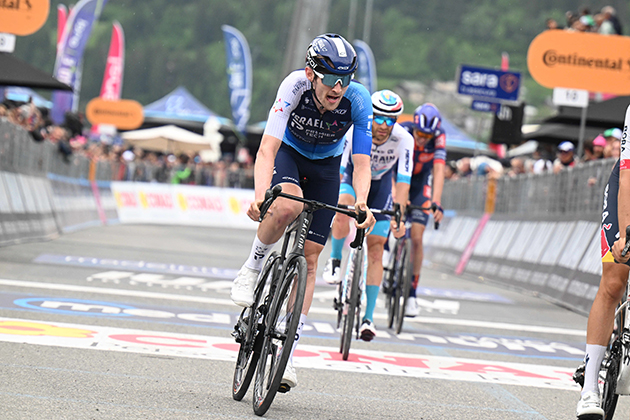
Derek Gee finishes stage 17. Sirotti photo
“It’s still 143 kilometers you have to get through safely,” he says, “so I can finally go home, get some rest, and begin to process what just happened here — what I achieved, and what we achieved together as a team.”
Just hours earlier, Gee had been part of the Giro’s grand finale — a thrilling showdown watched by millions, as four of the world’s top riders, including himself, battled it out in one of the most dramatic and unpredictable editions of the race in recent years.
Even though he finished fourth — often considered the most painful spot in sport — Gee insists: “There isn’t even a drop of bitterness, disappointment, or regret. None. On the contrary — if you’d told me two years ago, when the team first started developing me and believing in me as a GC rider, that I’d finish top-5 in my favorite race — the one I’ve adored since I was a little kid growing up in Ottawa — I would’ve had a hard time believing it was possible.”
In fact, Gee admits that during the race, his own belief in that possibility began to falter. He calls the experience “a rollercoaster — one moment you’re on a high, full of hope, and the next you’re down, starting to wonder if there’s any chance left.”
His Giro began as something of a nightmare. On the opening stage in Albania, he lost a full minute due to what seemed like a combination of poor positioning and what riders call “bad legs.”
A few days later, just as he was finding his rhythm again, came a crash on Stage 7 into Naples. And then, only two days later, a puncture on the gravel roads to Siena at the worst possible moment — costing him nearly a minute and a half to eventual winner Simon Yates.
It’s fair to say that without those three setbacks, Gee may very well have stood on the final podium.
But Gee refuses to look at it that way. On the contrary — he believes he and the team may have salvaged their Giro from total collapse when things seemed to be slipping out of control.
Derek Gee: “After that crash on the way to Naples, I started to doubt whether I could continue fighting for GC. The crash ended with a strained thigh muscle. I was afraid that was it. But luckily, I recovered quickly, and even when I lost more time, we didn’t lose our heads. I couldn’t let myself — I thought about all the massive investment from the staff and riders around me. They all believed in me. There was no way I could throw in the towel. That just wasn’t an option.”
Then came the turning point: a brilliant time trial on Stage 10 that launched him from the depths of 20th place straight back into the fight. From that moment on, he never looked back.
The highlight came on Stage 16, when Gee’s incredible ride left even the race leader Del Toro and eventual winner Simon Yates behind. From that point to Saturday’s final showdown on the mighty Finestre climb, Gee went all-in.
“Not only did I give everything — I truly believed I could do it,” he says. “Every day, I set out feeling like this could be the one. But to be totally honest: yesterday, in the ultimate test, when the four of us were on the Finestre, all of us on the limit — they were better than me. That’s it. That’s why I have zero disappointment, but great pride and enormous sattissfaction.”
Maybe it’s because, for Gee and the team, this really is just the beginning. He’s convinced his peak is still ahead of him. He adds: “We’ve made a massive leap forward to become a team that competes for GC. And now we all want more. I’m far from reaching my full potential. There’s still work to do.”
Do you see yourself winning a Grand Tour with the team? “I clearly see myself reaching the podium in a Grand Tour. I’m completely convinced I can. If I’ve already finished fourth, I can make the podium.
“Will I win? It’s hard to declare that out loud, especially with incredible riders like [Tadej] Pogačar and [Jonas] Vingegaard in the mix. So I won’t say it openly. But the truth? Deep down, I have to believe that a Grand Tour win is possible. Without belief that you’re capable of anything, you’ll never reach your highest level.”
The team’s top performance staff are convinced it’s possible. Enormous resources have been invested in Gee — including full-time support from lead coach Ciaran Rawlins O’Grady.
Also behind the “Derek Gee project” is team owner Sylvan Adams, who not only gave the green light to invest in Derek but opened the door for him years ago with the Israel – Premier Tech Academy.
There is general agreement that Gee still lacks one key element: explosiveness — the ability to switch from steady tempo to a brutal acceleration for a decisive attack. Could that missing piece be what kept him off the Giro podium — or even something bigger?
Gee agrees this element was missing but believes he can develop it: “It’s a trait I had in the past — as a track rider, I had a good kick. But we gave some of that up to develop my engine as a GC rider. We built a strong diesel, but now it might be time to make some adjustments. I believe I can improve that dimension.”
So what’s next after some much-needed rest at home? Will we see Gee in another Grand Tour this season?
The final decision will be made by the team’s performance staff, but Gee says he definitely sees himself riding the Vuelta a España: He says” “Maybe not as a GC rider — doing two Grand Tours in a season is incredibly demanding — but I really want to race the Vuelta. Maybe it’ll happen this season.”
And he hopes to ride alongside one of his favorite teammates — Israeli rider Nadav Raisberg. Gee has deep appreciation for his teammates and their support: “The riders around me in this Giro truly moved me with their total dedication.
“Seeing Marco Frigo come back to help me on the day we passed the house where he grew up, or Jakob Fuglsang dedicating his final career race to me — that was special. Actually it moves me to tears when I think about their dedication.
“I really looking forward to race with Nadav — riding with him is just a joy, with the great energy he brings.”
Gee returns home with a major personal milestone — but the implications for the future of the team are even more far-reaching.
“We took a huge step forward as a team in this Giro,” he says. “The investment came from everyone, the commitment was total. The entire team — not just me — took a step up and laid the foundation to fight for GC in the years to come. That’s massive for us.”







Content continues below the ads
Here’s the team’s post:
The Q36.5 Pro Cycling Team embarked on its first Grand Tour since its inception in 2023. The Giro d’Italia was the perfect place to begin this journey and showcase Q36.5, our proud Italian title sponsor. After 21 stages, General Manager Doug Ryder reflects on his experience of the race.
“The stats are the stats, and they show we were in the top ten in almost half of the stages. What we did was pretty damn decent. Our aim was to win stages with Tom and Matteo. They each got a podium. Having that result already on day five with Tom was a good boost to morale.”
Many fans were looking forward to stage 9, which featured several of the white gravel roads of Tuscany also seen in Strade Bianche—a race Tom Pidcock has won before and in which he finished second earlier this year.
“Sadly, the Strade Bianche stage didn’t work out for us, with flat tyres and bike changes, but we gave it a good crack. That day, and every day, I saw a team that was committed and rode well together. They carried that spirit all the way to Rome, where everyone stayed sharp and focused for one last push—and that got Matteo on the podium.”
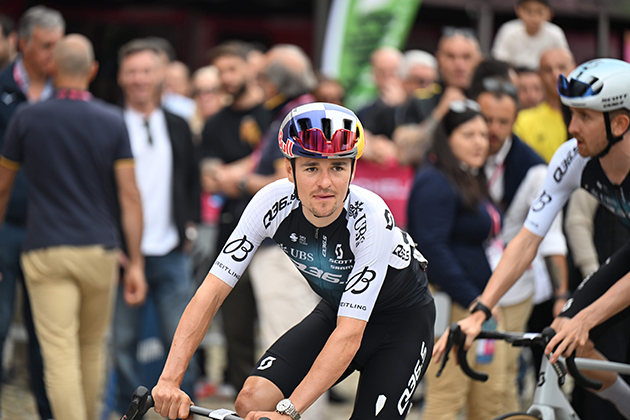
Tom Pidcock heads to the start of stage twelve. Sirotti photo
Riding its first Grand Tour was a huge honour for Q36.5 Pro Cycling Team, but it also came with challenges. Ryder prefers to focus on the positives and sees every race as a chance to grow.
“We learned a lot of lessons. We brought together a group of riders—Tom, Matteo, Mark, Milan, Nick, Damien, Xabier Mikel, and Emils—who didn’t have massive amounts of experience in Grand Tours. Nick and Milan were even rookies.
They did an amazing job being part of the action and trying to race every day. It was sad to lose Nick on stage four, but we made it to Rome with seven healthy, injury-free, smiling riders. That’s a testament to our professional staff too.
We raced for a general classification result with Tom and gave him the opportunity to see what that demands day in and day out. I must add that our preparation wasn’t ideal, as we only found out a month before the start that we had a wildcard for the Giro. We raced a lot beforehand, and that does take a toll during three weeks of extremely high-level racing.”
In the end, Tom Pidcock finished sixteenth in the overall classification. The team featured in many breakaways and placed in the top ten in eight stages—two of which ended on the podium. The next Grand Tour is the Vuelta a España, which starts in Italy this August.
“I’m proud of the whole team—the staff and the riders—for how they went on this journey together. We learned so much—and without learning, there’s no growth. That’s vital for the development of both the team and the individual riders. We’ll now prepare with precision for a big Vuelta and give the general classification another good shot. And yes, we’re all pretty tired after three weeks on the road in Albania and Italy, but I can’t wait to do it all again together in Italy and Spain in August.”
Content continues below the ads

Giro d’Italia: “The Giro Went Well But Not Perfectly!“
One could say “the Gladiators have arrived“ when the Giro d’Italia peloton looped around the historic Colosseum in Rome on stage 21, and finally crossed the finish line in the light of the setting sun over Italy’s capital.
Three weeks, 21 stages and 3,443 kilometers from Tirana in Albania, southern Italy, the white roads of Tuscany, a finish in Slovenia, the grueling steep slopes of Colle delle Finestre and finally to the Eternal City - the first Grand Tour of the season is history.
Tudor Pro Cycling takes home a top-10 overall with Michael Storer, the stage podiums of Maikel Zijlaard and Florian Stork and the emotions and experience of finishing the team’s second Grand Tour.
Michael Storer, Rick Pluimers, Yannis Voisard and Matteo Tosatto share their conclusions after a late finish in Rome and some well-deserved Pizza in the team bus.

The Tudor Pro Cycling Team before the start of this year's Tour de Romandie. Sirotti photo
Australian climber Michael Storer finished the Giro d’Italia in 10th overall and secured the second Grand Tour top 10 of his career: “The Giro went well but not perfectly for me. I was glad to be competing with the best GC riders in the race but in some moments I lost important time which cost me the opportunity to achieve a better result. For the team it was a good Giro, we were often not so far off a stage win and also three of our riders finished their first Grand Tour. Time to recover and focus on the next goals of the season.“
Rick Pluimers was one of those riders who finished their first Grand Tour on Sunday evening in Rome:
“Reflecting on the Giro, I must say it was intense but also a great experience. I liked those days when I could be part of the breakaway, be up there and at least fight for a result. Finishing in Rome was also very special. The ride through the Vatican City, being blessed by the Pope, and then racing around the Colosseum are hard to describe. Stage 19 is one I’ll remember; I’ve never done so much climbing in one day, and I think I’ve stretched my physiological limits on this day. Looking at the form, it’s a good sign I was improving over the time of this Giro and that the legs were still turning well throughout the third week.“
For Yannis Voisard, it was a childhood dream that came true by crossing the start- and finish line of the Giro d’Italia: “It was a childhood dream to race the Giro d'Italia!
“Looking back now, this Giro was a fantastic race with tough days and unforgettable memories. I loved the atmosphere along the road and the passion of the fans in Italy - goosebumps, not only once. My favorite memory from this race must be the day of stage 16. It was a big day in the mountains, and I was able to be in the breakaway. On the last climb, I was alone at the front end of the race, fighting with all I had left in my legs.
“The word ‘borraccia’ (bidon in Italian) will still be in my ears for quite some time - every day, you’ve heard the fans shouting for a 'borraccia' from start to finish and from every direction.“
Sports Director Matteo Tosatto looks back on action-packed and intense three weeks of Grand Tour racing: "For me, it was a beautiful Giro. It was very intense but beautiful! We started very well in Albania, had a good first TT with Michael Storer, moved to Italy, got our first podium finish with Maikel Zijlaard, and gained reasonable confidence in the race's first week. After that, it was a roller coaster for us. The crashes in Naples, a tough day on the Strade Bianche stage, and a strong 2nd place finish in Asiago with Florian Stork by the end of the second week. The third week was a big fight in the mountains; we consolidated the top 10 overall with Michael Storer and arrived in Rome with this result. Unfortunately, we lost Marco Brenner on stage 19 due to a crash. Luckily, he sustained no serious injuries and can ride his bike again very soon.
“With more luck and fewer crashes, we might have been able to fight for 6th or 7th in the GC, but I think it still was a positive Giro for the team and our riders - even though we were not able to achieve the targeted stage win. I'm proud of how the boys raced and worked together as a team; it was great to see their dedication and fighting spirit."
Asked what he’s looking forward to the most after the Giro d’Italia: (laughs) “Not having to pack the suitcase tomorrow morning!“
Content continues below the ads
The Lidl-Trek men exemplified the development philosophy and culture that the team was founded on in Italy
Every World Tour team enters a grand tour like the Giro d’Italia with a plan and a best case scenario in mind. Most teams will fall short, and only on rare occasions will a team exceed its ambitions. Cycling is a fragile, unpredictable, and often karmically cruel sport.
Which is to say that what Lidl-Trek accomplished at this year’s Giro should not be taken for granted for even a second. It was nothing short of one of the best performances in team history.
The final tally: six stage wins by three different riders, four of which came via Mads Pedersen, who arrived in Rome wearing the Maglia Ciclamino as the points competition winner of the Giro d’Italia. The results reflected two years of hard work since Lidl became the lead sponsor of the team.
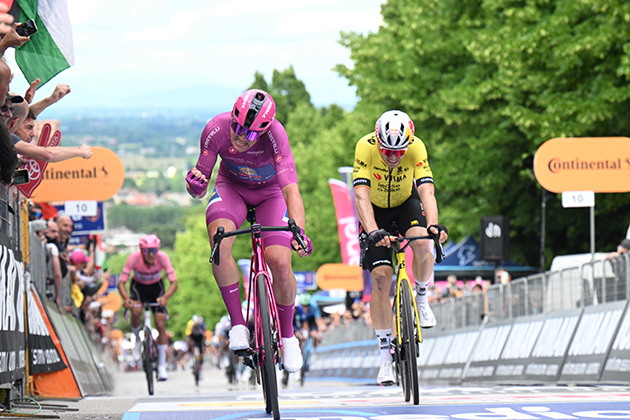
Mads Pedersen wins stage 13 just ahead of Wout van Aert. Sirotti photo
“I think that in this Giro, everything came together perfectly,” team manager Luca Guercilena said. “With the higher challenge of Lidl joining the team, this Giro has been a long time in the making, and for sure was accomplished with the same attitude that we’ve always had. Because we love to win, with happy faces, without much arrogance, always having fun together. That’s the best way to get results.”
Mads’ rampage through the Giro was just desserts for a man who has been, somewhat quietly, one of the fastest men on Earth all year. He spearheaded one of the men’s team’s best-ever Classics campaigns, winning Gent-Wevelgem and taking podiums at E3 Saxo Classic, Tour of Flanders and Paris-Roubaix — races in which only Tadej Pogacar and Mathieu Van Der Poel, two riders in all-time form, were faster. At the Giro, Mads finally got to take center stage.
But Mads’ plan for points had been Lidl-Trek’s mission since the outset of the season. The team didn’t necessarily expect to scoop up two more stage wins with a pair of valuable domestiques. Daan Hoole showed off his raw power and stamina on a brutally long Stage 10 time trial, besting Stage 2 time trial winner Josh Tarling in the process. And Carlos Verona gave one of the performances of the Giro, winning on a breakaway in the mountains after the team suffered a major setback.
Lidl-Trek’s Giro wasn’t perfect. First, Søren Kragh Andersen suffered a fractured wrist on Stage 4 that forced him to abandon, significantly hampering Pedersen’s leadout train. Then on Stage 14, Giulio Ciccone suffered multiple leg injuries in a heavy crash, and though he finished the day, he wouldn’t start the next. He had entered Stage 14 in seventh place on the general classification, with the major climbing stages still to come for the two-time grand tour King of the Mountains winner. A Top 5 GC finish in Rome, and the highest placing of any Italian rider, was well within his sights.
So what was an A-plus Giro was nearly an A-plus-plus, but adversity became an opportunity for Lidl-Trek to shine even more. Verona capitalized on Cicco’s absence and took a risk he might not have otherwise taken, going solo on the Stage 15 climb up Passo Dori with 44 kilometers remaining. He got to celebrate his win with his wife and children at the finish line. After the race, he explained how Ciccone helped motivate him to a career result.
“Everything changed yesterday when we lost Cicco,” Verona said. “I thought, ‘OK, maybe I don’t want to do it for me, but I have to do it for the Team.’ Today I was riding with my mind and my legs with them, especially Ciccone because I know how much he worked for this race, how many sacrifices he made.”
The Giro highlighted one of Lidl-Trek’s biggest goals since 2023: Compile the deepest team possible and ride for each other, foremost. The Giro was the best example yet of the team’s well-ingrained depth, versatility and selflessness. Even Pedersen, who could be forgiven for being laser-focused on a career achievement like the Maglia Ciclamino, vowed to ride for Ciccone in the mountains in the same way Cicco sacrificed himself for Pedersen during the Giro’s early sprint stages.
“Having Cicco in the leadout too, it shows something about his character and the person he is,” Pedersen said after his opening stage victory. “He has ambitions somewhere else but still, he is committed to the team, and helping me in a leadout like this. This shows what we can do on Lidl-Trek and we are supporting each other everywhere. I can’t wait to come to the mountains and give back to Cicco.”
Every World Tour team will say that teamwork is vital to its success. The claim is cliché, and across the sport, follow-through is mixed. But for the Lidl-Trek men, that bit of over-worn wisdom has been embodied in a way rarely seen in cycling. The team chemistry has been building for years as the team has gone all-in on nurturing team leaders, building up its scouting and development infrastructure, prioritizing staff continuity, and fostering a culture based on Trek’s family business model that not only rewards helping your fellow teammates, but makes it natural.
“We found that this matters,” Guercilena said. “It’s more important the name on the front of the jersey, not on the back of the jersey. And I think that that’s the right mentality, and this will always be the mentality of this team, that everyone has to help each other. And especially the strongest, they need to help each other. They need to carry all the others to the results.”
Lidl-Trek not only won big at the Giro, but did so in a way that should only make it stronger into the future. The race reinforced a model predicated on collective effort making everyone even better as individuals — individuals who, in turn, can collectively reach even greater heights. Teamwork done right is a perpetual success machine. Lidl-Trek’s Ciclamino-worthy Giro is proof.
Back to news and opinion index page for links to archived stories | Commentary