

Bicycle Racing News and Opinion,
Monday, April 21, 2025
Back to news and opinion index page for links to archived stories | Commentary | Our YouTube page
2024 Tour de France | 2024 Giro d'Italia
It is not because things are difficult that we do not dare, it is because we do not dare that they are difficult. - Seneca

Les Woodland's book Cycling Heroes: The Golden Years is available in the print, Kindle eBook & audiobook versions. To get your copy, just click on the Amazon link on the right.
Current racing:
- April 21 - 25: Tour of the Alps
Upcoming racing:
- April 23: La Flèche Wallonne
- April 24 - 27: Vuelta Asturias
- April 27: Liège-Bastogne-Liège
- April 27 - May 4: Tour of Turkey
- April 29 - May 4: Tour de Romandie
- May 1: Rund um den Finanzplaz Eschborn-Frankfurt
- May 9 - June 1: Giro d'Italia
Latest completed racing:
- April 20: Amstel Gold Race
- April 20: Tour du Doubs
- April 15 - 18: Giro d'Abruzzo
- April 18: De Brabantse Pijl
- April 12-13: Paris-Roubaix
- April 7 - 12: Vuelta Ciclista al Pais Vasco
- April 8 - 11: Region Pays de la Loire Tour
- April 9: Scheldeprijs
- April 6: Ronde van Vlaanderen
- April 5: GP Miguel Indurain
- April 5: Volta NXT Classic
- April 4: Route Adélie de Vitre
- April 2: Dwars door Vlaanderen
- April 2: Paris - Camembert Lepetit
- March 24 - 30: Volta Ciclista a Catalunya
- March 30: Gent - Wevelgem
- March 30: La Roue Tourangelle
Amstel Gold Race reports
We posted the report from third-place Remco Evenepoel's Team Soudal Quick-Step with the results.
Here's the report from winner Mattias Skjelmose's Team Lidl-Trek:
Mattias Skjemose took an impressive and emotional victory ahead of Tadej Pogačar (UAE Team Emirates - XRG) and Remco Evenepoel (Soudal Quick-Step) after a three-up sprint to the line following an intense and exciting race.
It’s not often that after Pogačar launches an attack, he is caught but that is exactly what happened today when Skjelmose, and eventually, Evenepoel came together behind the reigning world champion on the final lap of Amstel Gold Race.
It was on the Kruisberg, that the rainbow jersey rode away from the rest of the field, after making the initial jump with Julian Alaphilippe (Tudor Pro Cycling Team) one climb earlier up the Gulperberg with 47km to go. However, his gap never extended much beyond 30 seconds as it tends to do when he goes alone and Skjelmose saw an opportunity to make a move to try to close the gap from a chasing group that also included Thibau Nys, in his first edition of the race.
The Olympic champion eventually caught Skjelmose after more attacks from the group behind and perhaps to some people’s disbelief, with 8km to go, the 30-second gap had gone, and the catch was made.
Nothing separated the trio in the final ascent of the Cauberg and the stage was set for a three-up sprint to the line with Lidl-Trek’s young Danish superstar, starting the sprint for the back of the group but proving he had just enough left to snatch victory in an exhilarating race to the line.
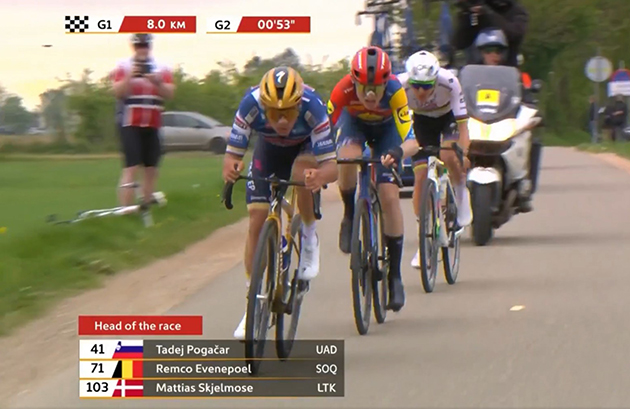
The winning break with 8 kilometers to go.
Skjelly tells his story!
"I was telling Remco all the time that I was on the limit and when we stopped riding together, I wanted to pull because I was riding for the podium, a podium would be a really big result for me. I tried to keep the group going so they didn't come back from behind and, obviously, sprint for the best result, but I thought I was going to cramp or see them go into the horizon.
"In the sprint, I think Remco did perfect. I tried to have a bit of a gap and go on the right because the wind came from the left, but, yeah, Remco went right, and then Tadej went right as well, so I had to go on the left side and I think, in the end, yeah I don't know, I don't know what happened. I didn't believe it [when I passed Pogačar], I really didn't believe it. I was like really something is wrong, no. It means so much to win this race. I have had so much bad luck this season already and it’s been super hard mentally. I lost my granddad more than a month ago and I really wanted to give him a win and so, this is for him.
"When Tadej goes, you know that you're riding for second, so when I did attack I knew it was for second. Up the Cauberg the last time, I had nothing left in my legs. My plan was just to not get dropped. I was already very happy to be in that group. I was thinking third would be the best result.
"After my crash in Paris - Nice, I was really struggling and I didn't know if I'd even make it to the start of Itzulia. Going into Basque at 95% was perfect with six hard stages then, I got the extra 5%. Personally when we attacked, I was on the limit. I think Remco made up 80% and I made up 20%. Alone I would never have caught Tadej.
"The best guy to have with me was Remco and, over the top of the Cauberg, the last time I went to the front just to keep the pace up because I wanted to keep the podium. It's a really important win for the team and gives them the result they deserve. I feel I've been unlucky but winning this with the start list that was here is really incredible. For my future and for the team's future it's really important that we make these results.
"On paper, Amstel is the race that suits me the least, but when it's ridden so hard like it was today, it goes into my favor. It's more in the favor of the climbers instead of the puncheurs. I'm not a big fan of the positioning battle, but we have the perfect team for me and for the first time in my career, I asked that a rider always be with me, and Otto Vergarde was just incredible today. He always kept me in the perfect position. The team worked perfectly and that's the only reason that I'm here.
Here's the Amstel Gold Race report from second-place Tadej Pogacar's UAE Team Emirates-XRG:
Tadej Pogačar made a fine start to his Ardennes Classics campaign, finishing second at the Amstel Gold Race in a three-up photo finish to race winner Mattias Skjelmose (Lidl-Trek). In third place was Soudal Quick-Step’s Remco Evenepoel, who led the pursuit of Pogačar when the world champion was on a trademark long-range assault.
With the three coming to the line together, it was Evenepoel who opened up his sprint first, before Pogačar appeared to have come around the Brabantse Pijl winner at the line. However, with his own late burst, Skjelmose surged over their left-hand shoulders to win his first Amstel title in a photo finish. Congratulating the Dane after the line, Pogačar was forced to settle for second place, two years after he and UAE Team Emirates-XRG won this race for the first time.
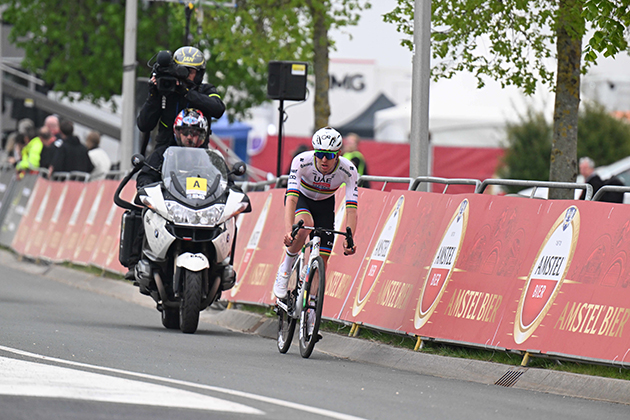
Pogacar on his solo break. Sirotti photo
Speaking to the media, Pogačar reflected on an entertaining battle that saw him ride alone for 34km before contesting the finale as part of a three-strong front group.
Pogačar: “It was a really nice race, it was a really good race from us but in the end, the line was 5m too long and [we accept] second place.
“When me and [Julian] Alaphilippe went, I was hoping that he would stay longer with me together, and that we could go long. But maybe we were too enthusiastic in that first attack and since then, I tried to commit alone. Once Remco [Evenepoel] joined [Mattias] Skjelmose, they were two and in the last 50km it was a really strong headwind, so I couldn’t make the gap bigger. I decided to wait for them and try to beat them in the sprint, but it was a little bit of a gamble.
“I knew that on the climbs they would come closer, so I tried to accelerate always on the top and on the bottom, but at 15km to go, it was a little bit downhill and a super strong headwind. This is where I paid the most for all the efforts before and they could roll through with two, and gain some time there.
“I was expecting [Evenepoel] to be so strong and he showed everybody again that he is in top shape. In the end, Skjelmose was the strongest today in the final sprint.”
As opposed to Pogačar’s usual exploits, the Slovenian went clear of the peloton thanks to the aggression of a rival, with Tudor Pro Cycling’s Julian Alaphilippe making the race’s first big attack at 47.6km to go.
Sporting the rainbow bands of a two-time former world champion, Alaphilippe looked back to form in the Netherlands, with only Pogačar able to hold the Frenchman’s wheel as they rode up the Gulperberg. At the top of the punishing climb, the pair had a 10-second advantage over the peloton, and soon rode in through-and-off routine to extend their gap. In the bunch, the likes of Ben Healy (EF Education-EasyPost), Michael Matthews and Mauro Schmid (both Jayco AlUla) looked to go in pursuit, but UAE Team Emirates-XRG’s Brandon McNulty rode smartly to follow the wheels.
On the Kruisberg climb that followed, a seated Pogačar attack left Alaphilippe in a world of trouble, with each pedal stroke distancing the Tudor Pro Cycling man further. With a look over his shoulder, Alaphilippe knew that the game was up, and he was soon swallowed by the peloton. At the front, Pogačar was alone and he pressed on in turn, with his gap to the chasing pack standing at 28 seconds with 40km to go.
For the next 10km, as Pogačar settled into his lonely endeavour at the head of the race, Soudal Quick-Step looked to rescue the race in the peloton for Remco Evenepoel, with Ilan Van Wilder burying himself on the front. Following his efforts, Evenepoel looked to capitalise on the Keutenberg, dropping a huge turn of pace that reduced the pack in size and drew out a counter-punch from Mattias Skjelmose.
Once as high as 35 seconds, the gap from the chasers to Pogačar had reduced to 21 seconds by the time the Slovenian began the iconic Cauberg climb for a penultimate time. By this point, Skjelmose and Evenepoel had formed a two-man chasing party behind, with the pair riding strongly to put a dent into the world champion’s advantage. His case was not helped by a howling headwind which stuntered any attempt to extend the gap.
The race was to-and-fro throughout the last 20km, with the gap between Pogačar and the Evevepoel/Skjelmose pairing dangling at just 13 seconds heading into the last lap of racing. The third group on the road, ostensibly the peloton, was never again in contention for the win, but McNulty remained attentive and eventually crossed the line in a credible 11th position. Earlier in the day, the American and his teammates Pavel Sivakov and Felix Großschartner had been instrumental in teeing up Pogačar’s long-range attack.
Over the penultimate climb (Bemelerberg), the gap reduced to single digits for the first time since Pogačar and Alaphilippe had gone on the charge, with the Slovenian soon deciding to sit up and wait for his pursuers. The catch was made at 8.1km to ride, bringing to an end his 34km assault. In turn, the three began to ride as a unit and did so for 5km before the final time up the Cauberg.
On the Cauberg, it was Evenepoel who took control of the pace-setting, with Pogačar and Skjelmose content to decide the day’s victory in a sprint.
Accepting his fate, Evenepoel led out the trio through the final 500m and became the first rider to open up his sprint to the line. At first, it looked as though Pogačar had timed his jump to perfection, before Skjelmose snuck a march on the outside to pick up the biggest win of his career to date.







Content continues below the ads
Here's the Amstel Gold Race report from fourth-place Wout van Aert's Team Visma | Lease a Bike:
Wout van Aert and Tiesj Benoot delivered a strong performance for Team Visma | Lease a Bike in a fiercely contested edition of the Amstel Gold Race. Van Aert sprinted to fourth place from the chasing group, while Benoot crossed the line in eighth. The victory went to Mattias Skjelmose.
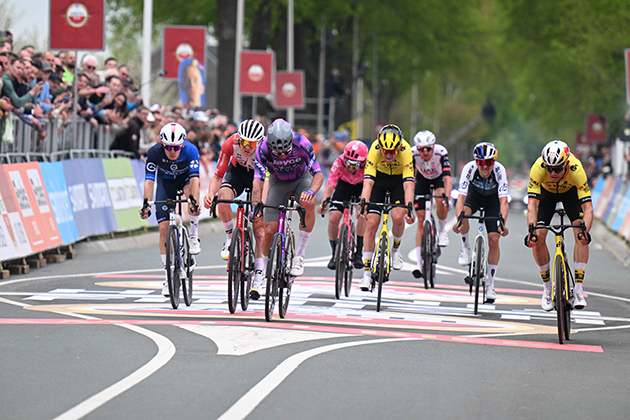
Wout van Aert (far right) wins the field sprint for fourth. Sirotti photo
The Amstel Gold Race, the most prestigious one-day race in the Netherlands, featured on this weekend’s calendar. The riders faced a demanding 260-kilometre course with over 3,000 altimeters. Team Visma | Lease a Bike has enjoyed success in recent years in the Dutch classic: Van Aert won the race in 2021, and Benoot claimed two third-place finishes in the last three editions.
After a relatively calm opening phase, tension mounted in the peloton approaching the first of three ascents of the Cauberg. The early breakaway was reeled in with 70 kilometres remaining. Team Visma | Lease a Bike remained well-positioned throughout the race, waiting for the anticipated attacks from the favourites.
With around 40 kilometres to go, world champion Tadej Pogacar launched the first major move on the Gulperberg. He went solo, but was gradually caught by chasers Skjelmose and Remco Evenepoel. The trio came together in the final kilometres, with Skjelmose surprisingly winning the sprint. In the group behind, Van Aert won the sprint for fourth, with Benoot also finishing in the top ten.
For Van Aert, it marked a fifth consecutive top-five finish. “We rode a strong race, but maybe missed an opportunity today,” he said. “Not reacting to Evenepoel’s attack was a misjudgment. At that moment, I didn’t quite believe we could still close the gap to Pogacar. Still, I’m happy with how I felt. Like in recent races, I was up front, but the icing on the cake remained out.”
Benoot finished just behind his teammate. “When Pogačar attacked on the Gulperberg, no one could follow,” said the 31-year-old Belgian. “Not responding to Evenepoel’s counterattack was a mistake, though we were right on our limit at that point. That was probably our only tactical error in what was otherwise a solid team performance. Wout and I were among the strongest again, and I’m pleased with that.”
Sports director Arthur van Dongen also reflected positively on the team’s performance. “As always, the Amstel Gold Race was a challenging day,” he said. “Wout and Tiesj once again showed their excellent form in the finale. Ben Tulett also rode very well, though he had an unfortunate puncture at a crucial moment. Perhaps more was possible today had we responded to Evenepoel’s move, but overall, we’re satisfied with having two riders in the top ten.”
Content continues below the ads

Here's the Amstel Gold Race report from sixth-place Louis Barré's Team
Intermarché-Wanty:
This Sunday 20th of April 20th, Louis Barré made the colours of Intermarché-Wanty shine at the Amstel Gold Race, securing an impressive sixth place in the first of the Ardennes classics.
The Frenchman, who recently celebrated his 25th birthday, was part of the battle among the favorites on the particularly challenging 257 kilometer course between Maastricht and Berg en Terblijt, which featured 34 climbs, including the Cauberg twice.
Supported by his teammates, Louis Barré maintained his position in the front when Julian Alaphilippe launched the attacks on the slopes of the Gulperberg, 60 kilometers from the finish, and then in the first group behind the trio of Pogacar, Evenepoel, and Skjelmose in the final hour of the race.
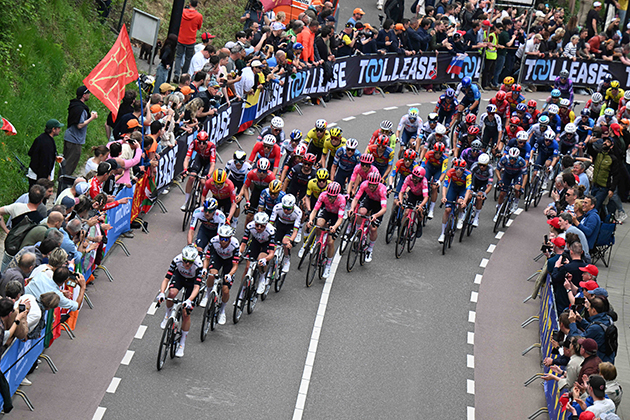
The peloton on the Coberg climb. Sirotti photo
After nearly six hours of racing, Barré achieved his best result in a World Tour classic, equaling his performance at the Tour of Guangxi 2023. This is the World Team’s first top 10 in this event since Enrico Gasparotto’s historic victory in 2016.
“I knew the parcours suited me well, however, I didn’t really know what to expect from this Amstel Gold Race as last week I had to leave Itzulia Basque Country because of sickness. But in the end I felt super good and I managed to position well all day. This is what made the difference to follow the best in the final, except for the three riders who were above the rest. I maybe had the legs to follow Remco Evenepoel when he bridged to the front of the race, but it was a tactical phase with a lot of accelerations and it was difficult to know which one would be decisive. With the headwind in the final straight, the sprint for fourth place was launched late. It was an effort of only 20 seconds. I should have started the sprint earlier. But when I read the names in front of me, I can be satisfied with this sixth place. I am very happy to improve my best result in a World Tour classic.” - Louis Barré
Seventh-place Romain Grégoire's Team Groupama-FDJ posted the Amstel Gold Race report:
In the opening of the “Ardennes” week, Romain Grégoire lived up to the expectations this Sunday on the Amstel Gold Race. On Dutch soil, the young Frenchman did find himself up there with the race favorites. And while he couldn’t keep up with the terrific trio that battled for victory after the Cauberg, he did, however, put up a superb fight in the chasing group to ultimately secure seventh place on the day. A very solid start.
A week after the end of the cobbled Classics, it was time for the punchers to take the spotlight this Sunday with the start of the “Ardennes Classics”. More precisely, it was not in the Ardennes, but in Dutch Limburg that the first act took place with the Amstel Gold Race, over 256 kilometres and across no fewer than thirty-four hills of varying difficulty. Before this continuous up-and-down sequence, Rémi Cavagna took advantage of a relatively flat start to the race to take the lead in a breakaway of eight riders. This group took a maximum advantage of about five minutes on the peloton, before the latter decided to accelerate, in a very serious way.
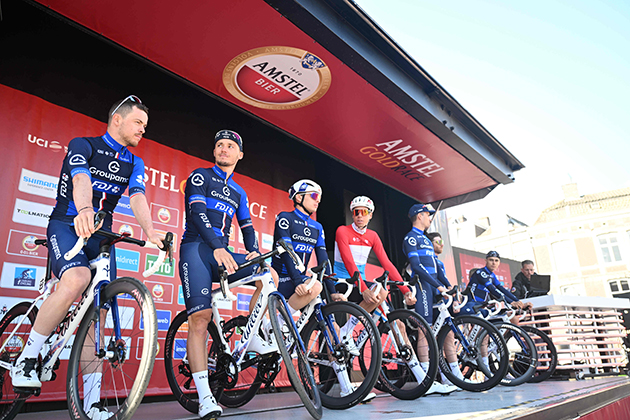
Team Groupama-FDJ is presented before the race start. Sirotti photo
“It was a very tough race, there was a huge pace all day long,” said Benoît Vaugrenard. “I’ve rarely seen that on the Amstel Gold Race, with many riders already being dropped after 130 kilometres.” “It was a pretty crazy race,” confirmed Romain Grégoire. “I think we weren’t expecting such a fast pace from the start. As we reached the final, we were all at the limit, and it exploded quickly.” Kevin Geniets concluded: “I’ve rarely seen a race with such a fast pace and where, after 200 kilometres, you could see riders already completely dead.”
Despite the furious pace, Rémi Cavagna was still able to keep a small lead after the first time up the Cauberg, 85 kilometres from the finish. With three other riders from the breakaway, the “Clermont-Ferrand’s TGV” pushed on for about ten more kilometres before the peloton made it across.
From then on, the first moves began, Valentin Madouas tried to join the party, but it was ultimately from the back that the peloton gradually thinned out. At least until the bottom of the Gulperberg, less than fifty kilometres from the finish. Julian Alaphilippe then opened up the big fight, went away with Tadej Pogacar, then the latter continued on his own. In a shattered peloton, Romain Grégoire and Valentin Madouas survived the Kruisberg, then only the younger one was able to resist when Remco Evenepoel reduced the chase group to around fifteen units on the Keutenberg.
At the summit, Mattias Skjelmose counterattacked, and the world time trial champion then joined him in pursuit. “I was already flat-out when they went away, I couldn’t go with them,” said Romain. “I rode the race I had to ride. I have no regrets.”
While the chasing duo gradually closed in on Pogacar, the second chase group remained a bit far in the final thirty kilometres. Romain Grégoire and his companions were about thirty seconds back at the penultimate time of the finish line, but then found themselves a minute behind entering the final ten kilometres. “Everyone was where he belonged, and the three in front were in another league,” he said. “I fought on every hill to stay with this group and compete for the top five at the finish.”
Although the leaders looked a bit at each other on the final climb of the Cauberg, two kilometres from the finish, the chase group was unable to get back into the podium fight. Behind Skjelmose, the surprise winner, Romain Grégoire battled to secure the best possible position. Beaten by Wout Van Aert, Michael Matthews, and Louis Barré, he ultimately finished seventh. “I did a decent sprint,” he said. “I could have opened a little earlier to have more space, but after 250 kilometres at such a fast pace, everyone is where he belongs. We’ll be happy with that. A top 10 at this level isn’t so bad”. “Romain is there, among the best. There were just three stronger riders today, but we can’t have any regrets,” concluded Benoît. Next stop: La Flèche Wallonne.
Content continues below the ads
Joe Blackmore's Team Israel-Premier Tech posted this report:
After showing his form at Brabanste Pijl, where he was the only rider to follow the winning move from Remco Evenepoel and Wout Van Aert, Joe Blackmore showed once again that he is built for the Ardennes Classics with a gutsy ride at Amstel Gold Race today.
Blackmore battled to finish in 14th place, after showing his tenacity by fighting to rejoin the select chase group on the final ascent of the Cauberg, while teammate Alexey Lutsenko finished a few places behind in 17th.

Joe Blackmore winning the U23 Liège-Bastogne-Liège in 2024.
Blackmore made his Amstel Gold Race debut in what was one of the most exciting and fastest editions in recent years, with the race eventually coming down to a three-man sprint with Mattias Skelmose (Lidl – Trek) taking the win, while Blackmore crossed the line 52 seconds later.
“I felt good after Brabanste Pijl,” said Blackmore. “I had a good recovery and felt ready to race today but it was definitely pretty hard for pretty long today. We all rode really well with Clarkey keeping us in good position from really far out so we worked well as a team. I dropped on the Cauberg [the second to last time] but I managed to come back and still managed to stay in that chase group of ten riders until the last time up the Cauberg through to the line.”
After turning pro halfway through last year, Blackmore is making his debut in all of the Spring Classics this season, with each one proving to be a learning opportunity.
“I finished at the back of the group and could barely pedal up the last climb so at that point I was just happy to reach the finish line. But I’m there and able to be competitive with the group for the top-ten and hopefully in the next races and next years, I find the edge to get that real big result.”
An attack from road captain Simon Clarke just over halfway through the race was unfortunately neutralized by the peloton’s determination to catch the breakaway, at which point Lutsenko started to find his legs and show himself at the front of the bunch.
“Today I was really suffering in the first two hours,” admitted Lutsenko. “After some caffeine gels I started to feel better and finally after the first three hours I was able to get up to the front of the peloton with Joe and Clarkey. I fought hard to stay in the first group and help Joe as much as possible. The small peloton split on the Cauberg and I was in the second group but I was able to do a last attack on the final time up the Cauberg to go alone from that group and finish in 17th place. I hope to have better legs for Flèche Wallonne and Liège – Bastogne – Liège.”
And here's the Amstel Gold Race report from Team Picnic-PostNL:
The Amstel Gold Race, one of the most prestigious one-day races in the Netherlands, got underway today over the challenging hills of Limburg. Known for its twisting roads, short but steep climbs, and constant changes in rhythm, the race once again delivered an intense day of racing. As expected, the early part of the race saw a breakaway form, consisting of 8 riders. The peloton kept them within striking distance, with the gap hovering between 4 and 5 minutes for much of the day. Shortly after the race entered its final 100 kilometres, the breakaway was caught by a heavily reduced peloton. Representing Team Picnic PostNL, both Warren Barguil and Frank van den Broek remained alert and well-positioned in the main group.
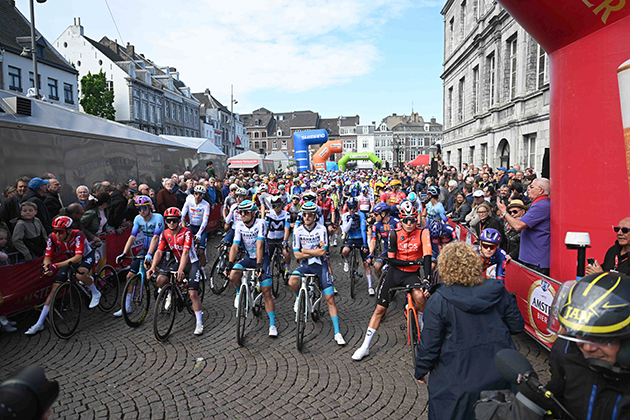
The peloton in the start city of Maastricht just before the race began. Sirotti photo
It was only a matter of time before Tadej Pogacar made his move, and he did so on the Gulperberg, with just under 50 kilometres to go. Launching an attack with Julian Alaphilippe, the World Champion soon found himself alone at the front. Behind him, the chasing groups began to fracture over the next series of climbs, and Frank van den Broek settled into the second chase group, sitting over a minute behind the leader with 30 kilometres to go. In the end, Skjelmose and Evenepoel managed to bridge across to Pogacar, before Skjelmose won the sprint. Frank van den Broek finished in one of the groups behind, crossing the line in 26th place as the first rider from Team Picnic PostNL and the best Dutch finisher of the day. Warren Barguil followed shortly after, finishing 30th.
After the race, Van den Broek said: “I felt pretty good out there today. I just missed that extra push to stay with the group of Van Aert on the Kruisberg and Eyserbosweg, but overall it went better than last year. I eventually finished in a group with Alaphilippe and Madouas—some really strong riders—so that’s something to be proud of. It was a hard, honest race, but I’m left with a satisfied feeling. This type of course suits me: repeated efforts, constant climbing. It’s something my body can handle well. I hope to take another step forward next year. If I can keep progressing, maybe a strong result is possible in the near future. Now it’s time to recover and start looking ahead to my next goals.”
Back to news and opinion index page for links to archived stories | Commentary