

2026 Vuelta a España
81st edition: Aug 22 - Sept 13, 2026
Vuelta Podium History | 2025 edition | Start list, Teams presentation photos, The Vuelta with 2 days to go, Statistics & list of stages, Route description
Stage 1 | Stage 2 | Stage 3 | Stage 4 | Stage 5 | Stage 6 | Stage 7 | Stage 8 | Stage 9 | Rest Day 1 | Stage 10 | Stage 11 | Stage 12 | Stage 13 | Stage 14 | Stage 15 | Rest Day 2 | Stage 16 | Stage 17 | Stage 18 | Stage 19 | Stage 20 | Stage 21
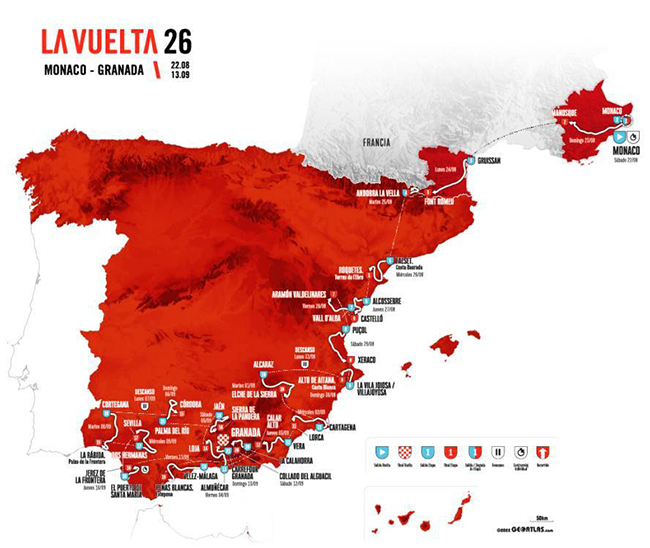
2026 Vuelta a España map: 21 stages covering a total of 3,014.8 kilometers
Sunday, September 13: 21st & Final Stage, Carrefour Granada - Granada, 112 km
Stage 21 map & profile | Stage 21 photos
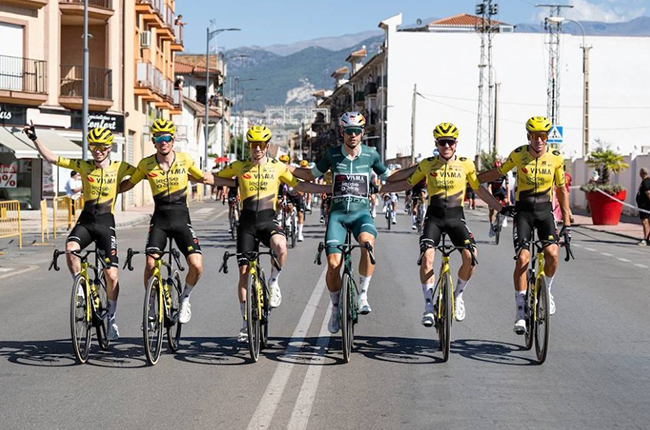
Team Visma | Lease a Bike has every reason to be happy. Wout van Aert won the green points jersey and the team won seven stages: van Aert won two and Matthew Brennan won an incredible five stages..

Les Woodland's book The Olympics' 50 Craziest Stories: A Five Ring Circus is available in print, Kindle eBook & audiobook versions. To get your copy, just click on the Amazon link on the right.
Weather at the finish city of Granada at 5:00 PM, local time: 323C (89F), sunny, with the wind from the southwest at 13 km/hr (8 mph). There is just a 2% chance of rain.
The stage: Granada will be the setting for the final stage of La Vuelta, which will feature the climb to the Alhambra as an added attraction along the circuit of the Nasrid city’s streets. The Granada monument will crown the race’s final winner in a stage where he will, no doubt, have to be an explosive cyclist.
The stage start is at 4:20 PM. GC was taken with 9.8 km to go, with no bonus seconds at the finish.
The race: All 142 stage 20 finishers began stage 21.
Here's the race organizer's stage 21 summary:
The finale of La Vuelta 26, held in Granada for the first time in its 81 editions, saw Tobias Johannessen (Uno-X Mobility) power to victory in an explosive finale, while Enric Mas (Movistar) perfectly navigated the final challenges of La Vuelta 26 to become the 64th overall winner, the first Spaniard to stand on the top step of the final podium since Alberto Contador in 2014. The puncheurs went all out on the circuit around the Alhambra and Johannessen got the better of Alessandro Romele (XDS Astana) in a two-man sprint after they distanced Matthew Brennan (Visma-Lease a Bike) in the final kilometre.
Wout van Aert (Visma-Lease a Bike) is the 13th Belgian winner of the points classification. Santiago Buitrago (Bahrain Victorious) is the fifth Colombian climber to rule the mountains standings. Oscar Onley (Netcompany Ineos) is the first British winner of the young riders standings.
The stage:
It’s the end of the road. After over 3,000 kilometres of racing, with some 5,000 metres of elevation gain, from Monaco, home to the Salida Official of La Vuelta 26 three weeks ago, the peloton are in Granada for the final stage.
An exhilarating finale is on the cards, with a punchy circuit around the iconic Alhambra to cap off this 81st edition. The times for the general classification will be neutralised as the riders pass the finish line for the penultimate time (9.8 km to go). At that point, it is all about the stage win, while the GC leaders can celebrate their achievements as Granada hosts the finale of La Vuelta for the first time.
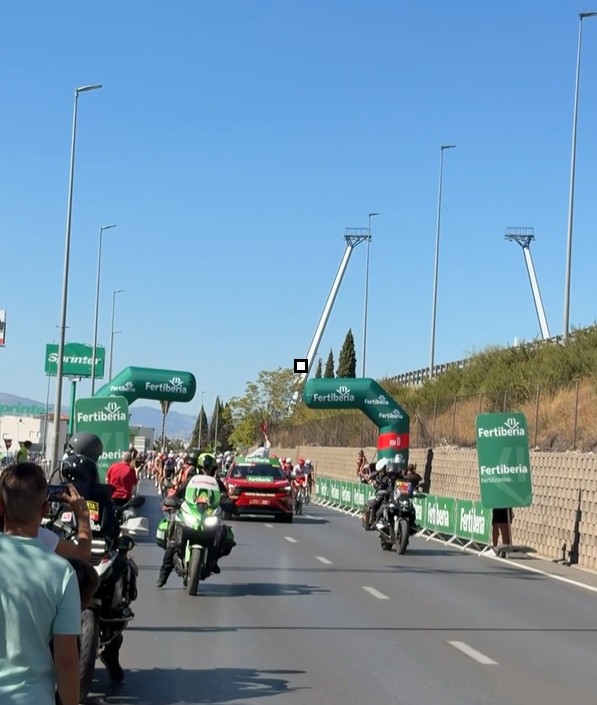
The 2026 Vuelta's final stage gets its official start.
Celebrations
The peloton take it easy as they roll from Carrefour Granada, ride through the streets of Armilla and head to the grand finale at the Alhambra. Wearing special jerseys for the occasion, Enric Mas and his Movistar teammates gradually increase the pace en route to Granada. Aged 31, Mas is set to become the 64th different winner of La Vuelta, the 25th Spaniard, twelve years after his idol Alberto Contador.
Into the final 50 kilometres of La Vuelta 26, the peloton enter Granada. The riders pass the finish line with 41.8 km to go. The road immediately rises to visit the Alhambra. Movistar still control the pace on this first climb.
Accelerations
Groupama-FDJ United take the reins of the peloton to enter the final three laps and tackle the second ascent of the day. Already the winner in Elche de la Sierra (stage 10), Bastien Tronchon (Groupama-FDJ United) attacks with 28 kilometres to go. Tobias Johannessen (Uno-X Mobility) and Matthew Brennan (Visma-Lease a Bike) are the quickest to react. A group of nine attackers emerge but a bunch regroups due to Uno-X Mobility. Movistar set the pace in the peloton behind them.
Onto the final ascent, Pau Miquel sets a brutal pace to propel Pello Bilbao (Bahrain Victorious), who attacks on his final Grand Tour stage before retiring. The Basque rider opens a gap, but Axel Laurance (Netcompany Ineos) counter-attacks with 8 km remaining. A group of twelve riders get back together on the final run-in, including Brennan.
Elation
Everyone wants to get rid of the British star, already the winner of five stages in La Vuelta 26. Ramses Debruyne (Alpecin-Premier Tech), Tobias Johannessen (Uno-X Mobility) and Alessandro Romele (XDS Astana) find an opening into the final kilometre. Second the day before at the Collado del Alguacil, Johannessen finally clinched his first Grand Tour stage win ahead of Romele.
Behind them, Enric Mas crosses the line with his six teammates by his side: Arcas, Aular, Canal, Castrillo, Garcia Pierna, and Romeo. They’ve completed their mission to win La Vuelta 26.
Complete results:
112 kilometers raced at an average speed of 38.591 km/hr
| 1 | Tobias Halland Johannessen | Uno-X Mobility | 2hr 54min 8sec |
| 2 | Alessandro Romele | XDS Astana Team | s.t. |
| 3 | Ramses Debruyne | Alpecin-Premier Tech | s.t. |
| 4 | Matthew Brennan | Team Visma | Lease a Bike | s.t. |
| 5 | Bastien Tronchon | Groupama-FDJ United | s.t. |
| 6 | Pello Bilbao | Bahrain Victorious | s.t. |
| 7 | Finn Fisher-Black | Red Bull-BORA-hansgrohe | s.t. |
| 8 | Axel Laurance | Netcompany INEOS Cycling Team | s.t. |
| 9 | Pau Martí | NSN Cycling Team | s.t. |
| 10 | Marco Brenner | Tudor Pro Cycling Team | s.t. |
| 11 | Valentin Paret-Peintre | Soudal Quick-Step | s.t. |
| 12 | Santiago Buitrago | Bahrain Victorious | s.t. |
| 13 | Thibau Nys | Lidl-Trek | s.t. |
| 14 | Jarno Widar | Lotto-Intermarché | s.t. |
| 15 | Léo Bisiaux | Decathlon CMA CGM Team | s.t. |
| 16 | Fabio Van den Bossche | Soudal Quick-Step | s.t. |
| 17 | Kevin Vermaerke | UAE Team Emirates-XRG | s.t. |
| 18 | Clément Alleno | Burgos Burpellet BH | s.t. |
| 19 | Alessandro Covi | Team Jayco-AlUla | s.t. |
| 20 | Ivan Cobo | Equipo Kern Pharma | s.t. |
| 21 | Lorenzo Rota | Lotto-Intermarché | s.t. |
| 22 | Embret Svestad-Bårdseng | Netcompany INEOS Cycling Team | s.t. |
| 23 | Gijs Leemreize | Team Picnic PostNL | s.t. |
| 24 | Guillaume Martin-Guyonnet | Groupama-FDJ United | s.t. |
| 25 | Mattias Skjelmose | Lidl-Trek | s.t. |
| 26 | Jørgen Nordhagen | Team Visma | Lease a Bike | s.t. |
| 27 | Carlos Rodriguez | Netcompany INEOS Cycling Team | s.t. |
| 28 | João Almeida | UAE Team Emirates-XRG | s.t. |
| 29 | Magnus Cort | Uno-X Mobility | s.t. |
| 30 | Fabian Weiss | Tudor Pro Cycling Team | s.t. |
| 31 | Marcel Camprubí | Pinarello-Q36.5 Pro Cycling Team | s.t. |
| 32 | Jan Hirt | NSN Cycling Team | s.t. |
| 33 | Martin Tjøtta | Uno-X Mobility | s.t. |
| 34 | Ivo Oliveira | UAE Team Emirates-XRG | @ 1min 1sec |
| 35 | Finlay Pickering | Team Jayco-AlUla | 1:33 |
| 36 | Reuben Thompson | Lotto-Intermarché | 1:15 |
| 37 | Gianmarco Garofoli | Soudal Quick-Step | @ 0sec |
| 38 | Bruno Armirail | Team Visma | Lease a Bike | @ 0sec |
| 39 | Julien Bernard | Lidl-Trek | @ 0sec |
| 40 | Harold Tejada | XDS Astana Team | @ 0sec |
| 41 | Gianni Moscon | Red Bull-BORA-hansgrohe | 1:49 |
| 42 | Luke Tuckwell | Red Bull-BORA-hansgrohe | s.t. |
| 43 | Gianni Vermeersch | Red Bull-BORA-hansgrohe | s.t. |
| 44 | Primoz Roglic | Red Bull-BORA-hansgrohe | s.t. |
| 45 | Oscar Chamberlain | Decathlon CMA CGM Team | s.t. |
| 46 | Felix Gall | Decathlon CMA CGM Team | s.t. |
| 47 | Sander De Pestel | Decathlon CMA CGM Team | 1:01 |
| 48 | Callum Scotson | Decathlon CMA CGM Team | 1:49 |
| 49 | Rasmus Tiller | Uno-X Mobility | s.t. |
| 50 | Fredrik Dversnes | Uno-X Mobility | s.t. |
| 51 | Alastair Mackellar | EF Education-EasyPost | s.t. |
| 52 | James Shaw | EF Education-EasyPost | s.t. |
| 53 | Simon Dalby | Uno-X Mobility | s.t. |
| 54 | Sylvain Moniquet | Cofidis | s.t. |
| 55 | Andreas Kron | Uno-X Mobility | s.t. |
| 56 | José Luis Faura | Burgos Burpellet BH | s.t. |
| 57 | Juan Rodríguez | EF Education-EasyPost | s.t. |
| 58 | Hannes Wilksch | Tudor Pro Cycling Team | s.t. |
| 59 | Richard Carapaz | EF Education-EasyPost | s.t. |
| 60 | Sergio Samitier | Cofidis | s.t. |
| 61 | Cristian Rodriguez | XDS Astana Team | s.t. |
| 62 | Jack Haig | Netcompany INEOS Cycling Team | s.t. |
| 63 | Oscar Onley | Netcompany INEOS Cycling Team | s.t. |
| 64 | Steven Kruijswijk | Team Visma | Lease a Bike | s.t. |
| 65 | Wout van Aert | Team Visma | Lease a Bike | @ 0sec |
| 66 | Lucas Hamilton | Netcompany INEOS Cycling Team | 1:49 |
| 67 | Lorenzo Fortunato | XDS Astana Team | s.t. |
| 68 | Milan Vader | Pinarello-Q36.5 Pro Cycling Team | s.t. |
| 69 | Roman Ermakov | Bahrain Victorious | s.t. |
| 70 | Jakob Omrzel | Bahrain Victorious | s.t. |
| 71 | Koen Bouwman | Team Jayco-AlUla | s.t. |
| 72 | Mathijs Paasschens | Bahrain Victorious | s.t. |
| 73 | Gal Glivar | Alpecin-Premier Tech | s.t. |
| 74 | Pau Miquel Delgado | Bahrain Victorious | @ 0sec |
| 75 | Sepp Kuss | Team Visma | Lease a Bike | 1:49 |
| 76 | Attila Valter | Bahrain Victorious | s.t. |
| 77 | Rémy Rochas | Groupama-FDJ United | s.t. |
| 78 | Valentin Madouas | Groupama-FDJ United | s.t. |
| 79 | Rudy Molard | Groupama-FDJ United | s.t. |
| 80 | Rudy Porter | Team Jayco-AlUla | s.t. |
| 81 | Clément Berthet | Groupama-FDJ United | s.t. |
| 82 | Enzo Paleni | Groupama-FDJ United | s.t. |
| 83 | Vito Braet | Lotto-Intermarché | s.t. |
| 84 | Alberto Dainese | Soudal Quick-Step | s.t. |
| 85 | Filippo Zana | Soudal Quick-Step | s.t. |
| 86 | Henok Mulubrhan | XDS Astana Team | s.t. |
| 87 | Iñigo Elosegui | Equipo Kern Pharma | s.t. |
| 88 | Roland Thalmann | Tudor Pro Cycling Team | s.t. |
| 89 | Bryan Coquard | Cofidis | @ 0sec |
| 90 | Emanuel Buchmann | Cofidis | 1:49 |
| 91 | Patrick Konrad | Lidl-Trek | s.t. |
| 92 | Lennard Kämna | Lidl-Trek | s.t. |
| 93 | Jose Manuel Diaz | Burgos Burpellet BH | s.t. |
| 94 | Mario Aparicio | Burgos Burpellet BH | s.t. |
| 95 | Urko Berrade | Equipo Kern Pharma | s.t. |
| 96 | Juan Martinez | Team Picnic PostNL | s.t. |
| 97 | Lars Craps | Lotto-Intermarché | s.t. |
| 98 | Paul Ourselin | Cofidis | s.t. |
| 99 | Lawrence Warbasse | Tudor Pro Cycling Team | s.t. |
| 100 | Mikel Landa | Soudal Quick-Step | s.t. |
| 101 | Ivan Sosa | Equipo Kern Pharma | s.t. |
| 102 | Louis Rouland | Cofidis | s.t. |
| 103 | William Barta | Tudor Pro Cycling Team | s.t. |
| 104 | Jesus Herrada | Burgos Burpellet BH | s.t. |
| 105 | David de la Cruz | Pinarello-Q36.5 Pro Cycling Team | s.t. |
| 106 | Walter Calzoni | Pinarello-Q36.5 Pro Cycling Team | s.t. |
| 107 | Raúl García | Movistar Team | s.t. |
| 108 | Orluis Aular | Movistar Team | s.t. |
| 109 | Enric Mas | Movistar Team | s.t. |
| 110 | Jorge Arcas | Movistar Team | s.t. |
| 111 | Carlos Canal | Movistar Team | s.t. |
| 112 | Pablo Castrillo | Movistar Team | s.t. |
| 113 | Iván Romeo | Movistar Team | s.t. |
| 114 | Timo de Jong | Team Picnic PostNL | s.t. |
| 115 | Jasha Sütterlin | Team Jayco-AlUla | 2:57 |
| 116 | Sinuhé Fernandez | Burgos Burpellet BH | 2:55 |
| 117 | Mats Wenzel | Equipo Kern Pharma | 1:49 |
| 118 | Ibon Ruiz | Equipo Kern Pharma | s.t. |
| 119 | Steffen De Schuyteneer | Lotto-Intermarché | 3:59 |
| 120 | Thomas Gloag | Pinarello-Q36.5 Pro Cycling Team | 1:49 |
| 121 | Xabier Azparren | Pinarello-Q36.5 Pro Cycling Team | s.t. |
| 122 | Jacopo Mosca | Lidl-Trek | 3:59 |
| 123 | Michael Gogl | Alpecin-Premier Tech | 2:59 |
| 124 | Nick Schultz | NSN Cycling Team | 3:59 |
| 125 | Hugo Hofstetter | NSN Cycling Team | s.t. |
| 126 | Frederik Wandahl | Red Bull-BORA-hansgrohe | s.t. |
| 127 | Darren Rafferty | EF Education-EasyPost | s.t. |
| 128 | Vincenzo Albanese | EF Education-EasyPost | s.t. |
| 129 | Georg Steinhauser | EF Education-EasyPost | s.t. |
| 130 | Marc Brustenga | Equipo Kern Pharma | s.t. |
| 131 | Mauri Vansevenant | Soudal Quick-Step | s.t. |
| 132 | Cesar Macias | Burgos Burpellet BH | s.t. |
| 133 | Matevz Govekar | Bahrain Victorious | s.t. |
| 134 | Domen Novak | UAE Team Emirates-XRG | s.t. |
| 135 | Darren van Bekkum | XDS Astana Team | s.t. |
| 136 | Andreas Leknessund | Uno-X Mobility | 5:49 |
| 137 | Mathias Sunekær Norsgaard | Lidl-Trek | s.t. |
| 138 | Asbjørn Hellemose | Team Jayco-AlUla | s.t. |
| 139 | Olivier Le Gac | Groupama-FDJ United | s.t. |
| 140 | Jordi Meeus | Red Bull-BORA-hansgrohe | s.t. |
| 141 | Ethan Hayter | Soudal Quick-Step | s.t. |
| 142 | Callum Thornley | Red Bull-BORA-hansgrohe | s.t. |
 Final GC after stage 21:
- GC winner: Enric Mas (Movistar)
- Mountains classification winner: Santiago Buitrago (Bahrain Victorious)
- Points classification winner: Wout van Aert (Visma | Lease a Bike)
- Best young rider: Oscar Onley (Netcompany INEOS)
- Teams classification winner: Decathlon CMA CGM
3,014.8 kilometers raced at an average speed of 40.806 km/hr
| 1 | Enric Mas | Movistar Team | 73hr 52min 55sec |
| 2 | Primoz Roglic | Red Bull-BORA-hansgrohe | @ 2min 15sec |
| 3 | Felix Gall | Decathlon CMA CGM Team | 2:44 |
| 4 | Richard Carapaz | EF Education-EasyPost | 6:54 |
| 5 | Sepp Kuss | Team Visma | Lease a Bike | 8:45 |
| 6 | Oscar Onley | Netcompany INEOS Cycling Team | 9:28 |
| 7 | Jakob Omrzel | Bahrain Victorious | 10:38 |
| 8 | Clément Berthet | Groupama-FDJ United | 11:41 |
| 9 | Cristian Rodriguez | XDS Astana Team | 11:59 |
| 10 | Harold Tejada | XDS Astana Team | 12:51 |
| 11 | Guillaume Martin-Guyonnet | Groupama-FDJ United | 20:14 |
| 12 | Léo Bisiaux | Decathlon CMA CGM Team | 25:03 |
| 13 | Mattias Skjelmose | Lidl-Trek | 25:43 |
| 14 | Mario Aparicio | Burgos Burpellet BH | 42:17 |
| 15 | Jan Hirt | NSN Cycling Team | 43:20 |
| 16 | Juan Rodríguez | EF Education-EasyPost | 47:56 |
| 17 | Santiago Buitrago | Bahrain Victorious | 50:56 |
| 18 | Filippo Zana | Soudal Quick-Step | 58:44 |
| 19 | Urko Berrade | Equipo Kern Pharma | 1:01:09 |
| 20 | Embret Svestad-Bårdseng | Netcompany INEOS Cycling Team | 1:10:46 |
| 21 | Koen Bouwman | Team Jayco-AlUla | 1:14:26 |
| 22 | Raúl García | Movistar Team | 1:16:45 |
| 23 | Jarno Widar | Lotto-Intermarché | 1:18:52 |
| 24 | Jack Haig | Netcompany INEOS Cycling Team | 1:21:35 |
| 25 | Emanuel Buchmann | Cofidis | 1:24:50 |
| 26 | Tobias Halland Johannessen | Uno-X Mobility | 1:26:03 |
| 27 | Gijs Leemreize | Team Picnic PostNL | 1:26:27 |
| 28 | Finlay Pickering | Team Jayco-AlUla | 1:29:10 |
| 29 | Kevin Vermaerke | UAE Team Emirates-XRG | 1:31:49 |
| 30 | Mikel Landa | Soudal Quick-Step | 1:36:39 |
| 31 | Jose Manuel Diaz | Burgos Burpellet BH | 1:44:33 |
| 32 | Ramses Debruyne | Alpecin-Premier Tech | 1:50:31 |
| 33 | Pello Bilbao | Bahrain Victorious | 1:54:02 |
| 34 | Valentin Paret-Peintre | Soudal Quick-Step | 1:56:41 |
| 35 | Valentin Madouas | Groupama-FDJ United | 1:56:47 |
| 36 | Carlos Rodriguez | Netcompany INEOS Cycling Team | 1:57:52 |
| 37 | Jørgen Nordhagen | Team Visma | Lease a Bike | 2:00:41 |
| 38 | Callum Scotson | Decathlon CMA CGM Team | 2:03:02 |
| 39 | Lorenzo Fortunato | XDS Astana Team | 2:07:42 |
| 40 | Patrick Konrad | Lidl-Trek | 2:08:19 |
| 41 | Lawrence Warbasse | Tudor Pro Cycling Team | 2:10:02 |
| 42 | Pau Miquel Delgado | Bahrain Victorious | 2:13:01 |
| 43 | Henok Mulubrhan | XDS Astana Team | 2:14:30 |
| 44 | Wout van Aert | Team Visma | Lease a Bike | 2:15:35 |
| 45 | Attila Valter | Bahrain Victorious | 2:18:39 |
| 46 | Luke Tuckwell | Red Bull-BORA-hansgrohe | 2:23:51 |
| 47 | Milan Vader | Pinarello-Q36.5 Pro Cycling Team | 2:28:23 |
| 48 | Hannes Wilksch | Tudor Pro Cycling Team | 2:28:27 |
| 49 | Julien Bernard | Lidl-Trek | 2:29:13 |
| 50 | Marco Brenner | Tudor Pro Cycling Team | 2:29:27 |
| 51 | Rudy Molard | Groupama-FDJ United | 2:33:24 |
| 52 | Finn Fisher-Black | Red Bull-BORA-hansgrohe | 2:36:23 |
| 53 | Gianmarco Garofoli | Soudal Quick-Step | 2:37:12 |
| 54 | William Barta | Tudor Pro Cycling Team | 2:37:27 |
| 55 | Mauri Vansevenant | Soudal Quick-Step | 2:38:35 |
| 56 | Rudy Porter | Team Jayco-AlUla | 2:38:50 |
| 57 | Reuben Thompson | Lotto-Intermarché | 2:38:55 |
| 58 | Paul Ourselin | Cofidis | 2:39:35 |
| 59 | Pau Martí | NSN Cycling Team | 2:40:08 |
| 60 | Bruno Armirail | Team Visma | Lease a Bike | 2:40:33 |
| 61 | Andreas Leknessund | Uno-X Mobility | 2:43:07 |
| 62 | Enzo Paleni | Groupama-FDJ United | 2:44:58 |
| 63 | Axel Laurance | Netcompany INEOS Cycling Team | 2:46:19 |
| 64 | James Shaw | EF Education-EasyPost | 2:46:32 |
| 65 | Marcel Camprubí | Pinarello-Q36.5 Pro Cycling Team | 2:50:55 |
| 66 | Andreas Kron | Uno-X Mobility | 2:51:03 |
| 67 | Thomas Gloag | Pinarello-Q36.5 Pro Cycling Team | 2:53:29 |
| 68 | Ibon Ruiz | Equipo Kern Pharma | 2:54:03 |
| 69 | Rémy Rochas | Groupama-FDJ United | 2:55:00 |
| 70 | Walter Calzoni | Pinarello-Q36.5 Pro Cycling Team | 2:56:58 |
| 71 | Lennard Kämna | Lidl-Trek | 2:57:47 |
| 72 | Fabian Weiss | Tudor Pro Cycling Team | 2:59:24 |
| 73 | Iván Romeo | Movistar Team | 3:01:28 |
| 74 | Clément Alleno | Burgos Burpellet BH | 3:01:55 |
| 75 | Bastien Tronchon | Groupama-FDJ United | 3:03:31 |
| 76 | Hugo Hofstetter | NSN Cycling Team | 3:03:47 |
| 77 | José Luis Faura | Burgos Burpellet BH | 3:05:08 |
| 78 | Sergio Samitier | Cofidis | 3:08:26 |
| 79 | Steven Kruijswijk | Team Visma | Lease a Bike | 3:08:32 |
| 80 | Sander De Pestel | Decathlon CMA CGM Team | 3:13:33 |
| 81 | Pablo Castrillo | Movistar Team | 3:14:39 |
| 82 | Simon Dalby | Uno-X Mobility | 3:16:53 |
| 83 | Vincenzo Albanese | EF Education-EasyPost | 3:19:12 |
| 84 | Lucas Hamilton | Netcompany INEOS Cycling Team | 3:20:41 |
| 85 | Jesus Herrada | Burgos Burpellet BH | 3:21:29 |
| 86 | Roland Thalmann | Tudor Pro Cycling Team | 3:22:35 |
| 87 | Ivan Sosa | Equipo Kern Pharma | 3:24:24 |
| 88 | Gianni Vermeersch | Red Bull-BORA-hansgrohe | 3:29:09 |
| 89 | Lars Craps | Lotto-Intermarché | 3:29:12 |
| 90 | Carlos Canal | Movistar Team | 3:30:08 |
| 91 | João Almeida | UAE Team Emirates-XRG | 3:30:16 |
| 92 | Alessandro Romele | XDS Astana Team | 3:31:07 |
| 93 | Jacopo Mosca | Lidl-Trek | 3:37:51 |
| 94 | Michael Gogl | Alpecin-Premier Tech | 3:40:20 |
| 95 | Sylvain Moniquet | Cofidis | 3:43:18 |
| 96 | Frederik Wandahl | Red Bull-BORA-hansgrohe | 3:44:17 |
| 97 | Fredrik Dversnes | Uno-X Mobility | 3:45:26 |
| 98 | Gal Glivar | Alpecin-Premier Tech | 3:46:27 |
| 99 | Ivo Oliveira | UAE Team Emirates-XRG | 3:46:43 |
| 100 | Lorenzo Rota | Lotto-Intermarché | 3:48:44 |
| 101 | Xabier Azparren | Pinarello-Q36.5 Pro Cycling Team | 3:48:45 |
| 102 | Mathijs Paasschens | Bahrain Victorious | 3:48:51 |
| 103 | Mats Wenzel | Equipo Kern Pharma | 3:50:54 |
| 104 | Darren Rafferty | EF Education-EasyPost | 3:55:15 |
| 105 | David de la Cruz | Pinarello-Q36.5 Pro Cycling Team | 3:57:34 |
| 106 | Magnus Cort | Uno-X Mobility | 3:58:30 |
| 107 | Nick Schultz | NSN Cycling Team | 3:58:53 |
| 108 | Matthew Brennan | Team Visma | Lease a Bike | 4:00:02 |
| 109 | Martin Tjøtta | Uno-X Mobility | 4:00:30 |
| 110 | Jorge Arcas | Movistar Team | 4:00:31 |
| 111 | Darren van Bekkum | XDS Astana Team | 4:01:08 |
| 112 | Thibau Nys | Lidl-Trek | 4:06:27 |
| 113 | Ivan Cobo | Equipo Kern Pharma | 4:08:21 |
| 114 | Oscar Chamberlain | Decathlon CMA CGM Team | 4:08:22 |
| 115 | Iñigo Elosegui | Equipo Kern Pharma | 4:11:57 |
| 116 | Sinuhé Fernandez | Burgos Burpellet BH | 4:14:13 |
| 117 | Bryan Coquard | Cofidis | 4:15:29 |
| 118 | Georg Steinhauser | EF Education-EasyPost | 4:16:16 |
| 119 | Roman Ermakov | Bahrain Victorious | 4:16:27 |
| 120 | Timo de Jong | Team Picnic PostNL | 4:24:01 |
| 121 | Gianni Moscon | Red Bull-BORA-hansgrohe | 4:24:15 |
| 122 | Orluis Aular | Movistar Team | 4:25:11 |
| 123 | Alastair Mackellar | EF Education-EasyPost | 4:26:34 |
| 124 | Jasha Sütterlin | Team Jayco-AlUla | 4:26:39 |
| 125 | Alessandro Covi | Team Jayco-AlUla | 4:29:00 |
| 126 | Rasmus Tiller | Uno-X Mobility | 4:29:51 |
| 127 | Fabio Van den Bossche | Soudal Quick-Step | 4:32:17 |
| 128 | Callum Thornley | Red Bull-BORA-hansgrohe | 4:32:20 |
| 129 | Juan Martinez | Team Picnic PostNL | 4:34:08 |
| 130 | Alberto Dainese | Soudal Quick-Step | 4:38:17 |
| 131 | Olivier Le Gac | Groupama-FDJ United | 4:41:40 |
| 132 | Vito Braet | Lotto-Intermarché | 4:48:14 |
| 133 | Cesar Macias | Burgos Burpellet BH | 4:48:46 |
| 134 | Louis Rouland | Cofidis | 4:55:04 |
| 135 | Steffen De Schuyteneer | Lotto-Intermarché | 4:56:43 |
| 136 | Marc Brustenga | Equipo Kern Pharma | 4:58:26 |
| 137 | Matevz Govekar | Bahrain Victorious | 5:01:15 |
| 138 | Asbjørn Hellemose | Team Jayco-AlUla | 5:13:22 |
| 139 | Ethan Hayter | Soudal Quick-Step | 5:17:18 |
| 140 | Domen Novak | UAE Team Emirates-XRG | 5:22:08 |
| 141 | Jordi Meeus | Red Bull-BORA-hansgrohe | 5:24:31 |
| 142 | Mathias Sunekær Norsgaard | Lidl-Trek | 6:15:51 |
Stage 21 map & profile:
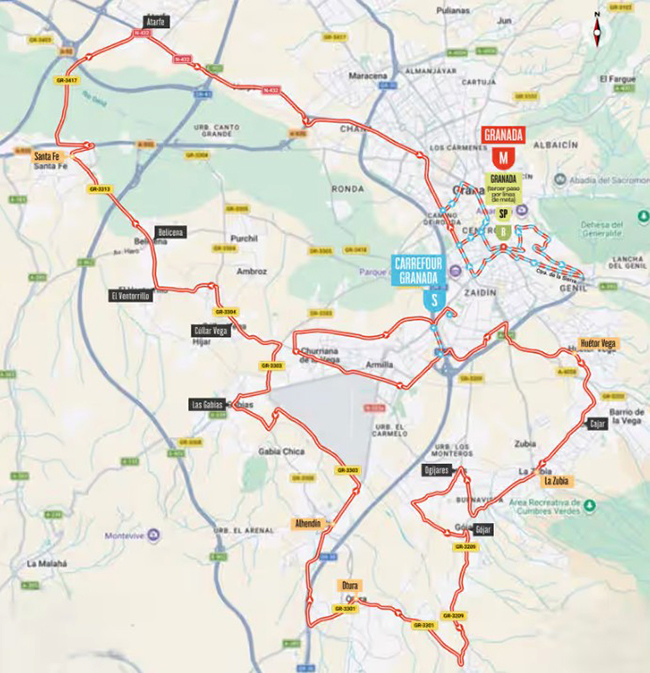
Stage 21 map
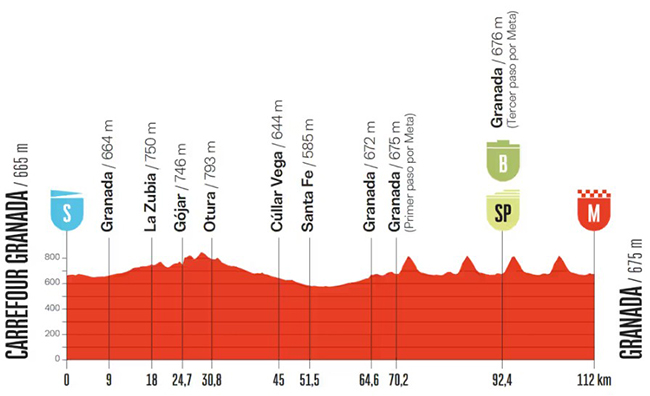
Stage 21 profile
Stage 21 photos by Fotoreporter Sirotti:
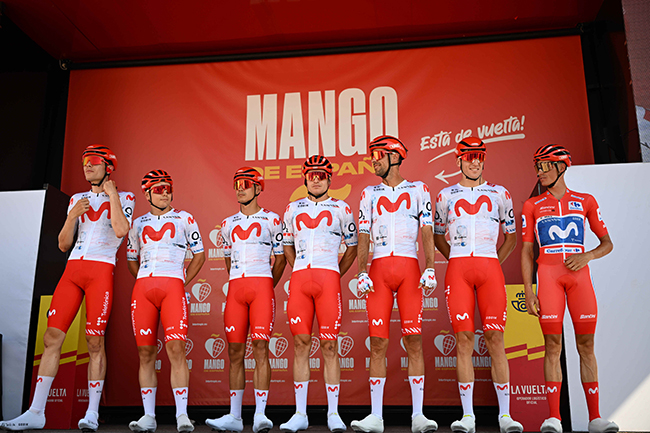
Teams presentation ceremony before the stage start. GC leader Enric Mas is in red and his Movistar teammates have lots of red as well.
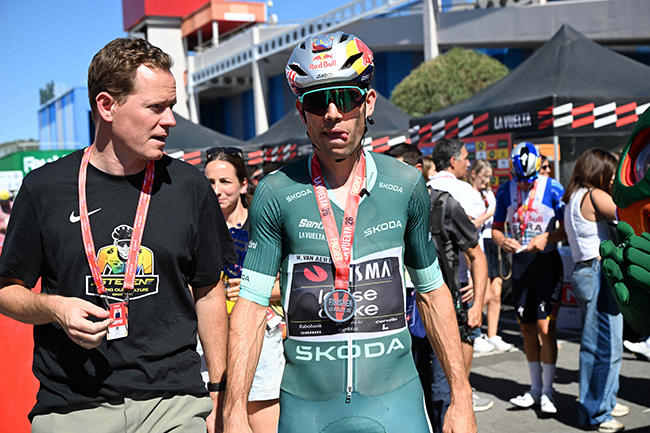
Points classification leader Wout van Aert before the stage start.
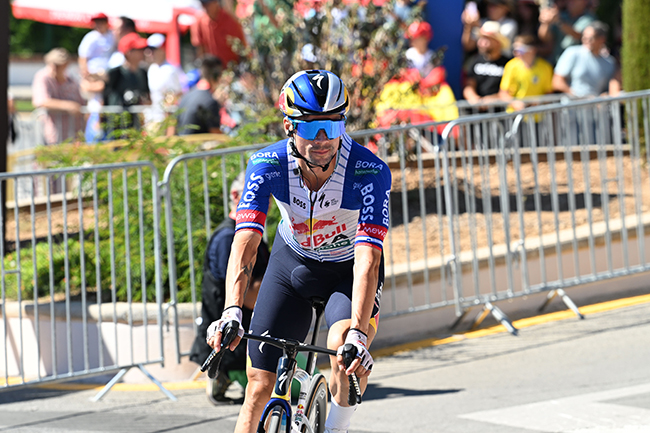
GC second-place rider Primoz Roglic heads to the start.
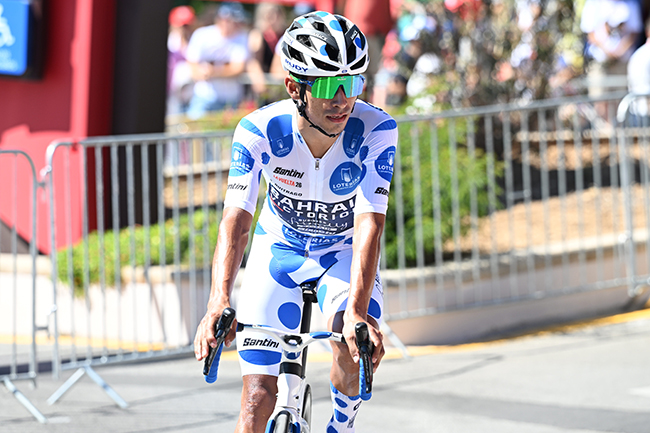
Mountains classification winner Santiago Buitrago
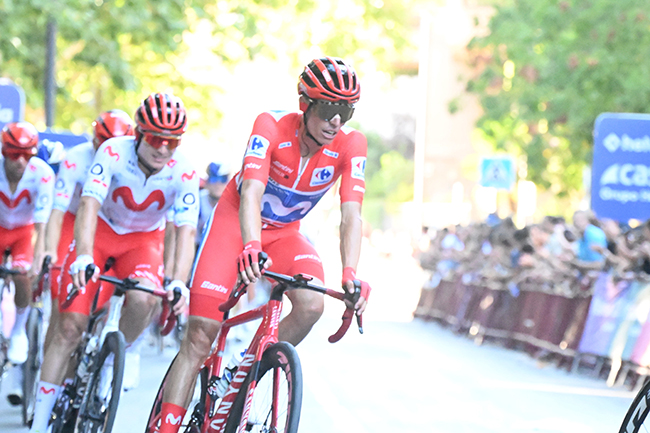
Near the end of the stage: GC winner Enric is well-guarded by his Movistar teammates.
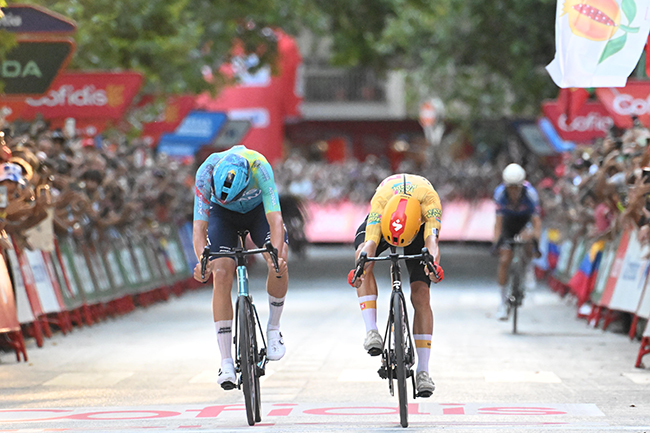
Alessandro Romele (left) & Tobias Halland Johannessen sprint for the stage win.
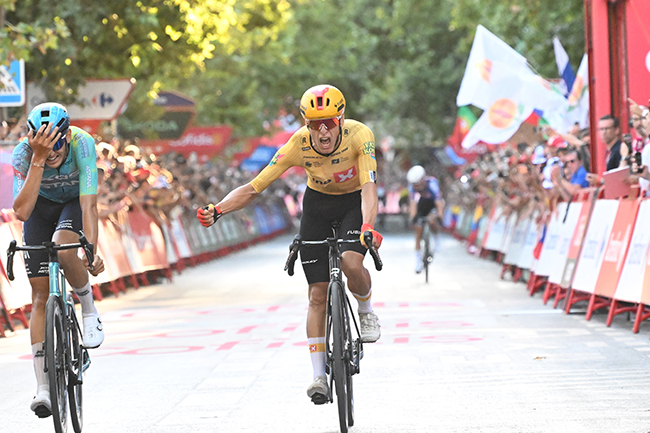
Tobias Halland Johannessen beats Alessandro for the stage win.
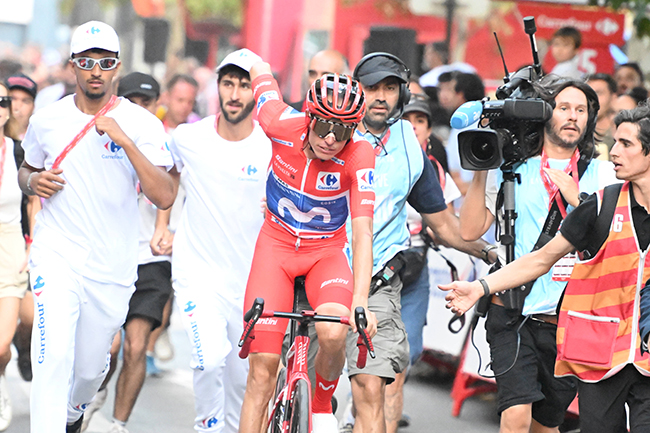
Just after ther stage finish, Enric Mas has just won the 2026 Vuelta a España.
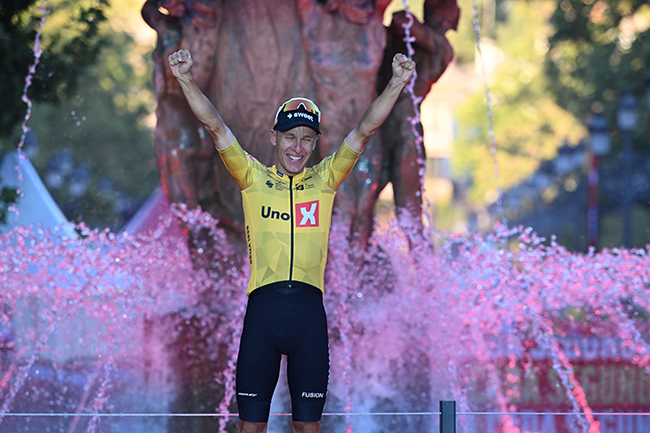
Stage winner Tobias Halland Johannessen
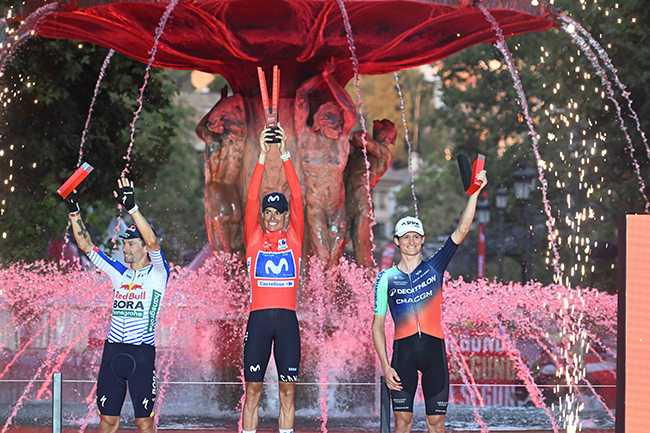
The final GC podium, from left: Primoz Roglic (2nd), Enric Mas (1st), & Felix Gall (3rd).
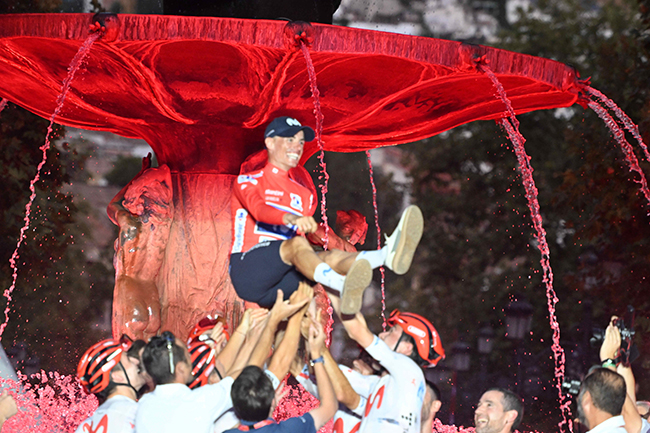
2026 Vuelta a España winner Enric Mas








Content continues below the ads
Saturday, September 12: Stage 20, La Calahorra - Collado del Alguacil, 186.8 km
Complete stage 20 results, stage story, photos, map & profile
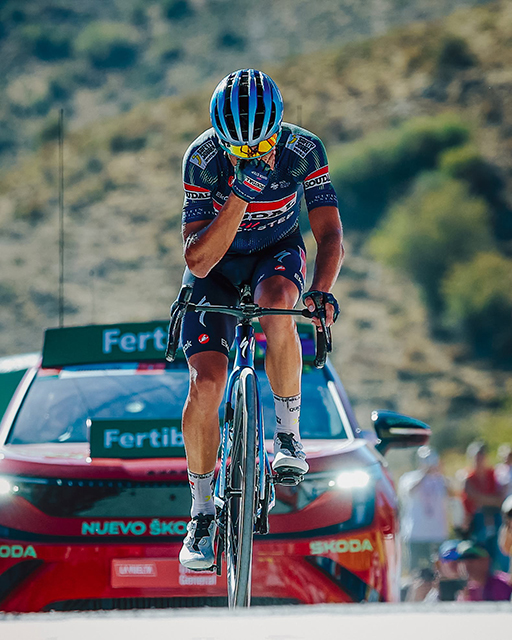
Mikel Landa wins stage twenty.
Results:
186.8 kilometers raced at an average speed of 37.609 km/hr
| 1 | Mikel Landa | Soudal Quick-Step | 4hr 58min 1sec |
| 2 | Tobias Halland Johannessen | Uno-X Mobility | @ 47sec |
| 3 | Ramses Debruyne | Alpecin-Premier Tech | 1:27 |
| 4 | Pau Miquel Delgado | Bahrain Victorious | 3:00 |
| 5 | Urko Berrade | Equipo Kern Pharma | 4:12 |
| 6 | Jan Hirt | NSN Cycling Team | 4:18 |
| 7 | Jørgen Nordhagen | Team Visma | Lease a Bike | 4:35 |
| 8 | Sepp Kuss | Team Visma | Lease a Bike | s.t. |
| 9 | Walter Calzoni | Pinarello-Q36.5 Pro Cycling Team | 4:48 |
| 10 | Lorenzo Fortunato | XDS Astana Team | 4:53 |
GC after stage 20:
- GC leader: Enric Mas (Movistar)
- Mountains classification leader: Santiago Buitrago (Bahrain Victorious)
- Points classification leader: Wout van Aert (Visma | Lease a Bike)
- Best young rider: Oscar Onley (Netcompany INEOS)
- Teams classification leader: Decathlon CMA CGM
2,912.6 kilometers raced so far at an average speed of 41.052 km/hr
| 1 | Enric Mas | Movistar Team | 70hr 56min 58sec |
| 2 | Primoz Roglic | Red Bull-BORA-hansgrohe | @ 2min 15sec |
| 3 | Felix Gall | Decathlon CMA CGM Team | 2:44 |
| 4 | Richard Carapaz | EF Education-EasyPost | 6:54 |
| 5 | Sepp Kuss | Team Visma | Lease a Bike | 8:45 |
| 6 | Oscar Onley | Netcompany INEOS Cycling Team | 9:28 |
| 7 | Jakob Omrzel | Bahrain Victorious | 10:38 |
| 8 | Clément Berthet | Groupama-FDJ United | 11:41 |
| 9 | Cristian Rodriguez | XDS Astana Team | 11:59 |
| 10 | Harold Tejada | XDS Astana Team | 14:40 |
Friday, September 11: Stage 19, Vélez Málaga - Peñas Blancas. Estepona, 210.8 km
Complete stage 19 results, stage story, photos, map & profile

Eddie Dunbar wins stage nineteen. Alone.
Results:
210.8 kilometers raced at an average speed of 42.034 km/hr
| 1 | Edward Dunbar | Pinarello-Q36.5 Pro Cycling Team | 5hr 0min 54sec |
| 2 | Santiago Buitrago | Bahrain Victorious | @ 14sec |
| 3 | Thomas Gloag | Pinarello-Q36.5 Pro Cycling Team | 0:23 |
| 4 | Urko Berrade | Equipo Kern Pharma | 0:44 |
| 5 | Marcel Camprubí | Pinarello-Q36.5 Pro Cycling Team | 1:44 |
| 6 | Andreas Leknessund | Uno-X Mobility | 2:01 |
| 7 | Guillaume Martin-Guyonnet | Groupama-FDJ United | 2:11 |
| 8 | Chris Hamilton | Team Picnic PostNL | 2:39 |
| 9 | Kevin Vermaerke | UAE Team Emirates-XRG | 3:03 |
| 10 | Sergio Samitier | Cofidis | 3:17 |
GC after stage 19:
- GC leader: Enric Mas (Movistar)
- Mountains classification leader: Santiago Buitrago (Bahrain Victorious)
- Points classification leader: Wout van Aert (Visma | Lease a Bike)
- Best young rider: Oscar Onley (Netcompany INEOS)
- Teams classification leader: Decathlon CMA CGM
2,725.8 kilometers raced so far at an average speed of 41.383 km/hr
| 1 | Enric Mas | Movistar Team | 65hr 52min 3sec |
| 2 | Primoz Roglic | Red Bull-BORA-hansgrohe | 1:37 |
| 3 | Felix Gall | Decathlon CMA CGM Team | 3:01 |
| 4 | Richard Carapaz | EF Education-EasyPost | 5:17 |
| 5 | Oscar Onley | Netcompany INEOS Cycling Team | 6:03 |
| 6 | Jakob Omrzel | Bahrain Victorious | 7:06 |
| 7 | Clément Berthet | Groupama-FDJ United | 7:57 |
| 8 | Cristian Rodriguez | XDS Astana Team | 8:21 |
| 9 | Mattias Skjelmose | Lidl-Trek | 9:06 |
| 10 | Harold Tejada | XDS Astana Team | 10:27 |
Thursday, September 10: Stage 18, El Puerto de Santa Maria - Jerez de la Frontera 32.1 km individual time trial
Complete stage 18 results, stage story, photos, map & profile

Stefan Küng riding to first place in the stage.
Results:
32.1 kilometers raced at an average speed of 54.458 km/hr
| 1 | Stefan Küng | Tudor Pro Cycling Team | 35min 22sec |
| 2 | Callum Thornley | Red Bull-BORA-hansgrohe | @ 3sec |
| 3 | João Almeida | UAE Team Emirates-XRG | 0:09 |
| 4 | Primoz Roglic | Red Bull-BORA-hansgrohe | 0:19 |
| 5 | Wout van Aert | Team Visma | Lease a Bike | 0:20 |
| 6 | Finn Fisher-Black | Red Bull-BORA-hansgrohe | 0:21 |
| 7 | Bruno Armirail | Team Visma | Lease a Bike | 0:26 |
| 8 | Ivo Oliveira | UAE Team Emirates-XRG | 0:30 |
| 9 | Ethan Hayter | Soudal Quick-Step | 0:32 |
| 10 | Xabier Azparren | Pinarello-Q36.5 Pro Cycling Team | 0:33 |
GC after stage 18:
- GC leader: Enric Mas (Movistar)
- Mountains classification leader: Santiago Buitrago (Bahrain Victorious)
- Points classification leader: Wout van Aert (Visma | Lease a Bike)
- Best young rider: Oscar Onley (Netcompany INEOS)
- Teams classification leader: Decathlon CMA CGM
2,515 kilometers raced so far at an average speed of 41.388 km/hr
| 1 | Enric Mas | Movistar Team | 60hr 45min 58sec |
| 2 | Primoz Roglic | Red Bull-BORA-hansgrohe | @ 1min 37sec |
| 3 | Felix Gall | Decathlon CMA CGM Team | 3:01 |
| 4 | Richard Carapaz | EF Education-EasyPost | 5:17 |
| 5 | Oscar Onley | Netcompany INEOS Cycling Team | 6:03 |
| 6 | Jakob Omrzel | Bahrain Victorious | 7:00 |
| 7 | Clément Berthet | Groupama-FDJ United | 7:47 |
| 8 | Mattias Skjelmose | Lidl-Trek | 7:51 |
| 9 | Cristian Rodriguez | XDS Astana Team | s.t. |
| 10 | Harold Tejada | XDS Astana Team | 9:57 |
Wednesday, September 9: Stage 17, Dos Hermanas - Sevilla (Seville), 184 km
Complete stage 17 results, stage story, photos, map & profile
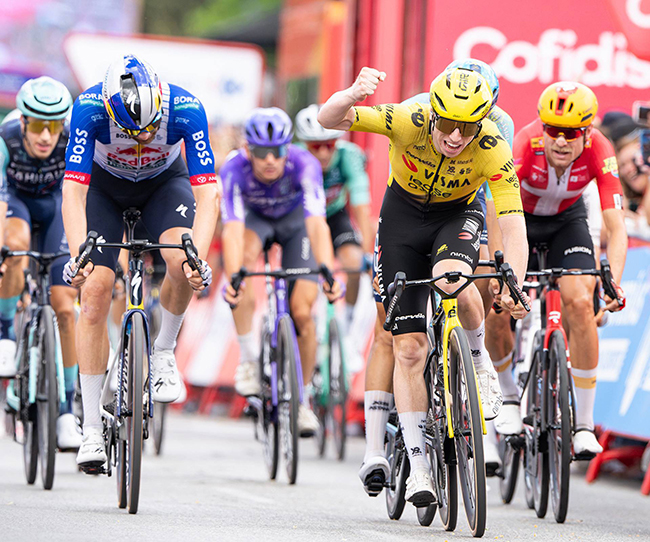
Matthew Brennan wins stage seventeen.
Results:
184 kilometers raced at an average speed of 44.651 km/hr
| 1 | Matthew Brennan | Team Visma | Lease a Bike | 4hr 7min 15sec |
| 2 | Jordi Meeus | Red Bull-BORA-hansgrohe | s.t. |
| 3 | Magnus Cort | Uno-X Mobility | s.t. |
| 4 | Alessandro Romele | XDS Astana Team | s.t. |
| 5 | Steffen De Schuyteneer | Lotto-Intermarché | s.t. |
| 6 | Axel Laurance | Netcompany INEOS Cycling Team | s.t. |
| 7 | Pau Miquel Delgado | Bahrain Victorious | s.t. |
| 8 | Cesar Macias | Burgos Burpellet BH | s.t. |
| 9 | Hugo Hofstetter | NSN Cycling Team | s.t. |
| 10 | Bryan Coquard | Cofidis | s.t. |
GC after stage 17:
- GC leader: Enric Mas (Movistar)
- Mountains classification leader: Santiago Buitrago (Bahrain Victorious)
- Points classification leader: Wout van Aert (Visma | Lease a Bike)
- Best young rider: Oscar Onley (Netcompany INEOS)
- Teams classification leader: Decathlon CMA CGM
2,482.9 kilometers raced so fat at an average speed of 41.270 km/hr
| 1 | Enric Mas | Movistar Team | 60hr 9min 44sec |
| 2 | Felix Gall | Decathlon CMA CGM Team | @ 2min 6sec |
| 3 | Primoz Roglic | Red Bull-BORA-hansgrohe | 2:10 |
| 4 | Richard Carapaz | EF Education-EasyPost | 4:24 |
| 5 | Oscar Onley | Netcompany INEOS Cycling Team | 5:44 |
| 6 | Jakob Omrzel | Bahrain Victorious | 6:14 |
| 7 | Mattias Skjelmose | Lidl-Trek | 6:49 |
| 8 | Cristian Rodriguez | XDS Astana Team | 7:01 |
| 9 | Clément Berthet | Groupama-FDJ United | 7:19 |
| 10 | Sepp Kuss | Team Visma | Lease a Bike | 8:55 |
Content continues below the ads

Tuesday, September 8: Stage 16, Cortegana - La Rábida. Palos de la Frontera, 181.1 km
Complete stage 16 results, stage story, photos, map & profile
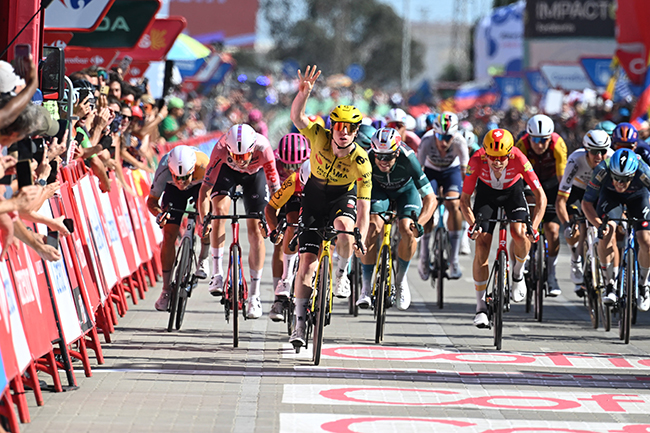
Speedy Matthew Brennan wins this stage. Sirotti photo
Results:
181.1 kilometers raced at an average speed of 45.935 km/hr
| 1 | Matthew Brennan | Team Visma | Lease a Bike | 3hr 56min 33sec |
| 2 | Bryan Coquard | Cofidis | s.t. |
| 3 | Vito Braet | Lotto-Intermarché | s.t. |
| 4 | Jordi Meeus | Red Bull-BORA-hansgrohe | s.t. |
| 5 | Magnus Cort | Uno-X Mobility | s.t. |
| 6 | Wout van Aert | Team Visma | Lease a Bike | s.t. |
| 7 | Hugo Hofstetter | NSN Cycling Team | s.t. |
| 8 | Vincenzo Albanese | EF Education-EasyPost | s.t. |
| 9 | Alberto Dainese | Soudal Quick-Step | s.t. |
| 10 | Cesar Macias | Burgos Burpellet BH | s.t. |
GC after stage 16:
- GC leader: Enric Mas (Movistar)
- Mountains classification leader: Santiago Buitrago (Bahrain Victorious)
- Points classification leader: Wout van Aert (Visma | Lease a Bike)
- Best young rider: Oscar Onley (Netcompany INEOS)
- Teams classification leader: Decathlon CMA CGM
2,298.9 kilometers raced so far at an average speed of 41.022 km/hr
| 1 | Enric Mas | Movistar Team | 56hr 2min 29sec |
| 2 | Felix Gall | Decathlon CMA CGM Team | @ 2min 6sec |
| 3 | Primoz Roglic | Red Bull-BORA-hansgrohe | 2:10 |
| 4 | Richard Carapaz | EF Education-EasyPost | 4:24 |
| 5 | Oscar Onley | Netcompany INEOS Cycling Team | 5:44 |
| 6 | Jakob Omrzel | Bahrain Victorious | 6:14 |
| 7 | Mattias Skjelmose | Lidl-Trek | 6:49 |
| 8 | Cristian Rodriguez | XDS Astana Team | 7:01 |
| 9 | Clément Berthet | Groupama-FDJ United | 7:19 |
| 10 | Sepp Kuss | Team Visma | Lease a Bike | 8:55 |
Monday, September 7: Rest Day Two
Sunday, September 6: Stage 15, Palma del Río - Córdoba, 180 110.2 km
Complete stage 15 results, stage story, photos, map & profile
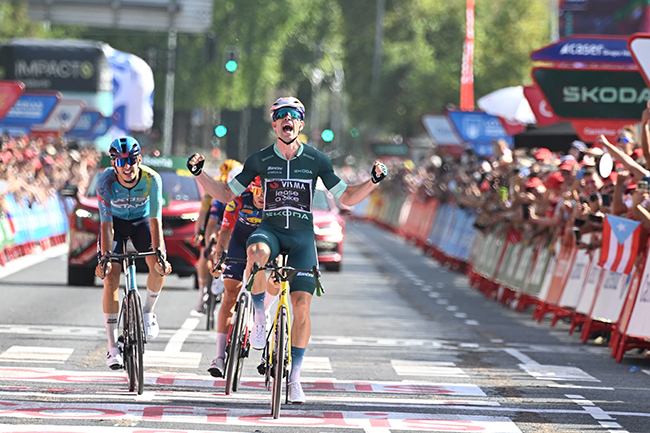
Wout van Aert wins his second stage this Vuelta. Sirotti photo
Results:
110.2 kilometers raced at an average speed of 42.658 km/hr
| 1 | Wout van Aert | Team Visma | Lease a Bike | 2hr 35min 0sec |
| 2 | Alessandro Romele | XDS Astana Team | s.t. |
| 3 | Thibau Nys | Lidl-Trek | s.t. |
| 4 | Ramses Debruyne | Alpecin-Premier Tech | @ 2sec |
| 5 | Andreas Leknessund | Uno-X Mobility | s.t. |
| 6 | Alessandro Covi | Team Jayco-AlUla | 0:58 |
| 7 | Bastien Tronchon | Groupama-FDJ United | s.t. |
| 8 | Henok Mulubrhan | XDS Astana Team | s.t. |
| 9 | Stefan Küng | Tudor Pro Cycling Team | s.t. |
| 10 | Ivo Oliveira | UAE Team Emirates-XRG | s.t. |
GC after stage 15:
- GC leader: Enric Mas (Movistar)
- Mountains classification leader: Santiago Buitrago (Bahrain Victorious)
- Points classification leader: Wout van Aert (Visma | Lease a Bike)
- Best young rider: Oscar Onley (Netcompany INEOS)
- Teams classification leader: Decathlon CMA CGM)
2117.8 kilometers raced so far at an average speed of 40.650 km/hr
| 1 | Enric Mas | Movistar Team | 52hr 5min 56sec |
| 2 | Felix Gall | Decathlon CMA CGM Team | @ 2min 6sec |
| 3 | Primoz Roglic | Red Bull-BORA-hansgrohe | 2:10 |
| 4 | Richard Carapaz | EF Education-EasyPost | 4:24 |
| 5 | Oscar Onley | Netcompany INEOS Cycling Team | 5:44 |
| 6 | Jakob Omrzel | Bahrain Victorious | 6:14 |
| 7 | Mattias Skjelmose | Lidl-Trek | 6:49 |
| 8 | Cristian Rodriguez | XDS Astana Team | 7:01 |
| 9 | Clément Berthet | Groupama-FDJ United | 7:19 |
| 10 | Sepp Kuss | Team Visma | Lease a Bike | 8:55 |
Saturday, September 5: Stage 14, Jaén - Sierra de la Pandera, 151.9 km
Complete stage 14 results, stage story, photos, map & profile
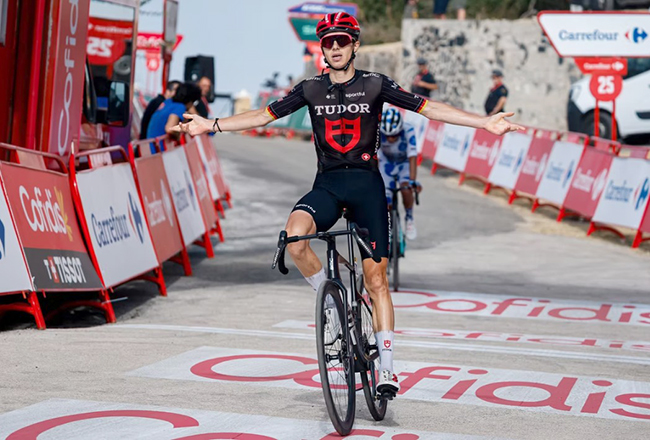
Marco Brenner wins stage fourteen.
Results:
151.9 kilometers raced at an average speed of 36.720 km/hr
| 1 | Marco Brenner | Tudor Pro Cycling Team | 4hr 15min 9sec |
| 2 | Santiago Buitrago | Bahrain Victorious | @ 1sec |
| 3 | Cristian Rodriguez | XDS Astana Team | 0:11 |
| 4 | Ivan Sosa | Equipo Kern Pharma | 0:14 |
| 5 | Valentin Paret-Peintre | Soudal Quick-Step | 0:22 |
| 6 | Clément Berthet | Groupama-FDJ United | 0:27 |
| 7 | Jørgen Nordhagen | Team Visma | Lease a Bike | 0:39 |
| 8 | Filippo Zana | Soudal Quick-Step | 0:43 |
| 9 | Walter Calzoni | Pinarello-Q36.5 Pro Cycling Team | 1:06 |
| 10 | João Almeida | UAE Team Emirates-XRG | 1:09 |
GC after stage 14:
- GC leader: Enric Mas (Movistar)
- Mountains classification leader: Santiago Buitrago (Bahrain Victorious)
- Points classification leader: Wout van Aert (Visma | Lease a Bike)
- Best young rider: Oscar Onley (Netcompany INEOS)
- Teams classification leader: Decathlon CMA CGM
2,007.6 kilometers raced so far at an average speed of 40.582 km/hr
| 1 | Enric Mas | Movistar Team | 49hr 28min 12sec |
| 2 | Felix Gall | Decathlon CMA CGM Team | @ 2min 6sec |
| 3 | Primoz Roglic | Red Bull-BORA-hansgrohe | 2:10 |
| 4 | Richard Carapaz | EF Education-EasyPost | 4:24 |
| 5 | Oscar Onley | Netcompany INEOS Cycling Team | 5:44 |
| 6 | Jakob Omrzel | Bahrain Victorious | 6:14 |
| 7 | Mattias Skjelmose | Lidl-Trek | 6:49 |
| 8 | Cristian Rodriguez | XDS Astana Team | 7:01 |
| 9 | Clément Berthet | Groupama-FDJ United | 7:19 |
| 10 | Sepp Kuss | Team Visma | Lease a Bike | 8:55 |
Friday, September 4: Stage 13, Almuñécar - Loja, 192.8 km
Complete stage 13 results, stage story, photos, map & profile
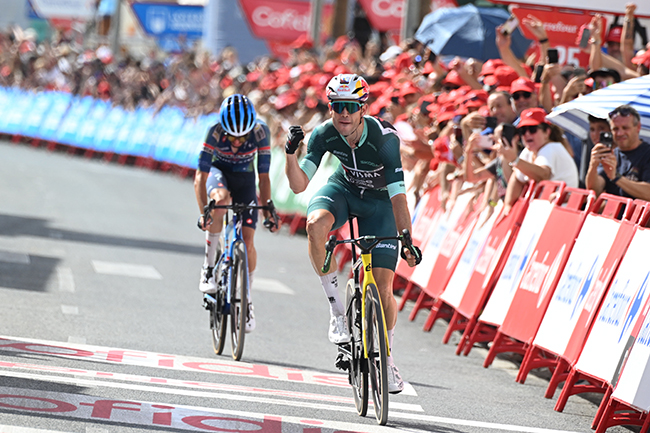
Wout van Aert beats Valentin Paret-Peintre for the stage win. Sirotti photo
Results:
192.8 kilometers raced at an average speed of 42.219 km/hr
| 1 | Wout van Aert | Team Visma | Lease a Bike | 4hr 34min 0sec |
| 2 | Valentin Paret-Peintre | Soudal Quick-Step | s.t. |
| 3 | Matthew Brennan | Team Visma | Lease a Bike | @ 24sec |
| 4 | Jarno Widar | Lotto-Intermarché | s.t. |
| 5 | Vincenzo Albanese | EF Education-EasyPost | s.t. |
| 6 | Finn Fisher-Black | Red Bull-BORA-hansgrohe | s.t. |
| 7 | Kevin Vermaerke | UAE Team Emirates-XRG | s.t. |
| 8 | Léo Bisiaux | Decathlon CMA CGM Team | 0:28 |
| 9 | Simon Dalby | Uno-X Mobility | 0:32 |
| 10 | Filippo Zana | Soudal Quick-Step | 0:45 |
GC after stage 13:
- GC leader: Enric Mas (Movistar)
- Mountains classification leader: Santiago Buitrago (Bahrain Victorious)
- Points classification leader: Wout van Aert (Visma | Lease a Bike)
- Best young rider: Oscar Onley (Netcompany INEOS)
- Teams classification leader: Decathlon CMA CGM
1,855.7 kilometers raced so far at an average speed of 41.103 km/hr
| 1 | Enric Mas | Movistar Team | 45hr 8min 51sec |
| 2 | Primoz Roglic | Red Bull-BORA-hansgrohe | @ 1min 45sec |
| 3 | Felix Gall | Decathlon CMA CGM Team | 2:06 |
| 4 | Richard Carapaz | EF Education-EasyPost | 3:53 |
| 5 | Oscar Onley | Netcompany INEOS Cycling Team | 4:29 |
| 6 | Jakob Omrzel | Bahrain Victorious | 4:59 |
| 7 | Mattias Skjelmose | Lidl-Trek | 5:32 |
| 8 | Sepp Kuss | Team Visma | Lease a Bike | 7:58 |
| 9 | Harold Tejada | XDS Astana Team | 8:33 |
| 10 | Clément Berthet | Groupama-FDJ United | 11:06 |
Thursday, September 3: Stage 12, Vera - Calar Alto, 166.6 km
Complete stage 12 results, stage story, photos, map & profile
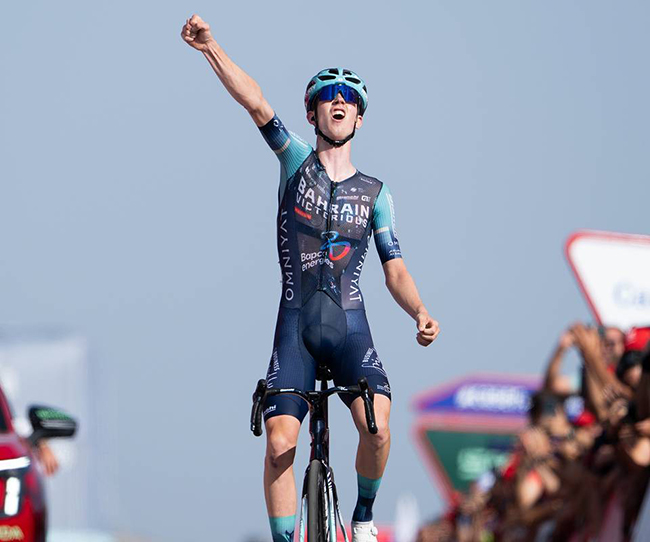
Jakob Omrzel takes a solo win atop Calar Alto
Results:
166.6 kilometers raced at an average speed of 37.038 km/hr
| 1 | Jakob Omrzel | Bahrain Victorious | 4hr 29min 53sec |
| 2 | Urko Berrade | Equipo Kern Pharma | @ 1min 56sec |
| 3 | Santiago Buitrago | Bahrain Victorious | 2:13 |
| 4 | Alexey Lutsenko | NSN Cycling Team | 2:49 |
| 5 | Mauri Vansevenant | Soudal Quick-Step | 2:53 |
| 6 | Enric Mas | Movistar Team | 2:56 |
| 7 | Felix Gall | Decathlon CMA CGM Team | 3:23 |
| 8 | Primoz Roglic | Red Bull-BORA-hansgrohe | s.t. |
| 9 | Richard Carapaz | EF Education-EasyPost | s.t. |
| 10 | Gregor Mühlberger | Decathlon CMA CGM Team | 3:50 |
GC after stage 12:
- GC leader: Enric Mas (Movistar)
- Mountains classification leader: Santiago Buitrago (Bahrain Victorious)
- Points classification leader: Wout van Aert (Visma | Lease a Bike)
- Best young rider: Oscar Onley (Netcompany INEOS)
- Teams classification leader: Decathlon CMA CGM
1,662.9 kilometers raced so far at an average speed of 41.028 km/hr
| 1 | Enric Mas | Movistar Team | 40hr 31min 51sec |
| 2 | Primoz Roglic | Red Bull-BORA-hansgrohe | @ 1min 45sec |
| 3 | Felix Gall | Decathlon CMA CGM Team | 2:06 |
| 4 | Richard Carapaz | EF Education-EasyPost | 3:53 |
| 5 | Oscar Onley | Netcompany INEOS Cycling Team | 4:29 |
| 6 | Jakob Omrzel | Bahrain Victorious | 4:59 |
| 7 | Mattias Skjelmose | Lidl-Trek | 7:42 |
| 8 | Sepp Kuss | Team Visma | Lease a Bike | 7:58 |
| 9 | Gregor Mühlberger | Decathlon CMA CGM Team | 8:27 |
| 10 | Harold Tejada | XDS Astana Team | 8:33 |
Wednesday, September 2: Stage 11, Cartagena - Lorca, 153.8 km
Complete stage 11 results, stage story, photos, map & profile
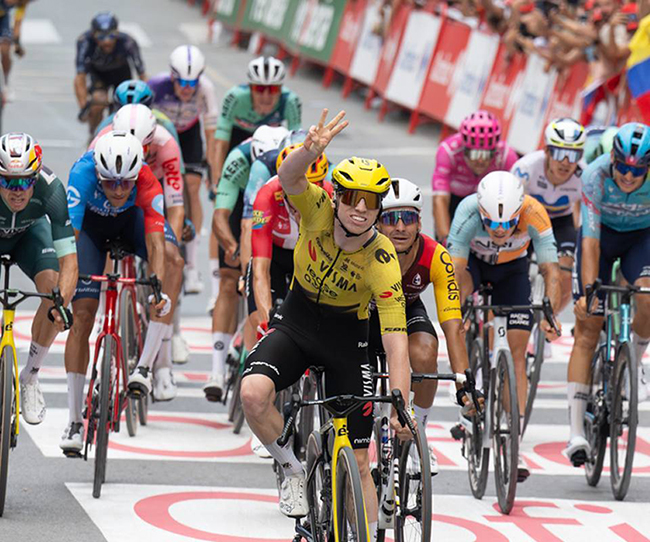
Matthew Brennan wins stage eleven.
Results:
153.8 kilometers raced at an average speed of 46.771 km/hr
| 1 | Matthew Brennan | Team Visma | Lease a Bike | 3hr 17min 18sec |
| 2 | Bryan Coquard | Cofidis | s.t. |
| 3 | Jordi Meeus | Red Bull-BORA-hansgrohe | s.t. |
| 4 | Magnus Cort | Uno-X Mobility | s.t. |
| 5 | Wout van Aert | Team Visma | Lease a Bike | s.t. |
| 6 | Hugo Hofstetter | NSN Cycling Team | s.t. |
| 7 | Bastien Tronchon | Groupama-FDJ United | s.t. |
| 8 | Alessandro Romele | XDS Astana Team | s.t. |
| 9 | Matevz Govekar | Bahrain Victorious | s.t. |
| 10 | Orluis Aular | Movistar Team | s.t. |
GC after stage 11:
- GC leader: Enric Mas (Movistar)
- Mountains classification leader: Santiago Buitrago (Bahrain Victorious)
- Points classification leader: Wout van Aert (Visma | Lease a Bike)
- Best young rider: Oscar Onley (Netcompany INEOS)
- Teams classification leader: Decathlon CMA CGM
1,496.3 kilometers raced so far at an average speed of 41.583 km/hr
| 1 | Enric Mas | Movistar Team | 35hr 59min 2sec |
| 2 | Primoz Roglic | Red Bull-BORA-hansgrohe | @ 1min 18sec |
| 3 | Felix Gall | Decathlon CMA CGM Team | 1:39 |
| 4 | Oscar Onley | Netcompany INEOS Cycling Team | 2:20 |
| 5 | Richard Carapaz | EF Education-EasyPost | 3:26 |
| 6 | Mattias Skjelmose | Lidl-Trek | 3:55 |
| 7 | Sepp Kuss | Team Visma | Lease a Bike | 4:09 |
| 8 | Harold Tejada | XDS Astana Team | 4:39 |
| 9 | Gregor Mühlberger | Decathlon CMA CGM Team | 7:33 |
| 10 | Jakob Omrzel | Bahrain Victorious | 8:05 |
Tuesday, September 1: Stage 10, Alcaraz - Elche de la Sierra, 184.7 km
Complete stage 10 results, stage story, photos, map & profile
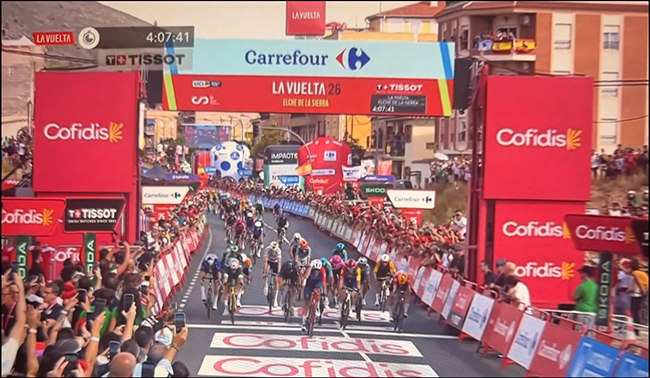
Bastien Tronchon wins stage ten. This is his first World Tour & Grand Tour victory.
Results:
184.7 kilometers raced at an average speed of 44.743 km/hr
| 1 | Bastien Tronchon | Groupama-FDJ United | 4hr 7min 41sec |
| 2 | Magnus Cort | Uno-X Mobility | s.t. |
| 3 | Thibau Nys | Lidl-Trek | s.t. |
| 4 | Wout van Aert | Team Visma | Lease a Bike | s.t. |
| 5 | Alessandro Romele | XDS Astana Team | s.t. |
| 6 | Xabier Azparren | Pinarello-Q36.5 Pro Cycling Team | s.t. |
| 7 | Finn Fisher-Black | Red Bull-BORA-hansgrohe | s.t. |
| 8 | Orluis Aular | Movistar Team | s.t. |
| 9 | Jordan Labrosse | Decathlon CMA CGM Team | s.t. |
| 10 | Hugo Hofstetter | NSN Cycling Team | s.t. |
GC after stage 10:
- GC leader: Enric Mas (Movistar)
- Mountains classification leader: Santiago Buitrago (Bahrain Victorious)
- Points classification leader: Wout van Aert (Visma | Lease a Bike)
- Best young rider: Oscar Onley (Netcompany INEOS)
- Teams classification leader: Decathlon CMA CGM
1,342.5 kilometers raced so far at an average speed of 41.061 km/hr
| 1 | Enric Mas | Movistar Team | 32hr 41min 44sec |
| 2 | Primoz Roglic | Red Bull-BORA-hansgrohe | @ 1min 18sec |
| 3 | Felix Gall | Decathlon CMA CGM Team | 1:39 |
| 4 | Oscar Onley | Netcompany INEOS Cycling Team | 2:20 |
| 5 | Richard Carapaz | EF Education-EasyPost | 3:26 |
| 6 | Mattias Skjelmose | Lidl-Trek | 3:55 |
| 7 | Sepp Kuss | Team Visma | Lease a Bike | 4:09 |
| 8 | Harold Tejada | XDS Astana Team | 4:39 |
| 9 | Gregor Mühlberger | Decathlon CMA CGM Team | 7:33 |
| 10 | Jakob Omrzel | Bahrain Victorious | 8:05 |
Monday, August 31: Rest Day One
Sunday, August 30: Stage 9, La Vila Joiosa/Villajoyosa - Alto de Aitana. Costa Blanca. 187.4 km
Complete stage 9 results, stage story, photos, map & profile
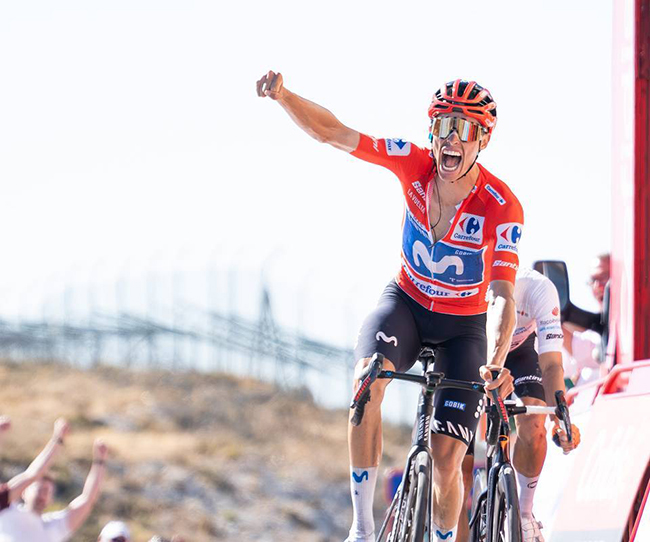
A happy, red-jersey'd Enric Mas wins stage nine.
Results:
187.4 kilometers raced at an average speed of 36.193 km/hr
| 1 | Enric Mas | Movistar Team | 5hr 10min 40sec |
| 2 | Oscar Onley | Netcompany INEOS Cycling Team | s.t. |
| 3 | Primoz Roglic | Red Bull-BORA-hansgrohe | @ 12sec |
| 4 | Felix Gall | Decathlon CMA CGM Team | 0:18 |
| 5 | Cristian Rodriguez | XDS Astana Team | 0:20 |
| 6 | Mattias Skjelmose | Lidl-Trek | s.t. |
| 7 | Jarno Widar | Lotto-Intermarché | 0:25 |
| 8 | Harold Tejada | XDS Astana Team | 0:33 |
| 9 | Richard Carapaz | EF Education-EasyPost | 0:54 |
| 10 | Santiago Buitrago | Bahrain Victorious | 1:41 |
GC after stage 9:
- GC leader: Enric Mas (Movistar)
- Mountains classification leader: Santiago Buitrago (Bahrain Victorious)
- Points classification leader: Wout van Aert (Visma | Lease a Bike)
- Best young rider: Oscar Onley (Netcompany INEOS)
- Teams classification leader: Decathlon CMA CGM
1,157.8 kilometers raced so far at an average speed of 40.529 km/hr
| 1 | Enric Mas | Movistar Team | 28hr 34min 3sec |
| 2 | Primoz Roglic | Red Bull-BORA-hansgrohe | @ 1min 18sec |
| 3 | Felix Gall | Decathlon CMA CGM Team | 1:39 |
| 4 | Oscar Onley | Netcompany INEOS Cycling Team | 2:20 |
| 5 | Richard Carapaz | EF Education-EasyPost | 3:26 |
| 6 | Mattias Skjelmose | Lidl-Trek | 3:55 |
| 7 | Sepp Kuss | Team Visma | Lease a Bike | 4:09 |
| 8 | Harold Tejada | XDS Astana Team | 4:39 |
| 9 | Gregor Mühlberger | Decathlon CMA CGM Team | 7:33 |
| 10 | Jakob Omrzel | Bahrain Victorious | 8:05 |
Content continues below the ads
Saturday, August 29: Stage 8, Puçol - Xeraco, 161 km
Complete stage 8 results, stage story, photos, map & profile
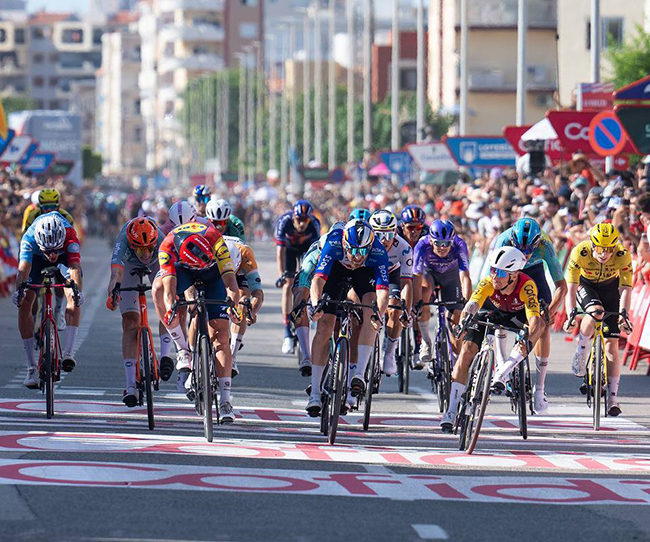
Bryan Coquard (on right) beats Mads Pedersen for the stage win.
Results:
161 kilometers raced at an average speed of 44.496 km/hr
| 1 | Bryan Coquard | Cofidis | 3hr 47hr 6sec |
| 2 | Mads Pedersen | Lidl-Trek | s.t. |
| 3 | Jordi Meeus | Red Bull-BORA-hansgrohe | s.t. |
| 4 | Ben Turner | Netcompany INEOS | s.t. |
| 5 | Jordan Labrosse | Decathlon CMA CGM Team | s.t. |
| 6 | Bastien Tronchon | XDS Astana Team | s.t. |
| 7 | Alessandro Romele | Groupama-FDJ United | s.t. |
| 8 | Hugo Hofstetter | NSN Cycling Team | s.t. |
| 9 | Orluis Aular | Movistar Team | s.t. |
| 10 | Matthew Brennan | Team Visma | Lease a Bike | s.t. |
GC after stage 8:
- GC leader: Enric Mas (Movistar)
- Mountains classification leader: Andreas Leknessund (Uno-X Mobility)
- Points classification leader: Wout van Aert (Visma | Lease a Bike)
- Best young rider: Oscar Onley (Netcompany INEOS)
- Teams classification leader: Decathlon CMA CGM
970.4 kilometers raced so far at an average speed of 41.471 km/hr
| 1 | Enric Mas | Movistar Team | 23hr 23min 33sec |
| 2 | Primož Roglič | Red Bull-BORA-hansgrohe | @ 1min 0sec |
| 3 | Felix Gall | Decathlon CMA CGM Team | 1:11 |
| 4 | Sepp Kuss | Team Visma | Lease a Bike | 2:15 |
| 5 | Oscar Onley | Netcompany INEOS | 2:16 |
| 6 | Mattias Skjelmose | EF Education-EasyPost | 2:22 |
| 7 | Richard Carapaz | Lidl-Trek | 3:27 |
| 8 | Harold Tejada | XDS Astana Team | 3:56 |
| 9 | Gregor Mühlberger | Decathlon CMA CGM Team | 5:39 |
| 10 | Jakob Omrzel | Bahrain-Victorious | 6:04 |
Friday, August 28: Stage 7, Vall d'Alba - Aramón Valdelinares, 148.8 km
Complete stage 7 results, stage story, photos, map & profile
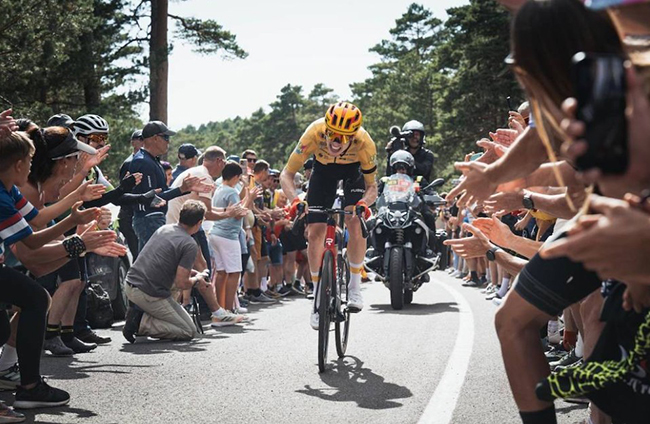
He's gone! Andreas Leknessund on his way to a solo stage win. Photo: Cxcling
Results:
148.8 kilometers raced at an average speed of 38.854 km/hr
| 1 | Andreas Leknessund | Uno-X Mobility | 3hr 49min 47sec |
| 2 | Tobias Halland Johannessen | Uno-X Mobility | @ 34sec |
| 3 | Wout van Aert | Team Visma | Lease a Bike | 0:47 |
| 4 | Jakob Omrzel | Bahrain Victorious | 0:58 |
| 5 | Juan Rodríguez | EF Education-EasyPost | 1:13 |
| 6 | Ivan Sosa | Equipo Kern Pharma | 1:16 |
| 7 | Alexey Lutsenko | NSN Cycling Team | 1:44 |
| 8 | Edward Dunbar | Pinarello-Q36.5 Pro Cycling Team | 1:51 |
| 9 | Léo Bisiaux | Decathlon CMA CGM Team | 1:53 |
| 10 | Raúl García | Movistar Team | 2:14 |
GC after stage 7:
- GC leader: Tadej Pogacar (UAE Team Emirates-XRG)
- Mountains classification leader: Tadej Pogacar (UAE Team Emirates-XRG)
- Points classification leader: Wout van Aert (Visma | Lease a Bike)
- Best young rider: Oscar Onley (Netcompany INEOS)
- Teams classification leader: Decathlon CMA CGM
809.4 kilometers raced so far at an average speed of 41.415 km/hr
| 1` | Tadej Pogacar | UAE Team Emirates-XRG | 19hr 32min 37sec |
| 2 | Enric Mas | Movistar Team | @ 3min 50sec |
| 3 | Primoz Roglic | Red Bull-BORA-hansgrohe | 4:50 |
| 4 | Felix Gall | Decathlon CMA CGM Team | 5:01 |
| 5 | Sepp Kuss | Team Visma | Lease a Bike | 6:05 |
| 6 | Oscar Onley | Netcompany INEOS Cycling Team | 6:06 |
| 7 | Richard Carapaz | EF Education-EasyPost | 6:12 |
| 8 | Mattias Skjelmose | Lidl-Trek | 7:17 |
| 9 | Harold Tejada | XDS Astana Team | 7:46 |
| 10 | Gregor Mühlberger | Decathlon CMA CGM Team | 9:29 |
Thursday, August 27: Stage 6, Alcossebre - Castellô, 177 km
Complete stage 6 results, stage story, photos, map & profile
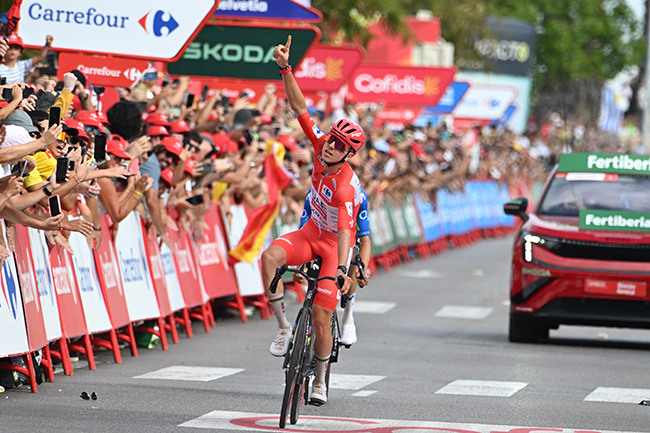
Tadej Pogacar beats Enric Mas for the stage win. Sirotti photo
Results:
177 kilometers raced at an average speed of 42.032 km/hr.
| 1 | Tadej Pogacar | UAE Team Emirates-XRG | 4hr 12min 40sec |
| 2 | Enric Mas | Movistar Team | s.t. |
| 3 | Ramses Debruyne | Alpecin-Premier Tech | @ 46sec |
| 4 | Richard Carapaz | EF Education-EasyPost | s.t. |
| 5 | Harold Tejada | XDS Astana Team | s.t. |
| 6 | Felix Gall | Decathlon CMA CGM Team | s.t. |
| 7 | Primoz Roglic | Red Bull-BORA-hansgrohe | s.t. |
| 8 | Cristian Rodriguez | XDS Astana Team | 1:38 |
| 9 | Clément Berthet | Groupama-FDJ United | s.t. |
| 10 | Mattias Skjelmose | Lidl-Trek | s.t. |
GC after stage 6:
- GC leader: Tadej Pogacar (UAE Team Emirates-XRG)
- Mountains classification leader: Tadej Pogacar (UAE Team Emirates-XRG)
- Points classification leader: Tadej Pogacar (UAE Team Emirates-XRG)
- Best young rider: Oscar Onley (Netcompany INEOS)
- Teams classification leader: Decathlon CMA CGM
660.6 kilometers raced so far at an average speed of 42.236 km/hr
| 1 | Tadej Pogacar | UAE Team Emirates-XRG | 15hr 38min 27sec |
| 2 | Enric Mas | Movistar Team | @ 3min 34sec |
| 3 | Primoz Roglic | Red Bull-BORA-hansgrohe | 4:21 |
| 4 | Richard Carapaz | EF Education-EasyPost | 4:50 |
| 5 | Felix Gall | Decathlon CMA CGM Team | 4:55 |
| 6 | Sepp Kuss | Team Visma | Lease a Bike | 5:36 |
| 7 | Oscar Onley | Netcompany INEOS Cycling Team | 5:37 |
| 8 | Ramses Debruyne | Alpecin-Premier Tech | 5:40 |
| 9 | Mattias Skjelmose | Lidl-Trek | 5:58 |
| 10 | Harold Tejada | XDS Astana Team | 6:30 |
Wednesday, August 26: Stage 5, Falset. Costa Daurada - Roquetes. Terre de l'Ebre, 169.3 km
Complete stage 5 results, stage story, photos, map & profile
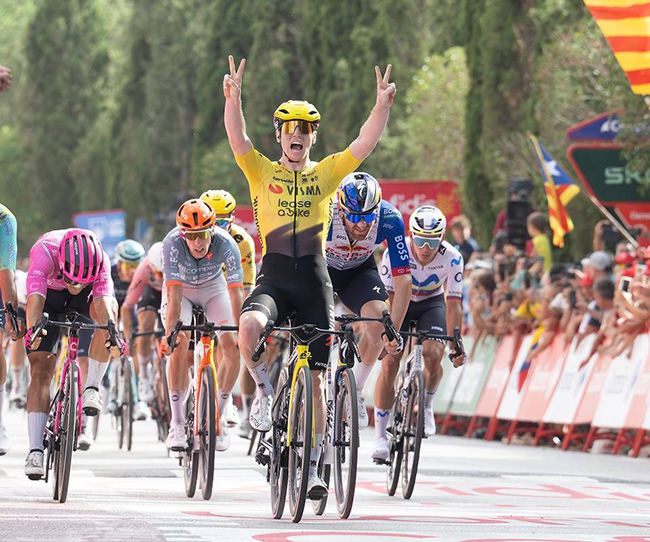
Matthew Brennan wins stage five.
Results:
169.3 kilometers raced at an average speed of 44.742 km/hr
| 1 | Matthew Brennan | Team Visma | Lease a Bike | 3hr 47min 2sec |
| 2 | Jordi Meeus | Red Bull-BORA-hansgrohe | s.t. |
| 3 | Vincenzo Albanese | EF Education-EasyPost | s.t. |
| 4 | Alessandro Romele | XDS Astana Team | s.t. |
| 5 | Axel Laurance | Netcompany INEOS Cycling Team | s.t. |
| 6 | Orluis Aular | Movistar Team | s.t. |
| 7 | Christophe Laporte | Team Visma | Lease a Bike | s.t. |
| 8 | Alberto Dainese | Soudal Quick-Step | s.t. |
| 9 | Vito Braet | Lotto-Intermarché | s.t. |
| 10 | David González | Pinarello-Q36.5 Pro Cycling Team | s.t. |
GC after stage 5:
- GC leader: Tadej Pogacar (UAE Team Emirates-XRG)
- Mountains classification leader: Tadej Pogacar (UAE Team Emirates-XRG)
- Points classification leader: Tadej Pogacar (UAE Team Emirates-XRG)
- Best young rider: Oscar Onley (Netcompany INEOS)
- Teams classification leader: UAE Team Emirates-XRG
483.6 kilometers raced so far at an average speed of 42.296 km/hr
| 1 | Tadej Pogacar | UAE Team Emirates-XRG | 11hr 26min 1sec |
| 2 | Primoz Roglic | Red Bull-BORA-hansgrohe | @ 3min 21sec |
| 3 | Enric Mas | Movistar Team | 3:32 |
| 4 | Sepp Kuss | Team Visma | Lease a Bike | 3:44 |
| 5 | Oscar Onley | Netcompany INEOS Cycling Team | 3:45 |
| 6 | Richard Carapaz | EF Education-EasyPost | 3:50 |
| 7 | Felix Gall | Decathlon CMA CGM Team | 3:57 |
| 8 | Mattias Skjelmose | Lidl-Trek | 4:06 |
| 9 | Jarno Widar | Lotto-Intermarché | 4:06 |
| 10 | Jay Vine | UAE Team Emirates-XRG | 4:11 |
Tuesday, August 25: Stage 4, Andorra la Vella - Andorra la Vella, 104.8 km
Complete stage 4 results, stage story, map & profile
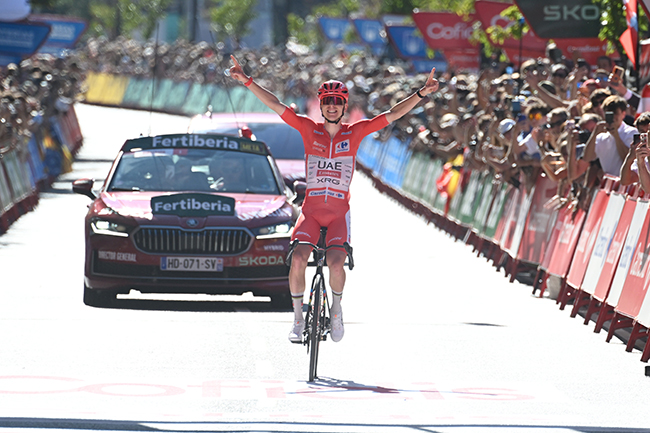
Tadej Pogacar solos across the finish line. Sirotti photo
Results:
104.8 kilometers raced at an average speed of 39.157 km/hr
| 1 | Tadej Pogacar | UAE Team Emirates-XRG | 2hr 40min 35sec |
| 2 | Jarno Widar | Lotto-Intermarché | @ 2min 39sec |
| 3 | Felix Gall | Decathlon CMA CGM Team | s.t. |
| 4 | Oscar Onley | Netcompany INEOS Cycling Team | s.t. |
| 5 | Sepp Kuss | Team Visma | Lease a Bike | s.t. |
| 6 | Enric Mas | Movistar Team | s.t. |
| 7 | Primoz Roglic | Red Bull-BORA-hansgrohe | s.t. |
| 8 | Richard Carapaz | EF Education-EasyPost | 2:57 |
| 9 | Mattias Skjelmose | Lidl-Trek | 3:17 |
| 10 | Gregor Mühlberger | Decathlon CMA CGM Team | s.t. |
GC after stage 4:
- GC leader: Tadej Pogacar (UAE Team Emirates-XRG)
- Mountains classification leader: Tadej Pogacar (UAE Team Emirates-XRG)
- Points classification leader: Tadej Pogacar (UAE Team Emirates-XRG)
- Best young rider: Oscar Onley (Netcompany INEOS)
- Teams classification leader: UAE Team Emirates-XRG
| 1 | Tadej Pogacar | UAE Team Emirates-XRG | 7hr 38min 59sec |
| 2 | Primoz Roglic | Red Bull-BORA-hansgrohe | @ 3min 21sec |
| 3 | Enric Mas | Movistar Team | 3:32 |
| 4 | Sepp Kuss | Team Visma | Lease a Bike | 3:44 |
| 5 | Oscar Onley | Netcompany INEOS Cycling Team | 3:45 |
| 6 | Richard Carapaz | EF Education-EasyPost | 3:50 |
| 7 | Felix Gall | Decathlon CMA CGM Team | 3:57 |
| 8 | Mattias Skjelmose | Lidl-Trek | 4:06 |
| 9 | Jarno Widar | Lotto-Intermarché | 4:06 |
| 10 | Jay Vine | UAE Team Emirates-XRG | 4:11 |
Monday, August 24: Stage 3, Gruissan-Aude - Font Romeu, 174 km
Stage 3 map & profile, stage story and GC brought forward from stage 2
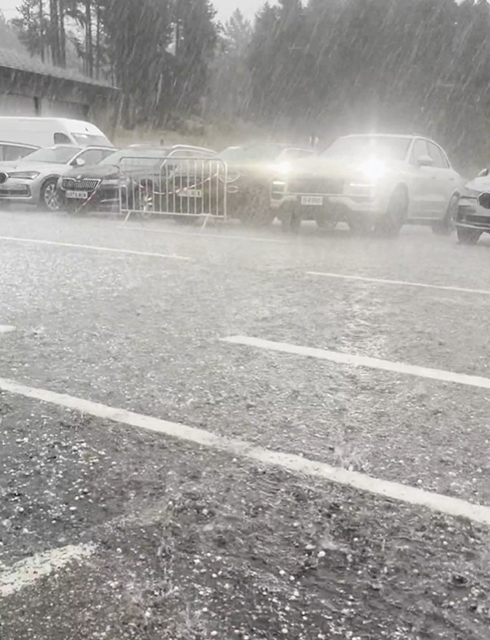
As heavy hail fell in the last kilometers of the stage the race was paused and then annulled. Team Groupama-FDJ posted this picture of the falling ice.
Results: Stage annulled.
GC after stage 3: Unchanged from stage two:
- GC leader: Tades Postcard (UAE Team Emirates-XRG)
- Mountains classification leader: Koen Bouwman (Jayco-AlUla)
- Points classification leader: Tadej Pogacar (UAE Team Emriates-XRG)
- Best young rider: Matthew Brennan (Visma | Lease a Bike)
- Teams classification leader: UAE Team Emirates-XRG
| 1 | Tadej Pogacar | UAE Team Emirates-XRG | 4hr 58min 40sec |
| 2 | Wout van Aert | Team Visma | Lease a Bike | @ 9sec |
| 3 | Matthew Brennan | Team Visma | Lease a Bike | 0:10 |
| 4 | Léo Bisiaux | Decathlon CMA CGM Team | 0:12 |
| 5 | Finn Fisher-Black | Red Bull-BORA-hansgrohe | 0:14 |
| 6 | Stefan Küng | Tudor Pro Cycling Team | 0:18 |
| 7 | Jay Vine | UAE Team Emirates-XRG | s.t. |
| 8 | Mads Pedersen | Lidl-Trek | 0:20 |
| 9 | Primoz Roglic | Red Bull-BORA-hansgrohe | 0:26 |
| 10 | Jordan Labrosse | Decathlon CMA CGM Team | 0:27 |
Sunday, August 23: Stage 2, Monaco - Manosque, 200.1 km
Complete stage 2 results, stage story, map & profile
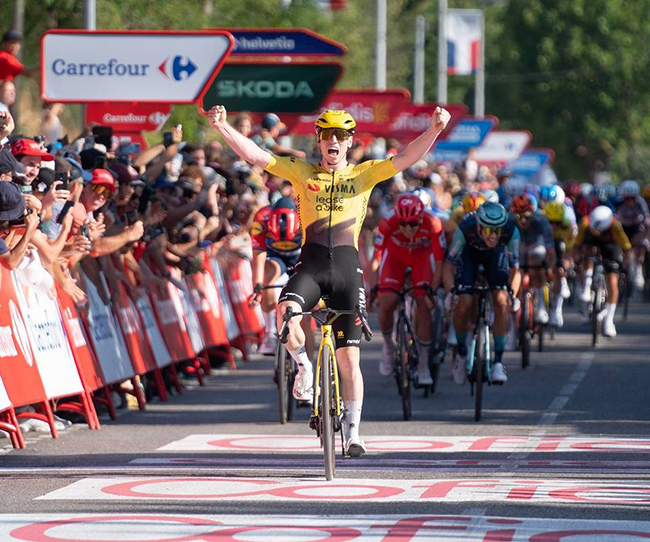
Matthew Brennan wins stage two.
Results:
200.1 kilometers raced at an average speed of 41.719 km/hr
| 1 | Matthew Brennan | Team Visma | Lease a Bike | 4hr 47min 47sec |
| 2 | Pau Miquel Delgado | Bahrain Victorious | s.t. |
| 3 | Tadej Pogacar | UAE Team Emirates-XRG | s.t. |
| 4 | Mads Pedersen | Lidl-Trek | s.t. |
| 5 | Hugo Hofstetter | NSN Cycling Team | s.t. |
| 6 | Tobias Halland Johannessen | Uno-X Mobility | s.t. |
| 7 | Finn Fisher-Black | Red Bull-BORA-hansgrohe | s.t. |
| 8 | Axel Laurance | Netcompany INEOS Cycling Team | s.t. |
| 9 | Oscar Onley | Netcompany INEOS Cycling Team | s.t. |
| 10 | Orluis Aular | Movistar Team | s.t. |
GC after stage 2
- GC leader: Tadej Pogacar (UAE Team Emirates-XRG)
- Mountains classification leader: Koen Bouwman (Jayco-AlUla)
- Points classification leader: Tadej Pogacar (UAE Team Emriates-XRG)
- Best young rider: Matthew Brennan (Visma | Lease a Bike)
- Teams classification leader: UAE Team Emirates-XRG
| 1 | Tadej Pogacar | UAE Team Emirates-XRG | 4hr 58min 40sec |
| 2 | Wout van Aert | Team Visma | Lease a Bike | @ 9sec |
| 3 | Matthew Brennan | Team Visma | Lease a Bike | 0:10 |
| 4 | Léo Bisiaux | Decathlon CMA CGM Team | 0:12 |
| 5 | Finn Fisher-Black | Red Bull-BORA-hansgrohe | 0:14 |
| 6 | Stefan Küng | Tudor Pro Cycling Team | 0:18 |
| 7 | Jay Vine | UAE Team Emirates-XRG | s.t. |
| 8 | Mads Pedersen | Lidl-Trek | 0:20 |
| 9 | Primoz Roglic | Red Bull-BORA-hansgrohe | 0:26 |
| 10 | Jordan Labrosse | Decathlon CMA CGM Team | 0:27 |
Saturday, August 22: Stage 1: Monaco 9.4 km individual time trial
Stage 1 complete results, stage story, photos, map & profile
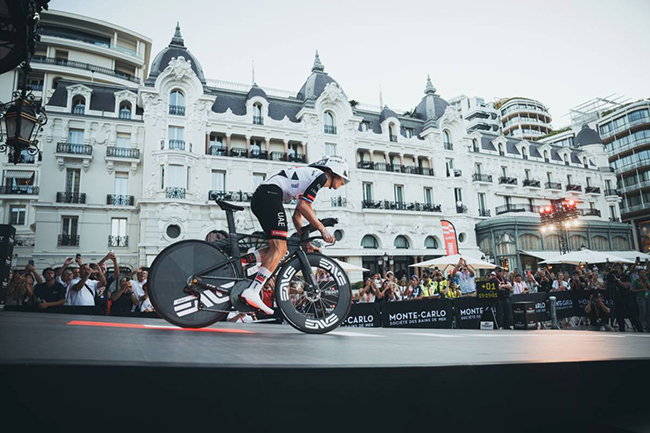
Tadej Pogacar starts his stage-winning ride.
| 1 | Tadej Pogacar | UAE Team Emirates-XRG | 10min 57sec |
| 2 | Ethan Hayter | Soudal Quick-Step | s.t. |
| 3 | Joshua Tarling | Netcompany INEOS Cycling Team | @ 4sec |
| 4 | Callum Thornley | Red Bull-BORA-hansgrohe | 0:05 |
| 5 | Christophe Laporte | Team Visma | Lease a Bike | 0:06 |
| 6 | Léo Bisiaux | Decathlon CMA CGM Team | 0:08 |
| 7 | Oscar Chamberlain | Decathlon CMA CGM Team | 0:09 |
| 8 | Wout van Aert | Team Visma | Lease a Bike | s.t. |
| 9 | Finn Fisher-Black | Red Bull-BORA-hansgrohe | 0:10 |
| 10 | Arthur Kluckers | Tudor Pro Cycling Team | 0:11 |