

2026 Tour de France
113th edition: July 4-July 26, 2026
2025 Tour | Start list, teams presentation photos, stage list, TDF sonnet by David Stanley, race description | Tour de France database
Stage 1 | Stage 2 | Stage 3 | Stage 4 | Stage 5 | Stage 6 | Stage 7 | Stage 8 | Stage 9 | Rest Day 1 | Stage 10 | Stage 11 | Stage 12 | Stage 13 | Stage 14 | Stage 15 | Rest Day 2 | Stage 16 | Stage 17 | Stage 18 | Stage 19 | Stage 20 | Stage 21
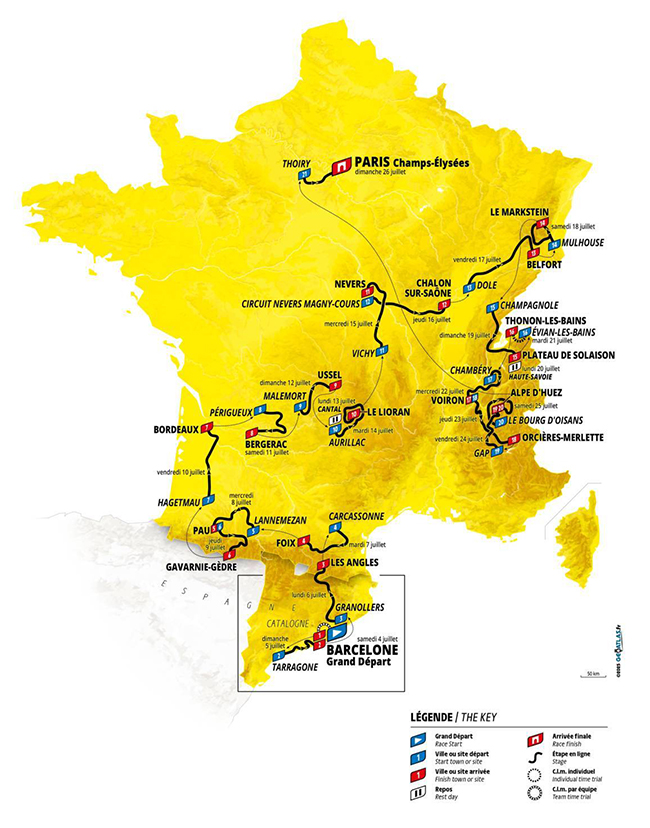
Map of the 2026 Tour de France. 3,197 km








Content continues below the ads
Sunday, July 25: 21st & Final Stage, Paris Champs-Élysées - Paris Champs-Élysées, 133 km 88.7 km
Stage 21 map & profile | Stage 21 photos
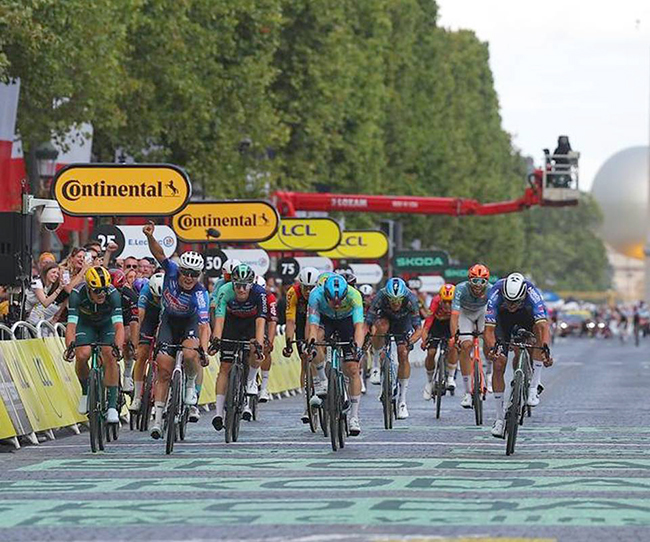
Mathieu van der Poel wins stage 21.
Bill & Carol McGann's book The Story of the Tour de France, Vol 1: 1903 - 1975 is available in print, Kindle eBook & audiobook versions. To get your copy, just click on the Amazon link on the right.
Weather at the start/finish city of Paris at 6:20 PM, local time: 26C (79F), cloudy, with the wind from the west-southwest at 19 km/hr (12 mph). There is just a 5% chance of rain.
 Rated ascents:
- Km 46.4: Côte de la Butte Montmartre, Cat. 4
- Km 62.4: Côte de la Butte Montmartre, Cat. 4
- Km 78.4: Côte de la Butte Montmartre, Cat. 4
The stage: Tour boss Christian Prudhomme wrote: "The explosive potential of Rue Lepic, which was discovered during the 2024 Olympic Games, was highlighted with a battle between the leaders on the final stage of the 2025 Tour. Once again, a Classics-style finish awaits the riders, with three passes over the Butte Montmartre. On this occasion, though, the finish line on the Champs-Élysées will be 15 kilometres from Sacré-Cœur. The strongest sprinters will still have a chance."
The times for the GC will be taken three laps before the finish. This corresponds to the last time they cross the finish line before heading to Côte de la Butte Montmartre.
About this stage:
- The route for Stage 21 has been shortened to 88.7 km, down from the 133 km originally planned.
- The caravan is scheduled to depart from Thoiry at 1:20 p.m. – after the parade, it will leave Thoiry and head directly to the final circuit in Paris.
- The team presentation will take place at 3:40 p.m.—after the presentation, the riders will travel directly to the final circuit in Paris by bus.
- The official start will be given from the finish line at 5:50 p.m.—the riders will complete two additional laps of the Champs-Élysées before heading to the Montmartre circuit for a scheduled finish at 7:45 p.m.
- A deeper explanation is posted here.
The race: Here's the race organizer's stage 21 report.
The final stage of the Tour de France 2026 delivered fireworks and crowned champions who already occupy a very special place in the history of the event. Clad in yellow as he rode towards a record-tying fifth overall triumph, Tadej Pogacar (UAE Emirates XRG) indulged himself with a flurry of attacks on the Côte de la Butte Montmartre. After the third and final ascent, only Mathieu Van der Poel (Alpecin-Premier Tech) was with him at the front. The duo collaborated to fend off the bunch in a most thrilling finale. As Pogacar faltered, Van der Poel covered the last 600 metres alone and resisted with a mere margin the sprinters, led by his teammate Jasper Philipsen at the line.
Third on the day, Mads Pedersen (Lidl-Trek) is the first Danish conqueror of the green jersey, and the sixth rider to win the points standings in all three Grand Tours. Richard Carapaz (EF Education-EasyPost) takes both the polka dot jersey and the Super Combativity award, as he did in 2024. Third overall, Isaac del Toro (UAE Emirates XRG) also takes home the white jersey as the winner of the young rider standings. The roll of honour also features the USA national champion Quinn Simmons (Lidl-Trek), named the best teammate of this edition.
The stage:
After a presentation in Thoiry, the riders head to Paris and the Champs-Élysées to start the final stage of the Tour de France 2026. The route was adapted due to the exceptional circumstances currently affecting France. The race is entirely held in Paris, with seven laps on the Champs-Élysées circuit and then three laps on the loop featuring the Côte de la Butte Montmartre for a total distance of 88.7 kilometres. After more than 3,000 kilometres of racing since the Grand Départ in Barcelona, this marks the 116th stage finish in Paris, and the 51st on the Champs-Élysées.
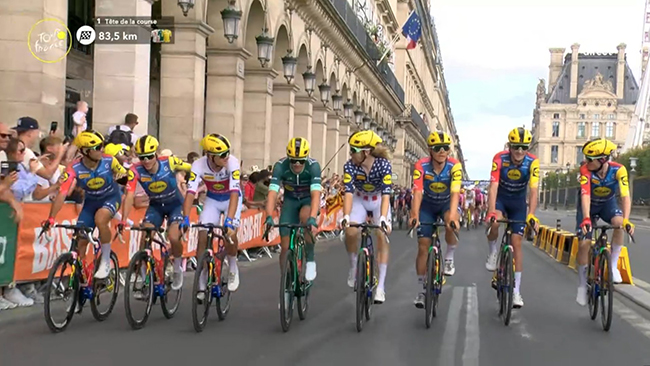
Lidl-Trek is going home with the green points classification jersey won by Mads Pedersen
First attacks
The first few laps serve as a celebration of the accomplishments of the riders who survived three weeks of battle. The action really kicks off when Baptiste Veistroffer (Lotto Intermarché) attacks 75 kilometres from the finish. The French baroudeur still has a bit of energy left but his several moves are covered by the fast-paced bunch.
As the riders enter the final three laps, the times for the GC are taken and the peloton head to the Côte de la Butte Montmartre (1 km at 6.5%). Xabier Mikel Azparren (Pinarello Q36.5) and Thibault Guernalec (Total Energies) are the first to tackle it. But Mads Pedersen (Lidl-Trek) unleashes his power and leads the way to the summit.
Pogacar ups the ante
The differences after this first ascent are minimal, and around 100 riders get back together for the penultimate lap. Onto the second ascent up the Côte de la Butte Montmartre, UAE Emirates XRG up the ante and Tadej Pogacar (UAE Emirates XRG) attacks.
Only Mathieu Van der Poel (Alpecin-Premier Tech) can follow the Maillot Jaune all the way to the summit. Remco Evenepoel (Red Bull-Bora-Hansgrohe) rapidly closes the gap. Then Mads Pedersen (Lidl-Trek) joins them 23 kilometres from the finish. The peloton trail by 15 seconds but Decathlon CMA CGM react. Back together with 19 kilometres to go.
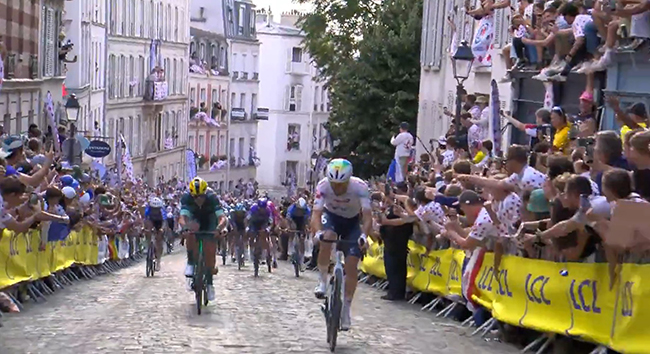
Mads Pedersen (yellow helmet, green jersey) powers up the Montmartre's Rue Lepic.
Van der Poel takes it home
Van der Poel puts in a strong attack on the final ascent of the Tour de France 2026. Pogacar follows him. And the duo open a gap of up 15 seconds on a same group of chasers, with the peloton right behind them. Decathlon CMA CGM are still up there, as well as NSN and Cofidis.
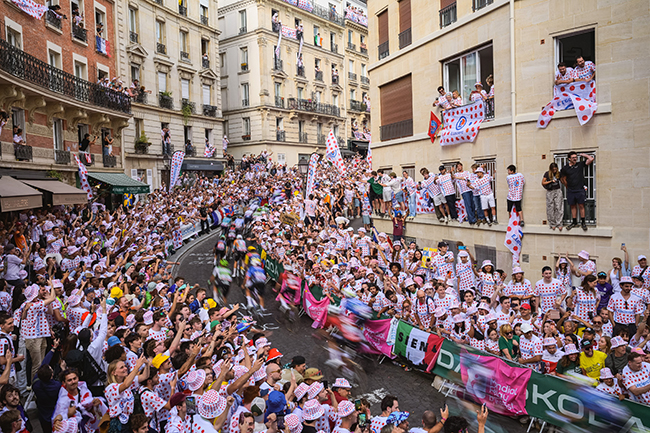
The final time up Montmartre's Rue Lepic. More than a few fans there to watch.
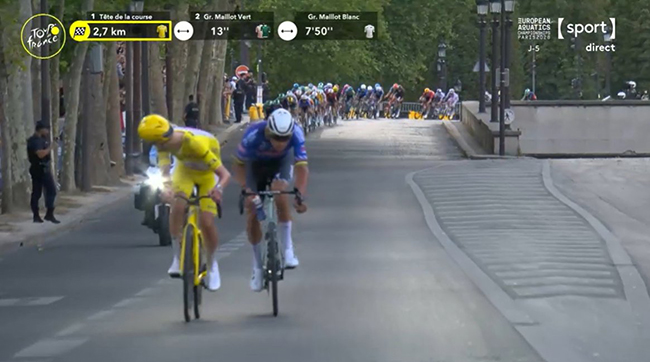
Pogacar & Van der Poel take a chance.
The gap decreases: 10 seconds with 3 km to go, 5 when they enter the final kilometre… As Pogacar falters, Van der Poel accelerates with 600 metres to go. Sprinters swoop on him but the Flying Dutchman narrowly edge them. His teammate Philipsen finishes second ahead of Mads Pedersen (Lidl-Trek).
Eventually 30th at the finish, Pogacar secures his fifth overall victory after the 2020, 2021, 2024, and 2025 editions. He ties the record set by Jacques Anquetil, Eddy Merckx, Bernard Hinault, and Miguel Indurain.
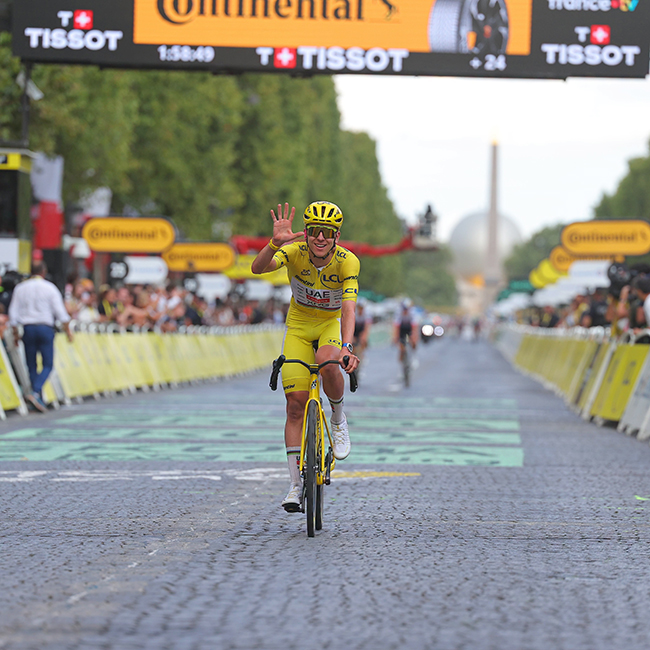
Tadej Pogacar safely finishes stage 21. He joins the five-Tour winners club of Jacques Anquetil, Eddy Merckx, Bernard Hinault, and Miguel Indurain. Photo: ASO/Morgan Bove
Complete results:
88.7 kilometers raced at an average speed of 44.792 km/hr
| 1 | Mathieu van der Poel | Alpecin-Premier Tech | 1hr 58min 49sec |
| 2 | Jasper Philipsen | Alpecin-Premier Tech | s.t. |
| 3 | Mads Pedersen | Lidl-Trek | s.t. |
| 4 | Max Kanter | XDS Astana Team | s.t. |
| 5 | Olav Kooij | Decathlon CMA CGM Team | s.t. |
| 6 | Matej Mohoric | Bahrain Victorious | s.t. |
| 7 | Rick Pluimers | Tudor Pro Cycling Team | s.t. |
| 8 | Anthony Turgis | Team TotalEnergies | s.t. |
| 9 | Milan Fretin | Cofidis | s.t. |
| 10 | Clément Russo | Groupama-FDJ United | s.t. |
| 11 | Biniam Girmay | NSN Cycling Team | s.t. |
| 12 | Jasper Stuyven | Soudal Quick-Step | s.t. |
| 13 | Michael Matthews | Team Jayco-AlUla | s.t. |
| 14 | Filippo Ganna | Netcompany INEOS Cycling Team | s.t. |
| 15 | Huub Artz | Lotto-Intermarché | s.t. |
| 16 | Marco Haller | Tudor Pro Cycling Team | s.t. |
| 17 | Tobias Halland Johannessen | Uno-X Mobility | s.t. |
| 18 | Javier Romo | Movistar Team | s.t. |
| 19 | Alexandre Delettre | Team TotalEnergies | s.t. |
| 20 | Brent Van Moer | Pinarello-Q36.5 Pro Cycling Team | s.t. |
| 21 | Simone Velasco | XDS Astana Team | s.t. |
| 22 | Alex Kirsch | Cofidis | s.t. |
| 23 | Alex Aranburu | Cofidis | s.t. |
| 24 | Mike Teunissen | XDS Astana Team | s.t. |
| 25 | Fred Wright | Pinarello-Q36.5 Pro Cycling Team | s.t. |
| 26 | Vlad Van Mechelen | Bahrain Victorious | s.t. |
| 27 | Nelson Oliveira | Movistar Team | s.t. |
| 28 | Victor Campenaerts | Team Visma | Lease a Bike | s.t. |
| 29 | Jonas Abrahamsen | Uno-X Mobility | s.t. |
| 30 | Tadej Pogacar | UAE Team Emirates-XRG | s.t. |
| 31 | Kasper Asgreen | EF Education-EasyPost | s.t. |
| 32 | Remco Evenepoel | Red Bull-BORA-hansgrohe | s.t. |
| 33 | Maxim Van Gils | Red Bull-BORA-hansgrohe | s.t. |
| 34 | Romain Grégoire | Groupama-FDJ United | s.t. |
| 35 | Liam Slock | Lotto-Intermarché | s.t. |
| 36 | Tiesj Benoot | Decathlon CMA CGM Team | s.t. |
| 37 | Ben Healy | EF Education-EasyPost | s.t. |
| 38 | Jake Stewart | NSN Cycling Team | s.t. |
| 39 | Richard Carapaz | EF Education-EasyPost | s.t. |
| 40 | Per Strand Hagenes | Team Visma | Lease a Bike | s.t. |
| 41 | Guillaume Martin-Guyonnet | Groupama-FDJ United | s.t. |
| 42 | Georg Zimmermann | Lotto-Intermarché | s.t. |
| 43 | Adam Yates | UAE Team Emirates-XRG | s.t. |
| 44 | Aurélien Paret-Peintre | Decathlon CMA CGM Team | s.t. |
| 45 | Daan Hoole | Decathlon CMA CGM Team | s.t. |
| 46 | Nicolas Prodhomme | Decathlon CMA CGM Team | s.t. |
| 47 | Paul Seixas | Decathlon CMA CGM Team | s.t. |
| 48 | Davide Piganzoli | Team Visma | Lease a Bike | s.t. |
| 49 | Matteo Jorgenson | Team Visma | Lease a Bike | s.t. |
| 50 | Jordan Jegat | Team TotalEnergies | s.t. |
| 51 | Mattéo Vercher | Team TotalEnergies | s.t. |
| 52 | Tim Marsman | Alpecin-Premier Tech | s.t. |
| 53 | Florian Vermeersch | UAE Team Emirates-XRG | s.t. |
| 54 | Nils Politt | UAE Team Emirates-XRG | s.t. |
| 55 | Joshua Tarling | Netcompany INEOS Cycling Team | s.t. |
| 56 | Davide Ballerini | XDS Astana Team | s.t. |
| 57 | Robbe Dhondt | Team Picnic PostNL | s.t. |
| 58 | Pavel Bittner | Team Picnic PostNL | s.t. |
| 59 | Clément Braz Afonso | Groupama-FDJ United | s.t. |
| 60 | Quinten Hermans | Pinarello-Q36.5 Pro Cycling Team | s.t. |
| 61 | Dylan van Baarle | Soudal Quick-Step | s.t. |
| 62 | Kévin Vauquelin | Netcompany INEOS Cycling Team | s.t. |
| 63 | Jenthe Biermans | Cofidis | s.t. |
| 64 | Toms Skujins | Lidl-Trek | s.t. |
| 65 | Mattias Skjelmose | Lidl-Trek | s.t. |
| 66 | Cees Bol | Decathlon CMA CGM Team | s.t. |
| 67 | Ewen Costiou | Groupama-FDJ United | s.t. |
| 68 | Quentin Pacher | Groupama-FDJ United | s.t. |
| 69 | Xandro Meurisse | Pinarello-Q36.5 Pro Cycling Team | s.t. |
| 70 | Sean Quinn | EF Education-EasyPost | s.t. |
| 71 | Georg Steinhauser | EF Education-EasyPost | s.t. |
| 72 | Michael Valgren | EF Education-EasyPost | s.t. |
| 73 | Marco Frigo | NSN Cycling Team | s.t. |
| 74 | Antonio Tiberi | Bahrain Victorious | s.t. |
| 75 | Warren Barguil | Team Picnic PostNL | s.t. |
| 76 | Frank van den Broek | Team Picnic PostNL | s.t. |
| 77 | Julius van den Berg | Team Picnic PostNL | s.t. |
| 78 | Anders Halland Johannessen | Uno-X Mobility | s.t. |
| 79 | Anders Skaarseth | Uno-X Mobility | s.t. |
| 80 | Alex Baudin | EF Education-EasyPost | s.t. |
| 81 | Felix Engelhardt | Team Jayco-AlUla | s.t. |
| 82 | Pascal Eenkhoorn | Soudal Quick-Step | s.t. |
| 83 | Valentin Paret-Peintre | Soudal Quick-Step | s.t. |
| 84 | Ion Izagirre | Cofidis | s.t. |
| 85 | Benjamin Thomas | Cofidis | s.t. |
| 86 | Magnus Cort | Uno-X Mobility | s.t. |
| 87 | Søren Wærenskjold | Uno-X Mobility | s.t. |
| 88 | Niklas Märkl | Team Picnic PostNL | s.t. |
| 89 | John Degenkolb | Team Picnic PostNL | s.t. |
| 90 | Tim van Dijke | Red Bull-BORA-hansgrohe | s.t. |
| 91 | Stefano Oldani | Caja Rural-Seguros RGA | s.t. |
| 92 | Mattia Cattaneo | Red Bull-BORA-hansgrohe | s.t. |
| 93 | Jai Hindley | Red Bull-BORA-hansgrohe | s.t. |
| 94 | Bruno Armirail | Team Visma | Lease a Bike | s.t. |
| 95 | Michael Storer | Tudor Pro Cycling Team | s.t. |
| 96 | Hugo Page | Cofidis | s.t. |
| 97 | Lewis Askey | NSN Cycling Team | s.t. |
| 98 | Raúl García | Movistar Team | s.t. |
| 99 | Pablo Castrillo | Movistar Team | s.t. |
| 100 | Jefferson Cepeda | Movistar Team | s.t. |
| 101 | Tobias Foss | Netcompany INEOS Cycling Team | s.t. |
| 102 | Michel Hessmann | Movistar Team | s.t. |
| 103 | Dorian Godon | Netcompany INEOS Cycling Team | s.t. |
| 104 | Thymen Arensman | Netcompany INEOS Cycling Team | s.t. |
| 105 | Michal Kwiatkowski | Netcompany INEOS Cycling Team | s.t. |
| 106 | Krists Neilands | NSN Cycling Team | s.t. |
| 107 | Matthew Riccitello | Decathlon CMA CGM Team | s.t. |
| 108 | Marc Hirschi | Tudor Pro Cycling Team | s.t. |
| 109 | Yannis Voisard | Tudor Pro Cycling Team | s.t. |
| 110 | Harold Tejada | XDS Astana Team | s.t. |
| 111 | Nicolas Vinokurov | XDS Astana Team | s.t. |
| 112 | Damiano Caruso | Bahrain Victorious | s.t. |
| 113 | Phil Bauhaus | Bahrain Victorious | s.t. |
| 114 | Robert Stannard | Bahrain Victorious | s.t. |
| 115 | Kamil Gradek | Bahrain Victorious | s.t. |
| 116 | Lenny Martinez | Bahrain Victorious | s.t. |
| 117 | Ben O'Connor | Team Jayco-AlUla | s.t. |
| 118 | Luke Plapp | Team Jayco-AlUla | s.t. |
| 119 | Max Walker | EF Education-EasyPost | s.t. |
| 120 | Luke Durbridge | Team Jayco-AlUla | s.t. |
| 121 | Louis Vervaeke | Soudal Quick-Step | s.t. |
| 122 | Damien Howson | Pinarello-Q36.5 Pro Cycling Team | s.t. |
| 123 | Xabier Azparren | Pinarello-Q36.5 Pro Cycling Team | @ 53sec |
| 124 | Sepp Kuss | Team Visma | Lease a Bike | @ 0sec |
| 125 | Tom Pidcock | Pinarello-Q36.5 Pro Cycling Team | s.t. |
| 126 | Aaron Gate | XDS Astana Team | s.t. |
| 127 | Mauro Schmid | Team Jayco-AlUla | s.t. |
| 128 | Lennert Van Eetvelt | Lotto-Intermarché | s.t. |
| 129 | Abel Balderstone | Caja Rural-Seguros RGA | s.t. |
| 130 | Sebastian Berwick | Caja Rural-Seguros RGA | s.t. |
| 131 | Piet Allegaert | Cofidis | s.t. |
| 132 | Sergio Higuita | XDS Astana Team | s.t. |
| 133 | Egan Bernal | Netcompany INEOS Cycling Team | s.t. |
| 134 | Nico Denz | Red Bull-BORA-hansgrohe | s.t. |
| 135 | Baptiste Veistroffer | Lotto-Intermarché | s.t. |
| 136 | Tim Wellens | UAE Team Emirates-XRG | s.t. |
| 137 | George Bennett | NSN Cycling Team | s.t. |
| 138 | Jan Tratnik | Red Bull-BORA-hansgrohe | s.t. |
| 139 | Julian Alaphilippe | Tudor Pro Cycling Team | s.t. |
| 140 | Isaac del Toro | UAE Team Emirates-XRG | s.t. |
| 141 | Felix Grossschartner | UAE Team Emirates-XRG | s.t. |
| 142 | Lorenzo Germani | Groupama-FDJ United | s.t. |
| 143 | Joris Delbove | Team TotalEnergies | s.t. |
| 144 | Mathis Le Berre | Team TotalEnergies | s.t. |
| 145 | Thibault Guernalec | Team TotalEnergies | @ 53sec |
| 146 | Nicolas Breuillard | Team TotalEnergies | @ 0sec |
| 147 | Silvan Dillier | Alpecin-Premier Tech | s.t. |
| 148 | Emiel Verstrynge | Alpecin-Premier Tech | s.t. |
| 149 | Edward Planckaert | Alpecin-Premier Tech | s.t. |
| 150 | Jonas Rickaert | Alpecin-Premier Tech | s.t. |
| 151 | Juan Ayuso | Lidl-Trek | s.t. |
| 152 | Quinn Simmons | Lidl-Trek | s.t. |
| 153 | Carlos Verona | Lidl-Trek | s.t. |
| 154 | Mathias Vacek | Lidl-Trek | s.t. |
| 155 | Derek Gee-West | Lidl-Trek | s.t. |
| 156 | Jakub Otruba | Caja Rural-Seguros RGA | s.t. |
| 157 | Joel Nicolau | Caja Rural-Seguros RGA | s.t. |
| 158 | Matis Louvel | NSN Cycling Team | s.t. |
 Final GC after stage 21:
- GC winner: Tadej Pogacar (UAE Team Emirates-XRG)
- Mountains classification winner: Richard Carapaz (EF Education-EasyPost)
- Points classification winner: Mads Pedersen (Lidl-Trek)
- Best young rider: Isaac del Toro (UAE Team Emirates-XRG)
- Teams classification winner: Lidl-Trek
3,197 kilometers raced at an average speed of 42.699 km/hr
| 1 | Tadej Pogacar | UAE Team Emirates-XRG | 74hr 52min 26sec |
| 2 | Remco Evenepoel | Red Bull-BORA-hansgrohe | @ 6min 26sec |
| 3 | Isaac del Toro | UAE Team Emirates-XRG | 9:42 |
| 4 | Paul Seixas | Decathlon CMA CGM Team | 11:56 |
| 5 | Lenny Martinez | Bahrain Victorious | 13:02 |
| 6 | Mattias Skjelmose | Lidl-Trek | 14:59 |
| 7 | Juan Ayuso | Lidl-Trek | 17:48 |
| 8 | Richard Carapaz | EF Education-EasyPost | 20:00 |
| 9 | Tom Pidcock | Pinarello-Q36.5 Pro Cycling Team | 29:28 |
| 10 | Jordan Jegat | Team TotalEnergies | 33:21 |
| 11 | Yannis Voisard | Tudor Pro Cycling Team | 38:02 |
| 12 | Tobias Halland Johannessen | Uno-X Mobility | 56:37 |
| 13 | Sepp Kuss | Team Visma | Lease a Bike | 1:01:23 |
| 14 | Davide Piganzoli | Team Visma | Lease a Bike | 1:03:43 |
| 15 | Jai Hindley | Red Bull-BORA-hansgrohe | 1:23:28 |
| 16 | Nicolas Prodhomme | Decathlon CMA CGM Team | 1:25:01 |
| 17 | Tiesj Benoot | Decathlon CMA CGM Team | 1:32:56 |
| 18 | Quinn Simmons | Lidl-Trek | 1:35:28 |
| 19 | Sean Quinn | EF Education-EasyPost | 1:47:05 |
| 20 | Egan Bernal | Netcompany INEOS Cycling Team | 1:47:58 |
| 21 | Adam Yates | UAE Team Emirates-XRG | 1:51:59 |
| 22 | Thymen Arensman | Netcompany INEOS Cycling Team | 2:02:42 |
| 23 | Carlos Verona | Lidl-Trek | 2:05:22 |
| 24 | Matthew Riccitello | Decathlon CMA CGM Team | 2:11:09 |
| 25 | Derek Gee-West | Lidl-Trek | 2:12:59 |
| 26 | Harold Tejada | XDS Astana Team | 2:19:47 |
| 27 | Maxim Van Gils | Red Bull-BORA-hansgrohe | 2:24:09 |
| 28 | Ben O'Connor | Team Jayco-AlUla | 2:31:38 |
| 29 | Pablo Castrillo | Movistar Team | 2:31:43 |
| 30 | Matteo Jorgenson | Team Visma | Lease a Bike | 2:33:29 |
| 31 | Guillaume Martin-Guyonnet | Groupama-FDJ United | 2:34:15 |
| 32 | Felix Grossschartner | UAE Team Emirates-XRG | 2:43:22 |
| 33 | Mattia Cattaneo | Red Bull-BORA-hansgrohe | 2:51:19 |
| 34 | Raúl García | Movistar Team | 2:52:32 |
| 35 | Mauro Schmid | Team Jayco-AlUla | 2:53:29 |
| 36 | Kévin Vauquelin | Netcompany INEOS Cycling Team | 3:01:17 |
| 37 | Antonio Tiberi | Bahrain Victorious | 3:03:52 |
| 38 | Sergio Higuita | XDS Astana Team | 3:04:35 |
| 39 | Quinten Hermans | Pinarello-Q36.5 Pro Cycling Team | 3:05:23 |
| 40 | Clément Braz Afonso | Groupama-FDJ United | 3:06:23 |
| 41 | Lennert Van Eetvelt | Lotto-Intermarché | 3:08:22 |
| 42 | Aurélien Paret-Peintre | Decathlon CMA CGM Team | 3:08:28 |
| 43 | Tobias Foss | Netcompany INEOS Cycling Team | 3:08:29 |
| 44 | Valentin Paret-Peintre | Soudal Quick-Step | 3:09:21 |
| 45 | Ion Izagirre | Cofidis | 3:10:13 |
| 46 | Alex Baudin | EF Education-EasyPost | 3:11:41 |
| 47 | Abel Balderstone | Caja Rural-Seguros RGA | 3:24:26 |
| 48 | Marc Hirschi | Tudor Pro Cycling Team | 3:29:59 |
| 49 | Mathias Vacek | Lidl-Trek | 3:34:36 |
| 50 | Nicolas Breuillard | Team TotalEnergies | 3:34:36 |
| 51 | Joris Delbove | Team TotalEnergies | 3:37:06 |
| 52 | Michael Matthews | Team Jayco-AlUla | 3:37:35 |
| 53 | Michael Valgren | EF Education-EasyPost | 3:39:09 |
| 54 | Javier Romo | Movistar Team | 3:41:49 |
| 55 | Damiano Caruso | Bahrain Victorious | 3:46:43 |
| 56 | Xandro Meurisse | Pinarello-Q36.5 Pro Cycling Team | 3:49:13 |
| 57 | Romain Grégoire | Groupama-FDJ United | 3:50:00 |
| 58 | Quentin Pacher | Groupama-FDJ United | 3:50:29 |
| 59 | Ben Healy | EF Education-EasyPost | 3:51:03 |
| 60 | Anders Skaarseth | Uno-X Mobility | 4:03:07 |
| 61 | Alexandre Delettre | Team TotalEnergies | 4:03:16 |
| 62 | Bruno Armirail | Team Visma | Lease a Bike | 4:03:26 |
| 63 | Michael Storer | Tudor Pro Cycling Team | 4:11:37 |
| 64 | Anders Halland Johannessen | Uno-X Mobility | 4:14:42 |
| 65 | Nelson Oliveira | Movistar Team | 4:17:56 |
| 66 | Vlad Van Mechelen | Bahrain Victorious | 4:18:07 |
| 67 | Louis Vervaeke | Soudal Quick-Step | 4:18:38 |
| 68 | George Bennett | NSN Cycling Team | 4:18:42 |
| 69 | Clément Russo | Groupama-FDJ United | 4:20:25 |
| 70 | Felix Engelhardt | Team Jayco-AlUla | 4:22:31 |
| 71 | Jasper Stuyven | Soudal Quick-Step | 4:22:49 |
| 72 | Nils Politt | UAE Team Emirates-XRG | 4:23:30 |
| 73 | Rick Pluimers | Tudor Pro Cycling Team | 4:24:31 |
| 74 | Tim Wellens | UAE Team Emirates-XRG | 4:25:28 |
| 75 | Mathieu van der Poel | Alpecin-Premier Tech | 4:26:28 |
| 76 | Mathis Le Berre | Team TotalEnergies | 4:26:49 |
| 77 | Jonas Abrahamsen | Uno-X Mobility | 4:30:23 |
| 78 | Marco Frigo | NSN Cycling Team | 4:32:04 |
| 79 | Ewen Costiou | Groupama-FDJ United | 4:32:23 |
| 80 | Mads Pedersen | Lidl-Trek | 4:33:05 |
| 81 | Brent Van Moer | Pinarello-Q36.5 Pro Cycling Team | 4:33:14 |
| 82 | Victor Campenaerts | Team Visma | Lease a Bike | 4:34:17 |
| 83 | Jan Tratnik | Red Bull-BORA-hansgrohe | 4:34:24 |
| 84 | Kasper Asgreen | EF Education-EasyPost | 4:35:37 |
| 85 | Alex Aranburu | Cofidis | 4:37:55 |
| 86 | Mattéo Vercher | Team TotalEnergies | 4:38:44 |
| 87 | Warren Barguil | Team Picnic PostNL | 4:40:03 |
| 88 | Damien Howson | Pinarello-Q36.5 Pro Cycling Team | 4:41:38 |
| 89 | Sebastian Berwick | Caja Rural-Seguros RGA | 4:44:04 |
| 90 | Georg Zimmermann | Lotto-Intermarché | 4:44:21 |
| 91 | Matej Mohoric | Bahrain Victorious | 4:44:30 |
| 92 | Luke Plapp | Team Jayco-AlUla | 4:44:30 |
| 93 | Lorenzo Germani | Groupama-FDJ United | 4:48:18 |
| 94 | Toms Skujins | Lidl-Trek | 4:49:39 |
| 95 | Nico Denz | Red Bull-BORA-hansgrohe | 4:52:16 |
| 96 | Emiel Verstrynge | Alpecin-Premier Tech | 4:57:11 |
| 97 | Magnus Cort | Uno-X Mobility | 4:57:57 |
| 98 | Nicolas Vinokurov | XDS Astana Team | 5:01:12 |
| 99 | Xabier Azparren | Pinarello-Q36.5 Pro Cycling Team | 5:03:47 |
| 100 | Simone Velasco | XDS Astana Team | 5:04:15 |
| 101 | Jefferson Cepeda | Movistar Team | 5:04:42 |
| 102 | Per Strand Hagenes | Team Visma | Lease a Bike | 5:07:27 |
| 103 | Frank van den Broek | Team Picnic PostNL | 5:07:36 |
| 104 | Michel Hessmann | Movistar Team | 5:11:28 |
| 105 | Robert Stannard | Bahrain Victorious | 5:13:12 |
| 106 | Max Walker | EF Education-EasyPost | 5:13:19 |
| 107 | Luke Durbridge | Team Jayco-AlUla | 5:13:26 |
| 108 | Anthony Turgis | Team TotalEnergies | 5:14:55 |
| 109 | Michal Kwiatkowski | Netcompany INEOS Cycling Team | 5:15:39 |
| 110 | Thibault Guernalec | Team TotalEnergies | 5:16:20 |
| 111 | Tim van Dijke | Red Bull-BORA-hansgrohe | 5:16:43 |
| 112 | Jakub Otruba | Caja Rural-Seguros RGA | 5:17:23 |
| 113 | Georg Steinhauser | EF Education-EasyPost | 5:19:39 |
| 114 | Edward Planckaert | Alpecin-Premier Tech | 5:24:18 |
| 115 | Jonas Rickaert | Alpecin-Premier Tech | 5:24:39 |
| 116 | Florian Vermeersch | UAE Team Emirates-XRG | 5:26:49 |
| 117 | Benjamin Thomas | Cofidis | 5:27:05 |
| 118 | Robbe Dhondt | Team Picnic PostNL | 5:27:16 |
| 119 | Hugo Page | Cofidis | 5:27:56 |
| 120 | Joshua Tarling | Netcompany INEOS Cycling Team | 5:28:28 |
| 121 | Aaron Gate | XDS Astana Team | 5:28:56 |
| 122 | Alex Kirsch | Cofidis | 5:30:05 |
| 123 | Filippo Ganna | Netcompany INEOS Cycling Team | 5:31:00 |
| 124 | Mike Teunissen | XDS Astana Team | 5:31:58 |
| 125 | Julian Alaphilippe | Tudor Pro Cycling Team | 5:33:07 |
| 126 | Stefano Oldani | Caja Rural-Seguros RGA | 5:33:34 |
| 127 | Fred Wright | Pinarello-Q36.5 Pro Cycling Team | 5:36:21 |
| 128 | Liam Slock | Lotto-Intermarché | 5:36:40 |
| 129 | Joel Nicolau | Caja Rural-Seguros RGA | 5:37:07 |
| 130 | Daan Hoole | Decathlon CMA CGM Team | 5:38:04 |
| 131 | Dylan van Baarle | Soudal Quick-Step | 5:38:53 |
| 132 | Huub Artz | Lotto-Intermarché | 5:42:34 |
| 133 | Tim Marsman | Alpecin-Premier Tech | 5:43:11 |
| 134 | Krists Neilands | NSN Cycling Team | 5:43:58 |
| 135 | Jasper Philipsen | Alpecin-Premier Tech | 5:44:35 |
| 136 | Dorian Godon | Netcompany INEOS Cycling Team | 5:46:54 |
| 137 | Silvan Dillier | Alpecin-Premier Tech | 5:48:36 |
| 138 | Søren Wærenskjold | Uno-X Mobility | 5:48:38 |
| 139 | Niklas Märkl | Team Picnic PostNL | 5:51:31 |
| 140 | Pavel Bittner | Team Picnic PostNL | 5:51:51 |
| 141 | Biniam Girmay | NSN Cycling Team | 5:54:20 |
| 142 | Max Kanter | XDS Astana Team | 5:55:29 |
| 143 | Pascal Eenkhoorn | Soudal Quick-Step | 5:57:18 |
| 144 | John Degenkolb | Team Picnic PostNL | 6:01:31 |
| 145 | Jenthe Biermans | Cofidis | 6:01:44 |
| 146 | Baptiste Veistroffer | Lotto-Intermarché | 6:02:14 |
| 147 | Marco Haller | Tudor Pro Cycling Team | 6:02:20 |
| 148 | Milan Fretin | Cofidis | 6:06:10 |
| 149 | Olav Kooij | Decathlon CMA CGM Team | 6:09:18 |
| 150 | Jake Stewart | NSN Cycling Team | 6:10:47 |
| 151 | Lewis Askey | NSN Cycling Team | 6:10:48 |
| 152 | Davide Ballerini | XDS Astana Team | 6:11:22 |
| 153 | Piet Allegaert | Cofidis | 6:12:22 |
| 154 | Phil Bauhaus | Bahrain Victorious | 6:13:49 |
| 155 | Kamil Gradek | Bahrain Victorious | 6:16:12 |
| 156 | Julius van den Berg | Team Picnic PostNL | 6:17:26 |
| 157 | Matis Louvel | NSN Cycling Team | 6:17:36 |
| 158 | Cees Bol | Decathlon CMA CGM Team | 6:22:08 |
Climbers' competition
| 1 | Richard Carapaz | EF Education-EasyPost | 156 points |
| 2 | Tadej Pogacar | UAE Team Emirates-XRG | 100 |
| 3 | Valentin Paret-Peintre | Soudal Quick-Step | 99 |
| 4 | Sepp Kuss | Team Visma | Lease a Bike | 55 |
| 5 | Remco Evenepoel | Red Bull-BORA-hansgrohe | 50 |
| 6 | Lenny Martinez | Bahrain Victorious | 41 |
| 7 | Isaac del Toro | UAE Team Emirates-XRG | 40 |
| 8 | Paul Seixas | Decathlon CMA CGM Team | 36 |
| 9 | Tobias Halland Johannessen | Uno-X Mobility | 29 |
| 10 | Jai Hindley | Red Bull-BORA-hansgrohe | 28 |
| 11 | Davide Piganzoli | Team Visma | Lease a Bike | 24 |
| 12 | Juan Ayuso | Lidl-Trek | 22 |
| 13 | Mauro Schmid | Team Jayco-AlUla | 22 |
| 14 | Tom Pidcock | Pinarello-Q36.5 Pro Cycling Team | 20 |
| 15 | Matthew Riccitello | Decathlon CMA CGM Team | 19 |
| 16 | Quinn Simmons | Lidl-Trek | 18 |
| 17 | Nicolas Prodhomme | Decathlon CMA CGM Team | 17 |
| 18 | Thymen Arensman | Netcompany INEOS Cycling Team | 17 |
| 19 | Alex Baudin | EF Education-EasyPost | 16 |
| 20 | Ben Healy | EF Education-EasyPost | 14 |
| 21 | Tobias Foss | Netcompany INEOS Cycling Team | 11 |
| 22 | Javier Romo | Movistar Team | 10 |
| 23 | Mattias Skjelmose | Lidl-Trek | 10 |
| 24 | Matteo Jorgenson | Team Visma | Lease a Bike | 8 |
| 25 | Raúl García | Movistar Team | 8 |
| 26 | Yannis Voisard | Tudor Pro Cycling Team | 6 |
| 27 | Maxim Van Gils | Red Bull-BORA-hansgrohe | 6 |
| 28 | Tim Wellens | UAE Team Emirates-XRG | 6 |
| 29 | Marco Frigo | NSN Cycling Team | 5 |
| 30 | Jan Tratnik | Red Bull-BORA-hansgrohe | 5 |
| 31 | Mathieu van der Poel | Alpecin-Premier Tech | 5 |
| 32 | Baptiste Veistroffer | Lotto-Intermarché | 5 |
| 33 | Mads Pedersen | Lidl-Trek | 5 |
| 34 | Adam Yates | UAE Team Emirates-XRG | 5 |
| 35 | Anders Halland Johannessen | Uno-X Mobility | 5 |
| 36 | Mathias Vacek | Lidl-Trek | 4 |
| 37 | Felix Grossschartner | UAE Team Emirates-XRG | 4 |
| 38 | Vlad Van Mechelen | Bahrain Victorious | 4 |
| 39 | Luke Plapp | Team Jayco-AlUla | 4 |
| 40 | Pablo Castrillo | Movistar Team | 3 |
| 41 | Kévin Vauquelin | Netcompany INEOS Cycling Team | 3 |
| 42 | Bruno Armirail | Team Visma | Lease a Bike | 3 |
| 43 | Felix Engelhardt | Team Jayco-AlUla | 3 |
| 44 | Ben O'Connor | Team Jayco-AlUla | 2 |
| 45 | Quinten Hermans | Pinarello-Q36.5 Pro Cycling Team | 2 |
| 46 | Liam Slock | Lotto-Intermarché | 2 |
| 47 | Lennert Van Eetvelt | Lotto-Intermarché | 2 |
| 48 | Mattéo Vercher | Team TotalEnergies | 2 |
| 49 | Frank van den Broek | Team Picnic PostNL | 2 |
| 50 | Egan Bernal | Netcompany INEOS Cycling Team | 1 |
| 51 | Jordan Jegat | Team TotalEnergies | 1 |
| 52 | Tiesj Benoot | Decathlon CMA CGM Team | 1 |
| 53 | Sean Quinn | EF Education-EasyPost | 1 |
| 54 | Louis Vervaeke | Soudal Quick-Step | 1 |
| 55 | George Bennett | NSN Cycling Team | 1 |
| 56 | Ewen Costiou | Groupama-FDJ United | 1 |
| 57 | Xabier Azparren | Pinarello-Q36.5 Pro Cycling Team | 1 |
| 58 | Georg Steinhauser | EF Education-EasyPost | 1 |
| 59 | Joshua Tarling | Netcompany INEOS Cycling Team | 1 |
Points competition:
| 1 | Mads Pedersen | Lidl-Trek | 559 points |
| 2 | Jasper Philipsen | Alpecin-Premier Tech | 475 |
| 3 | Biniam Girmay | NSN Cycling Team | 367 |
| 4 | Max Kanter | XDS Astana Team | 289 |
| 5 | Olav Kooij | Decathlon CMA CGM Team | 246 |
| 6 | Tadej Pogacar | UAE Team Emirates-XRG | 198 |
| 7 | Søren Wærenskjold | Uno-X Mobility | 159 |
| 8 | Remco Evenepoel | Red Bull-BORA-hansgrohe | 157 |
| 9 | Isaac del Toro | UAE Team Emirates-XRG | 143 |
| 10 | Anthony Turgis | Team TotalEnergies | 139 |
| 11 | Tobias Halland Johannessen | Uno-X Mobility | 133 |
| 12 | Mauro Schmid | Team Jayco-AlUla | 131 |
| 13 | Richard Carapaz | EF Education-EasyPost | 130 |
| 14 | Mathieu van der Poel | Alpecin-Premier Tech | 127 |
| 15 | Milan Fretin | Cofidis | 125 |
| 16 | Huub Artz | Lotto-Intermarché | 121 |
| 17 | Paul Seixas | Decathlon CMA CGM Team | 110 |
| 18 | Clément Russo | Groupama-FDJ United | 108 |
| 19 | Quinn Simmons | Lidl-Trek | 107 |
| 20 | Mattias Skjelmose | Lidl-Trek | 104 |
| 21 | Baptiste Veistroffer | Lotto-Intermarché | 103 |
| 22 | Rick Pluimers | Tudor Pro Cycling Team | 96 |
| 23 | Michael Matthews | Team Jayco-AlUla | 92 |
| 24 | Tom Pidcock | Pinarello-Q36.5 Pro Cycling Team | 89 |
| 25 | Lenny Martinez | Bahrain Victorious | 81 |
| 26 | Juan Ayuso | Lidl-Trek | 70 |
| 27 | Edward Planckaert | Alpecin-Premier Tech | 66 |
| 28 | Harold Tejada | XDS Astana Team | 64 |
| 29 | Mathias Vacek | Lidl-Trek | 61 |
| 30 | Pavel Bittner | Team Picnic PostNL | 60 |
| 31 | Raúl García | Movistar Team | 56 |
| 32 | Pablo Castrillo | Movistar Team | 54 |
| 33 | Matteo Jorgenson | Team Visma | Lease a Bike | 52 |
| 34 | Jake Stewart | NSN Cycling Team | 48 |
| 35 | Alex Baudin | EF Education-EasyPost | 46 |
| 36 | Liam Slock | Lotto-Intermarché | 46 |
| 37 | Jakub Otruba | Caja Rural-Seguros RGA | 45 |
| 38 | Bruno Armirail | Team Visma | Lease a Bike | 44 |
| 39 | Sepp Kuss | Team Visma | Lease a Bike | 423 |
| 40 | Dorian Godon | Netcompany INEOS Cycling Team | 40 |
| 41 | Jordan Jegat | Team TotalEnergies | 39 |
| 42 | Nelson Oliveira | Movistar Team | 39 |
| 43 | Felix Engelhardt | Team Jayco-AlUla | 39 |
| 44 | Kévin Vauquelin | Netcompany INEOS Cycling Team | 33 |
| 45 | Davide Ballerini | XDS Astana Team | 33 |
| 46 | Phil Bauhaus | Bahrain Victorious | 32 |
| 47 | Mathis Le Berre | Team TotalEnergies | 31 |
| 48 | Valentin Paret-Peintre | Soudal Quick-Step | 31 |
| 49 | Ben Healy | EF Education-EasyPost | 31 |
| 50 | Luke Plapp | Team Jayco-AlUla | 31 |
| 51 | Fred Wright | Pinarello-Q36.5 Pro Cycling Team | 30 |
| 52 | Tobias Foss | Netcompany INEOS Cycling Team | 28 |
| 53 | Jasper Stuyven | Soudal Quick-Step | 28 |
| 54 | Filippo Ganna | Netcompany INEOS Cycling Team | 28 |
| 55 | Maxim Van Gils | Red Bull-BORA-hansgrohe | 25 |
| 56 | Jenthe Biermans | Cofidis | 25 |
| 57 | Victor Campenaerts | Team Visma | Lease a Bike | 24 |
| 58 | Thymen Arensman | Netcompany INEOS Cycling Team | 23 |
| 59 | Aaron Gate | XDS Astana Team | 23 |
| 60 | Lewis Askey | NSN Cycling Team | 23 |
| 61 | Sean Quinn | EF Education-EasyPost | 22 |
| 62 | Marco Frigo | NSN Cycling Team | 22 |
| 63 | Mike Teunissen | XDS Astana Team | 22 |
| 64 | Clément Braz Afonso | Groupama-FDJ United | 21 |
| 65 | Lennert Van Eetvelt | Lotto-Intermarché | 21 |
| 66 | Julian Alaphilippe | Tudor Pro Cycling Team | 21 |
| 67 | Joris Delbove | Team TotalEnergies | 20 |
| 68 | Tim Wellens | UAE Team Emirates-XRG | 20 |
| 69 | Xabier Azparren | Pinarello-Q36.5 Pro Cycling Team | 20 |
| 70 | Nicolas Breuillard | Team TotalEnergies | 19 |
| 71 | Jai Hindley | Red Bull-BORA-hansgrohe | 18 |
| 72 | Matthew Riccitello | Decathlon CMA CGM Team | 18 |
| 73 | Romain Grégoire | Groupama-FDJ United | 18 |
| 74 | Matej Mohoric | Bahrain Victorious | 18 |
| 75 | Quinten Hermans | Pinarello-Q36.5 Pro Cycling Team | 16 |
| 76 | Warren Barguil | Team Picnic PostNL | 16 |
| 77 | Frank van den Broek | Team Picnic PostNL | 16 |
| 78 | Thibault Guernalec | Team TotalEnergies | 16 |
| 79 | Davide Piganzoli | Team Visma | Lease a Bike | 15 |
| 80 | Stefano Oldani | Caja Rural-Seguros RGA | 15 |
| 81 | Michael Storer | Tudor Pro Cycling Team | 14 |
| 82 | Michal Kwiatkowski | Netcompany INEOS Cycling Team | 14 |
| 83 | Egan Bernal | Netcompany INEOS Cycling Team | 13 |
| 84 | Krists Neilands | NSN Cycling Team | 13 |
| 85 | Mattéo Vercher | Team TotalEnergies | 12 |
| 86 | Tim Marsman | Alpecin-Premier Tech | 12 |
| 87 | Yannis Voisard | Tudor Pro Cycling Team | 11 |
| 88 | Xandro Meurisse | Pinarello-Q36.5 Pro Cycling Team | 11 |
| 89 | Nico Denz | Red Bull-BORA-hansgrohe | 11 |
| 90 | Tiesj Benoot | Decathlon CMA CGM Team | 10 |
| 91 | Mattia Cattaneo | Red Bull-BORA-hansgrohe | 10 |
| 92 | Antonio Tiberi | Bahrain Victorious | 9 |
| 93 | Magnus Cort | Uno-X Mobility | 9 |
| 94 | Derek Gee-West | Lidl-Trek | 8 |
| 95 | Abel Balderstone | Caja Rural-Seguros RGA | 8 |
| 96 | Dylan van Baarle | Soudal Quick-Step | 8 |
| 97 | Nicolas Prodhomme | Decathlon CMA CGM Team | 7 |
| 98 | Adam Yates | UAE Team Emirates-XRG | 7 |
| 99 | Florian Vermeersch | UAE Team Emirates-XRG | 7 |
| 100 | Hugo Page | Cofidis | 6 |
| 101 | Joshua Tarling | Netcompany INEOS Cycling Team | 6 |
| 102 | Alex Kirsch | Cofidis | 6 |
| 103 | Michael Valgren | EF Education-EasyPost | 5 |
| 104 | Alexandre Delettre | Team TotalEnergies | 5 |
| 105 | Ewen Costiou | Groupama-FDJ United | 5 |
| 106 | Jonas Rickaert | Alpecin-Premier Tech | 5 |
| 107 | Marc Hirschi | Tudor Pro Cycling Team | 4 |
| 108 | Kasper Asgreen | EF Education-EasyPost | 4 |
| 109 | Jefferson Cepeda | Movistar Team | 4 |
| 110 | Joel Nicolau | Caja Rural-Seguros RGA | 4 |
| 111 | Felix Großschartner | UAE Team Emirates-XRG | 3 |
| 112 | Anders Halland Johannessen | Uno-X Mobility | 3 |
| 113 | Jan Tratnik | Red Bull-BORA-hansgrohe | 3 |
| 114 | Alex Aranburu | Cofidis | 3 |
| 115 | Sergio Higuita | XDS Astana Team | 2 |
| 116 | Javier Romo | Movistar Team | 2 |
| 117 | Per Strand Hagenes | Team Visma | Lease a Bike | 2 |
| 118 | Robert Stannard | Bahrain Victorious | 2 |
| 119 | Guillaume Martin-Guyonnet | Groupama-FDJ United | 1 |
| 120 | George Bennett | NSN Cycling Team | 1 |
Young rider competition:
| 1 | Isaac del Toro | UAE Team Emirates-XRG | 75hr 2min 15sec |
| 2 | Paul Seixas | Decathlon CMA CGM Team | @ 2min 14sec |
| 3 | Lenny Martinez | Bahrain Victorious | 3:20 |
| 4 | Juan Ayuso | Lidl-Trek | 8:06 |
| 5 | Davide Piganzoli | Team Visma | Lease a Bike | 54:01 |
| 6 | Quinn Simmons | Lidl-Trek | 1:25:46 |
| 7 | Matthew Riccitello | Decathlon CMA CGM Team | 2:01:27 |
| 8 | Pablo Castrillo | Movistar Team | 2:22:01 |
| 9 | Raúl García | Movistar Team | 2:42:50 |
| 10 | Kévin Vauquelin | Netcompany INEOS Cycling Team | 2:51:35 |
| 11 | Antonio Tiberi | Bahrain Victorious | 2:54:10 |
| 12 | Lennert Van Eetvelt | Lotto-Intermarché | 2:58:40 |
| 13 | Valentin Paret-Peintre | Soudal Quick-Step | 2:59:39 |
| 14 | Alex Baudin | EF Education-EasyPost | 3:01:59 |
| 15 | Mathias Vacek | Lidl-Trek | 3:24:54 |
| 16 | Romain Grégoire | Groupama-FDJ United | 3:40:18 |
| 17 | Vlad Van Mechelen | Bahrain Victorious | 4:08:25 |
| 18 | Mathis Le Berre | Team TotalEnergies | 4:17:07 |
| 19 | Ewen Costiou | Groupama-FDJ United | 4:22:41 |
| 20 | Mattéo Vercher | Team TotalEnergies | 4:29:02 |
| 21 | Lorenzo Germani | Groupama-FDJ United | 4:38:36 |
| 22 | Emiel Verstrynge | Alpecin-Premier Tech | 4:47:29 |
| 23 | Nicolas Vinokurov | XDS Astana Team | 4:51:30 |
| 24 | Per Strand Hagenes | Team Visma | Lease a Bike | 4:57:45 |
| 25 | Michel Hessmann | Movistar Team | 5:01:46 |
| 26 | Max Walker | EF Education-EasyPost | 5:03:37 |
| 27 | Georg Steinhauser | EF Education-EasyPost | 5:09:57 |
| 28 | Robbe Dhondt | Team Picnic PostNL | 5:17:34 |
| 29 | Hugo Page | Cofidis | 5:18:14 |
| 30 | Joshua Tarling | Netcompany INEOS Cycling Team | 5:18:46 |
| 31 | Huub Artz | Lotto-Intermarché | 5:32:52 |
| 32 | Pavel Bittner | Team Picnic PostNL | 5:42:09 |
| 33 | Milan Fretin | Cofidis | 5:56:28 |
| 34 | Olav Kooij | Decathlon CMA CGM Team | 5:59:36 |
| 35 | Lewis Askey | NSN Cycling Team | 6:01:06 |
Teams classification:
| 1 | Lidl-Trek | 224hr 57min 43sec |
| 2 | UAE Team Emirates-XRG | @ 36min 57sec |
| 3 | Red Bull-BORA-hansgrohe | 1:06:22 |
| 4 | Decathlon CMA CGM Team | 1:47:44 |
| 5 | Team Visma | Lease a Bike | 2:18:03 |
| 6 | EF Education-EasyPost | 3:38:20 |
| 7 | Netcompany INEOS Cycling Team | 4:49:54 |
| 8 | Bahrain Victorious | 5:38:20 |
| 9 | Team TotalEnergies | 5:49:30 |
| 10 | Pinarello-Q36.5 Pro Cycling Team | 5:50:07 |
| 11 | Movistar Team | 6:00:07 |
| 12 | Tudor Pro Cycling Team | 6:30:28 |
| 13 | Uno-X Mobility | 6:52:54 |
| 14 | Groupama-FDJ United | 7:23:07 |
| 15 | Soudal Quick-Step | 7:29:12 |
| 16 | Team Jayco-AlUla | 7:49:00 |
| 17 | XDS Astana Team | 8:40:33 |
| 18 | Caja Rural-Seguros RGA | 10:17:05 |
| 19 | Lotto-Intermarché | 10:58:51 |
| 20 | Alpecin-Premier Tech | 11:16:27 |
| 21 | Cofidis | 11:52:30 |
| 22 | NSN Cycling Team | 13:21:16 |
| 23 | Team Picnic PostNL | 13:51:35 |
Stage 21 map & profile
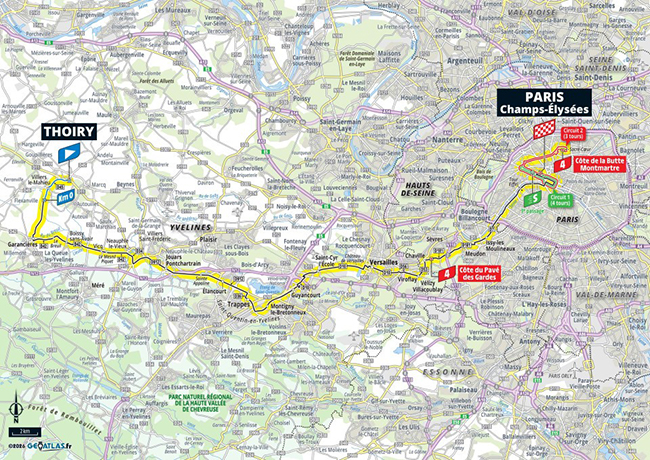
Stage 21 map
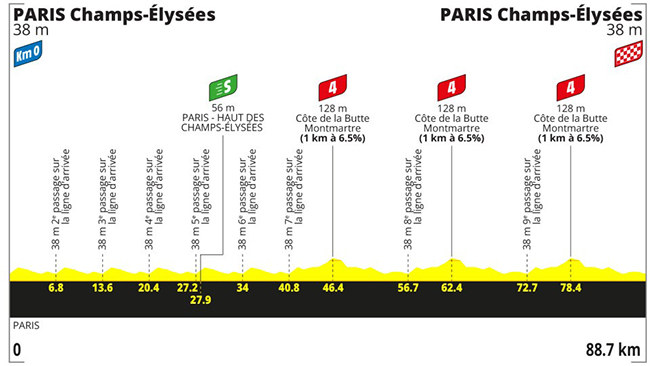
Stage 21 profile
Stage 21 photos by Fotoreporter Sirotti:
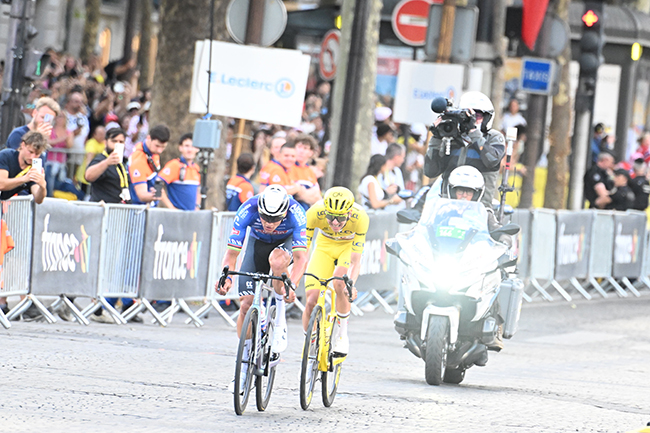
Late in the stage Mathieu van der Poel and Tadej Pogacar escaped for a short while.
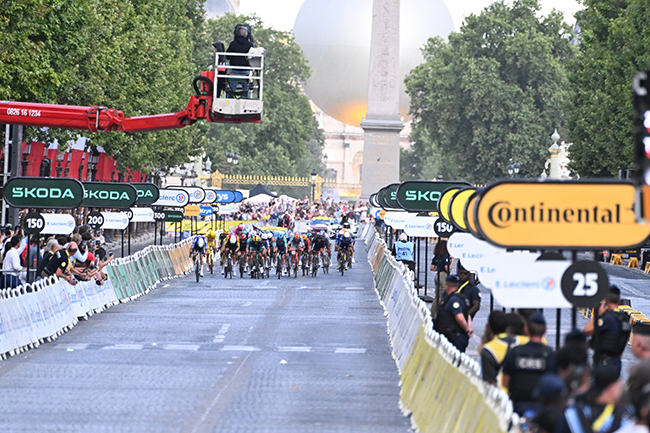
Here they come....
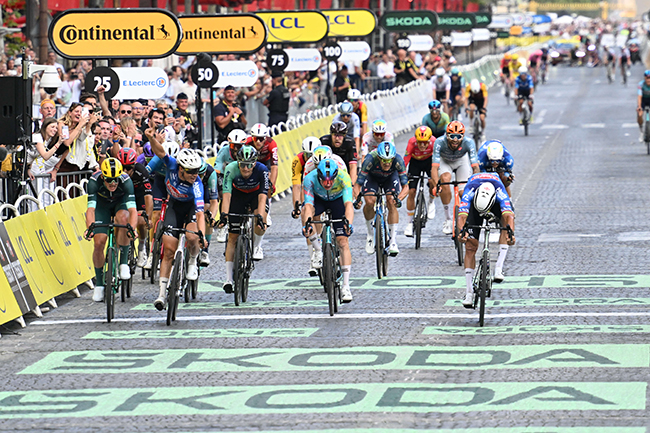
Mathieu van der Poel wins stage 21 with his teammate Jasper Philipsen 2nd.
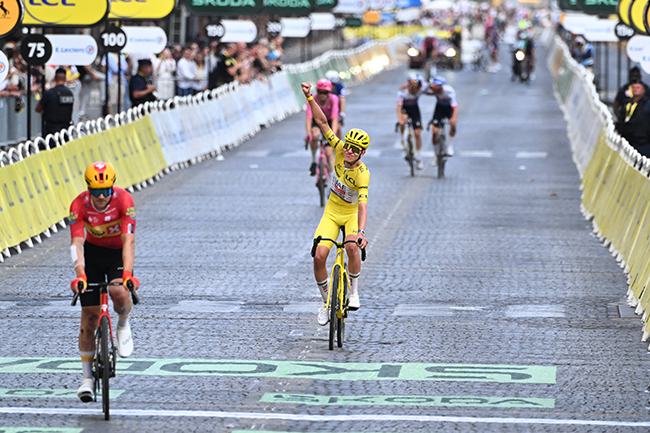
Tadej Pogacar finishes 30th in the stage to claim his fifth Tour de France.
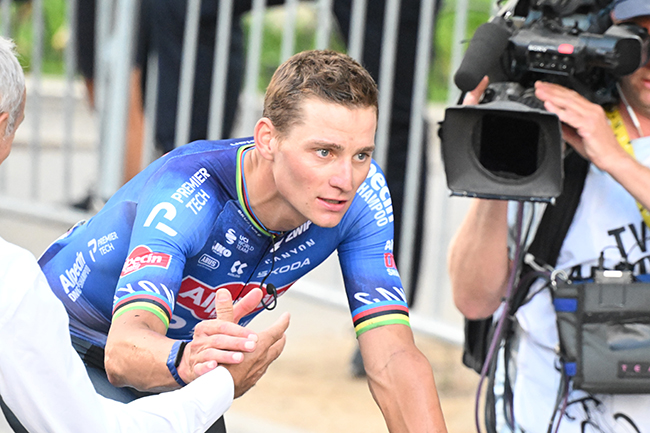
Stage winner Mathieu van der Poel just after finishing the stage.
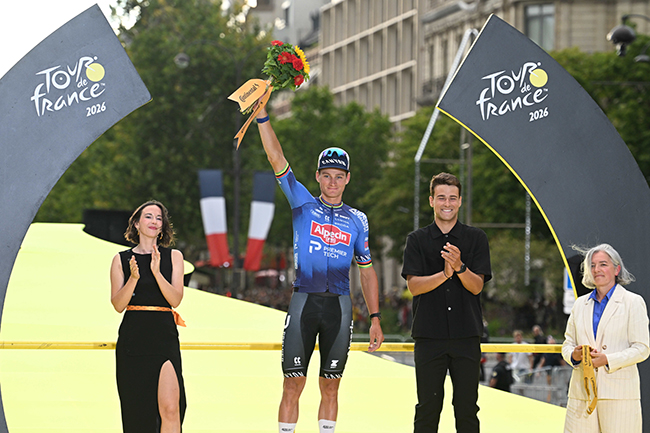
Stage winner Mathieu van der Poel
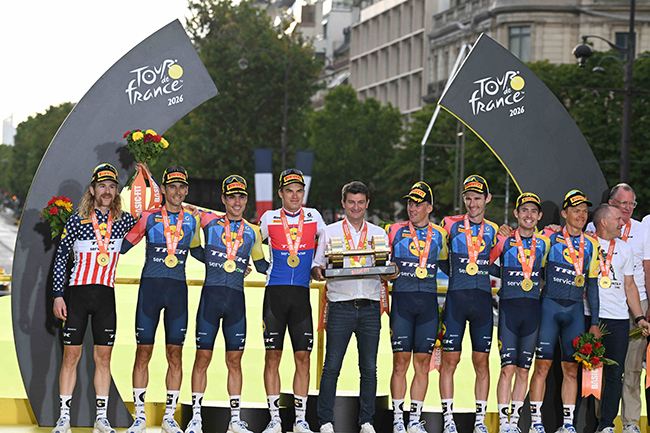
Teams classification winner Lidl-Trek
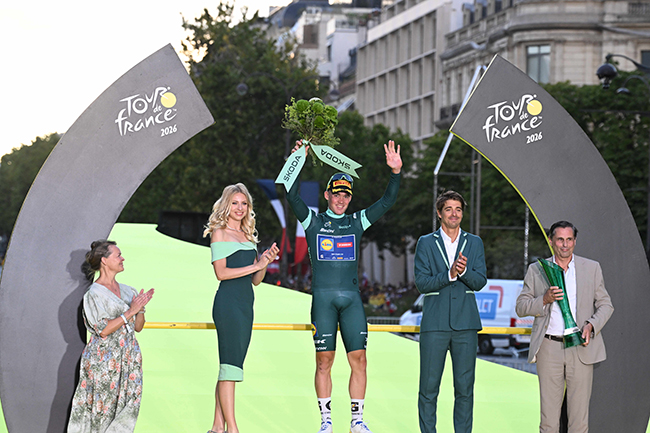
Points classification winner Mads Pedersen
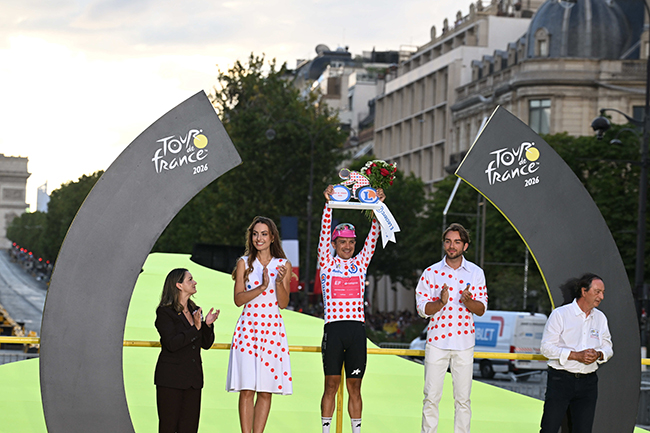
Richard Carapaz is King of the Mountains.
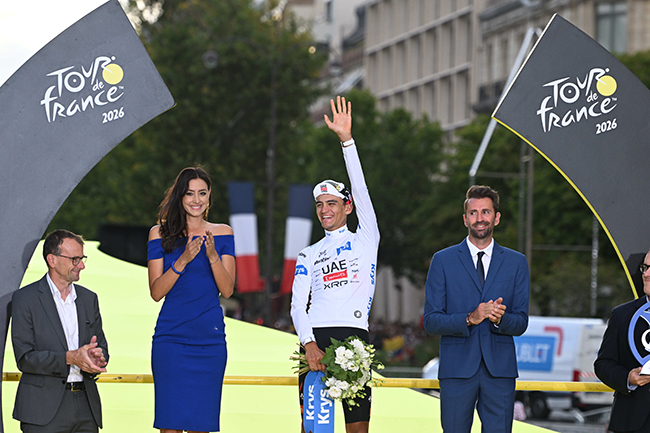
Best Young Rider Isaac del Toro
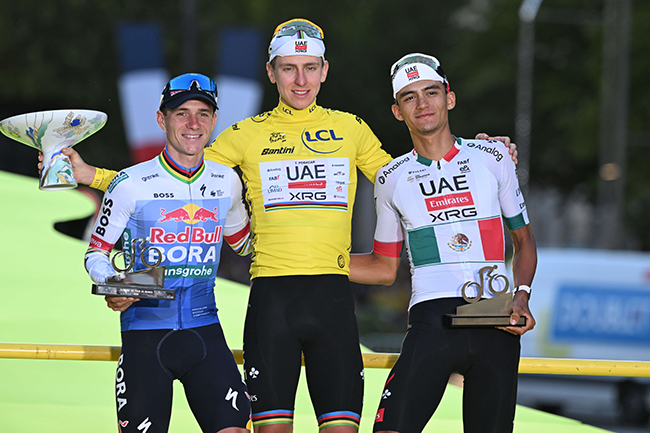
The final GC podium, from left: Remco Evenepoel (2nd), Tadej Pogacar (1st) & Isaac del Toro (3rd).
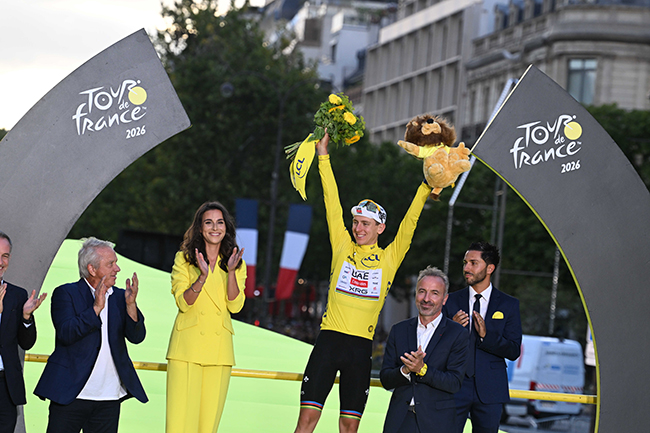
2026 Tour de France winner Tadej Pogacar. On the left is three-time (1986, 1989, 1990) Tour winner Greg LeMond. Lemond was honored on the 40th anniversary of his historic 1986 Tour win.
Saturday, July 25: Stage 20, Le Bourg d'Oisans - Alpe d'Huez, 170.9 km
Complete stage 20 results, stage story, photos, map & profiles
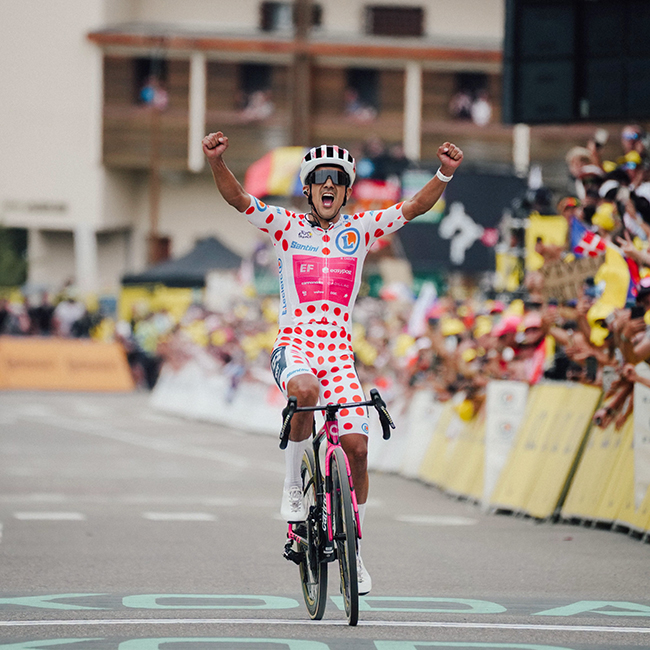
Richard Carapaz wins stage 20. Photo: Photo: ASO/Thomas Maheux
Results:
170.9 kilometers raced at an average speed of 34.220 km/hr
| 1 | Richard Carapaz | EF Education-EasyPost | 4hr 59min 39sec |
| 2 | Remco Evenepoel | Red Bull-BORA-hansgrohe | @ 26sec |
| 3 | Sepp Kuss | Team Visma | Lease a Bike | 0:31 |
| 4 | Tadej Pogacar | UAE Team Emirates-XRG | 1:05 |
| 5 | Isaac del Toro | UAE Team Emirates-XRG | s.t. |
| 6 | Lenny Martinez | Bahrain Victorious | 1:07 |
| 7 | Jai Hindley | Red Bull-BORA-hansgrohe | 2:15 |
| 8 | Mattias Skjelmose | Lidl-Trek | 2:55 |
| 9 | Juan Ayuso | Lidl-Trek | s.t. |
| 10 | Paul Seixas | Decathlon CMA CGM Team | s.t. |
GC after stage 20:
- GC leader: Tadej Pogacar (UAE Team Emirates-XRG)
- Mountains classification leader: Richard Carapaz (EF Education-EasyPost)
- Points classification leader: Mads Pedersen (Lidl-Trek)
- Best young rider: Isaac del Toro (UAE Team Emirates-XRG)
- Teams classification leader: Lidl-Trek
3,156.3 kilometers raced so far at an average speed of 43.299 km/hr
| 1 | Tadej Pogacar | UAE Team Emirates-XRG | 72hr 53min 22sec |
| 2 | Remco Evenepoel | Red Bull-BORA-hansgrohe | @ 6min 26sec |
| 3 | Isaac del Toro | UAE Team Emirates-XRG | 9:42 |
| 4 | Paul Seixas | Decathlon CMA CGM Team | 11:56 |
| 5 | Lenny Martinez | Bahrain Victorious | 13:02 |
| 6 | Mattias Skjelmose | Lidl-Trek | 14:59 |
| 7 | Juan Ayuso | Lidl-Trek | 17:48 |
| 8 | Richard Carapaz | EF Education-EasyPost | 20:00 |
| 9 | Tom Pidcock | Pinarello-Q36.5 Pro Cycling Team | 29:28 |
| 10 | Jordan Jegat | Team TotalEnergies | 33:21 |
Friday, July 24: Stage 19, Gap - Alpe d'Huez, 127.9 km
Complete stage 19 results, stage story, photos, map & profiles
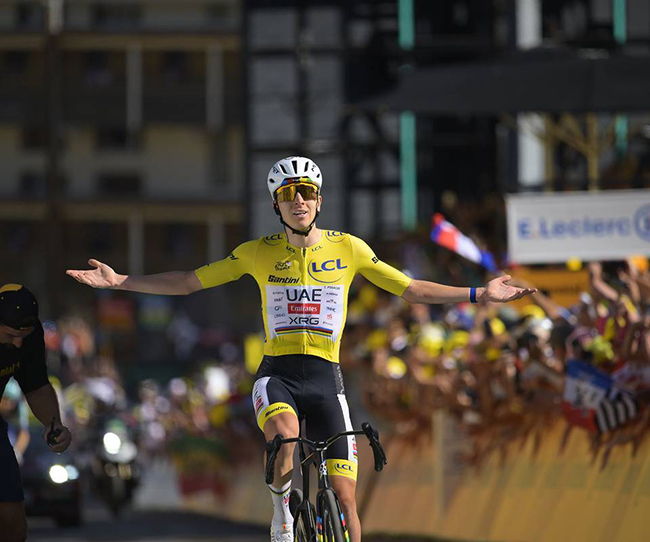
Tadej Pogacar takes a solo win atop Alpe d'Huez.
Results:
127.9 kilometers raced at an average speed of 38.767 km/hr
| 1 | Tadej Pogačar | UAE Team Emirates-XRG | 3hr 17min 57sec |
| 2 | Lenny Martinez | Bahrain-Victorious | @ 6sec |
| 3 | Richard Carapaz | EF Education-EasyPost | 0:09 |
| 4 | Sepp Kuss | Team Visma | Lease a Bike | 1:14 |
| 5 | Tobias Halland Johannessen | Uno-X Mobility | 2:07 |
| 6 | Remco Evenepoel | Red Bull-BORA-hansgrohe | 2:29 |
| 7 | Isaac del Toro | UAE Team Emirates-XRG | 2:41 |
| 8 | Paul Seixas | Lidl-Trek | 2:45 |
| 9 | Mattias Skjelmose | Decathlon CMA CGM Team | s.t. |
| 10 | Harold Tejada | XDS Astana Team | 3:22 |
GC after stage 19:
- GC leader: Tadej Pogacar (UAE Team Emirates-XRG)
- Mountains classification leader: Richard Carapaz (EF Education-EasyPost)
- Points classification leader: Mads Pedersen (Lidl-Trek)
- Best young rider: Isaac del Toro (UAE Team Emirates-XRG)
- Teams classification leader: Lidl-Trek
2,985.4 kilometers raced so far at an average speed of 43.978 km/hr
| 1 | Tadej Pogačar | UAE Team Emirates-XRG | 67hr 53min 0sec |
| 2 | Remco Evenepoel | Red Bull-BORA-hansgrohe | @ 7min 11sec |
| 3 | Isaac del Toro | UAE Team Emirates-XRG | 9:42 |
| 4 | Paul Seixas | Decathlon CMA CGM Team | 10:06 |
| 5 | Lenny Martinez | Bahrain-Victorious | 13:00 |
| 6 | Mattias Skjelmose | Lidl-Trek | 13:09 |
| 7 | Juan Ayuso | Lidl-Trek | 15:58 |
| 8 | Tom Pidcock | EF Education-EasyPost | 21:15 |
| 9 | Richard Carapaz | Pinarello Q36.5 Pro Cycling Team | 21:30 |
| 10 | Jordan Jegat | TotalEnergies | 23:21 |
Thursday, July 23: Stage 18, Voiron-Orcières-Merlette, 185.2 km
Stage 18 complete results, stage story, photos, map & profiles
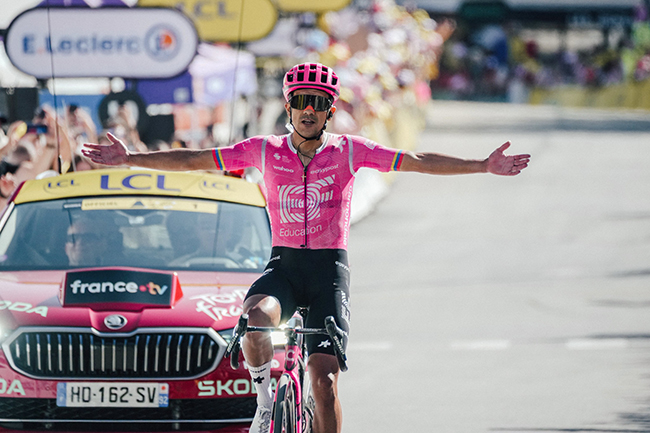
Richard Carapaz takes a solo stage win in Orcières-Merlette. Photo: ASO/Thomas Maheux
Results:
185.2 kilometers raced at an average speed of 41.720 km/hr
| 1 | Richard Carapaz | EF Education-EasyPost | 4hr 26min 21sec |
| 2 | Mauro Schmid | Team Jayco-AlUla | @ 45sec |
| 3 | Matteo Jorgenson | Team Visma | Lease a Bike | s.t. |
| 4 | Valentin Paret-Peintre | Soudal Quick-Step | 1:14 |
| 5 | Tobias Halland Johannessen | Uno-X Mobility | 1:57 |
| 6 | Raúl García | Movistar Team | 2:12 |
| 7 | Pablo Castrillo | Movistar Team | 4:30 |
| 8 | Lenny Martinez | Bahrain Victorious | 4:35 |
| 9 | Remco Evenepoel | Red Bull-BORA-hansgrohe | s.t. |
| 10 | Tom Pidcock | Pinarello-Q36.5 Pro Cycling Team | s.t. |
GC after stage 18:
- GC leader: Tadej Pogacar (UAE Team Emirates-XRG)
- Mountains classification leader: Tadej Pogacar (UAE Team Emirates-XRG)
- Points classification leader: Mads Pedersen (Lidl-Trek)
- Best young rider: Isaac del Toro (UAE Team Emirates-XRG)
- Teams classification leader: Lidl-Trek
2,857.5 kilometers raced so far at an average speed of 44.243 km/hr
| 1 | Tadej Pogacar | UAE Team Emirates-XRG | 64hr 35min 13sec |
| 2 | Remco Evenepoel | Red Bull-BORA-hansgrohe | @ 4min 32sec |
| 3 | Isaac del Toro | UAE Team Emirates-XRG | 6:51 |
| 4 | Paul Seixas | Decathlon CMA CGM Team | 7:11 |
| 5 | Juan Ayuso | Lidl-Trek | 9:22 |
| 6 | Mattias Skjelmose | Lidl-Trek | 10:14 |
| 7 | Lenny Martinez | Bahrain Victorious | 12:50 |
| 8 | Tom Pidcock | Pinarello-Q36.5 Pro Cycling Team | 12:58 |
| 9 | Jordan Jegat | Team TotalEnergies | 14:04 |
| 10 | Richard Carapaz | EF Education-EasyPost | 21:00 |
Wednesday, July 22: Stage 17, Chambéry-Voiron, 174.7 km
Complete stage 17 results, stage story, photos, map & profile
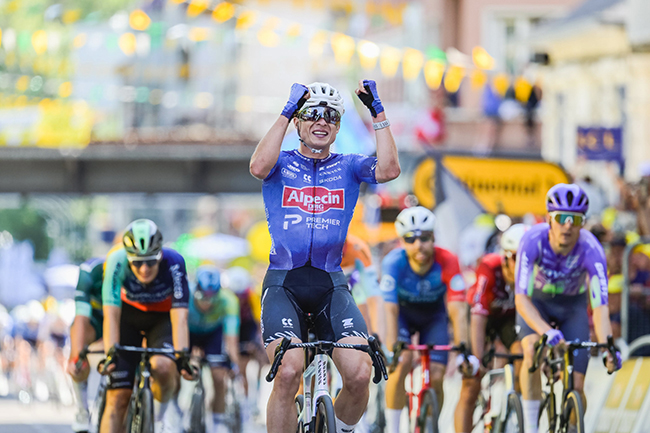
Jasper Philipsen wins stage seventeen. Photo: ASO/Charly Lopez
Results:
174.7 kilometers raced at an average speed of 47.383 km/hr
| 1 | Jasper Philipsen | Alpecin-Premier Tech | 3hr 41min 13sec |
| 2 | Mauro Schmid | Team Jayco-AlUla | s.t. |
| 3 | Olav Kooij | Decathlon CMA CGM Team | s.t. |
| 4 | Lewis Askey | NSN Cycling Team | s.t. |
| 5 | Rick Pluimers | Tudor Pro Cycling Team | s.t. |
| 6 | Clément Russo | Groupama-FDJ United | s.t. |
| 7 | Huub Artz | Lotto-Intermarché | s.t. |
| 8 | Mads Pedersen | Lidl-Trek | s.t. |
| 9 | Michael Matthews | Team Jayco-AlUla | s.t. |
| 10 | Aaron Gate | XDS Astana Team | s.t. |
GC after stage 17:
- GC leader: Tadej Pogacar (UAE Team Emirates-XRG)
- Mountains classification leader: Tadej Pogacar (UAE Team Emirates-XRG)
- Points classification leader: Mads Pedersen (Lidl-Trek)
- Best young rider: Isaac del Toro (UAE Team Emirates-XRG)
- Teams classification leader: Lidl-Trek
2,672.3 kilometers raced so far at an average speed of 44.485 km/hr
| 1 | Tadej Pogacar | UAE Team Emirates-XRG | 60hr 4min 17sec |
| 2 | Remco Evenepoel | Red Bull-BORA-hansgrohe | @ 4min 32sec |
| 3 | Isaac del Toro | UAE Team Emirates-XRG | 6:51 |
| 4 | Paul Seixas | Decathlon CMA CGM Team | 7:11 |
| 5 | Juan Ayuso | Lidl-Trek | 9:22 |
| 6 | Mattias Skjelmose | Lidl-Trek | 10:14 |
| 7 | Lenny Martinez | Bahrain Victorious | 12:50 |
| 8 | Tom Pidcock | Pinarello-Q36.5 Pro Cycling Team | 12:58 |
| 9 | Jordan Jegat | Team TotalEnergies | 14:04 |
| 10 | Yannis Voisard | Tudor Pro Cycling Team | 24:18 |
Tuesday, July 21: Stage 16, Évian-les-Bains -Thonon-les-Bains 26.1 km individual time trial
Complete stage 16 results, stage story, photos, map & profile
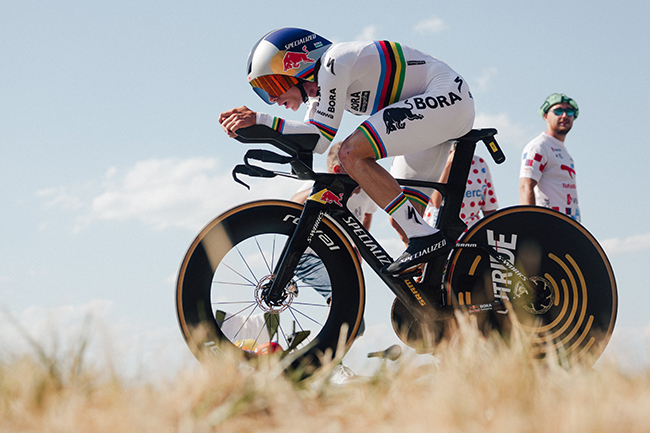
World time trial champion Remco Evenepoel on his way to winning the stage. ASO photo
Results:
26.1 kilometers raced at an average speed of 48.458 km/hr
| 1 | Remco Evenepoel | Red Bull-BORA-hansgrohe | 32min 19sec |
| 2 | Tadej Pogacar | UAE Team Emirates-XRG | @ 28sec |
| 3 | Mattias Skjelmose | Lidl-Trek | 1:04 |
| 4 | Paul Seixas | Decathlon CMA CGM Team | 1:16 |
| 5 | Isaac del Toro | UAE Team Emirates-XRG | 1:21 |
| 6 | Mattia Cattaneo | Red Bull-BORA-hansgrohe | 1:42 |
| 7 | Thymen Arensman | Netcompany INEOS Cycling Team | 1:47 |
| 8 | Bruno Armirail | Team Visma | Lease a Bike | 1:55 |
| 9 | Pablo Castrillo | Movistar Team | 2:00 |
| 10 | Joshua Tarling | Netcompany INEOS Cycling Team | 2:02 |
GC after stage 16:
- GC leader Tadej Pogacar (UAE Team Emirates-XRG)
- Mountains classification leader: Tadej Pogacar (UAE Team Emirates-XRG)
- Points classification leader: Mads Pedersen (Lidl-Trek)
- Best young rider: Isaac del Toro (UAE Team Emirates-XRG)
- Teams classification leader: Lidl-Trek
2,497.6 kilometers raced so far at an average speed of 44.411 km/hr
| 1 | Tadej Pogacar | UAE Team Emirates-XRG | 56hr 14min 18sec |
| 2 | Remco Evenepoel | Red Bull-BORA-hansgrohe | @ 4min 32sec |
| 3 | Isaac del Toro | UAE Team Emirates-XRG | 6:51 |
| 4 | Paul Seixas | Decathlon CMA CGM Team | 7:11 |
| 5 | Juan Ayuso | Lidl-Trek | 9:22 |
| 6 | Mattias Skjelmose | Lidl-Trek | 10:14 |
| 7 | Lenny Martinez | Bahrain Victorious | 12:50 |
| 8 | Tom Pidcock | Pinarello-Q36.5 Pro Cycling Team | 12:58 |
| 9 | Jordan Jegat | Team TotalEnergies | 22:50 |
| 10 | Yannis Voisard | Tudor Pro Cycling Team | 24:22 |
Monday, July 20: Rest Day Two, Haute Savoie region
Sunday, July 19: Stage 15, Champagnole-Plateau du Solaison, 183.9 km
Complete stage 15 results, stage story, photos, map & profile
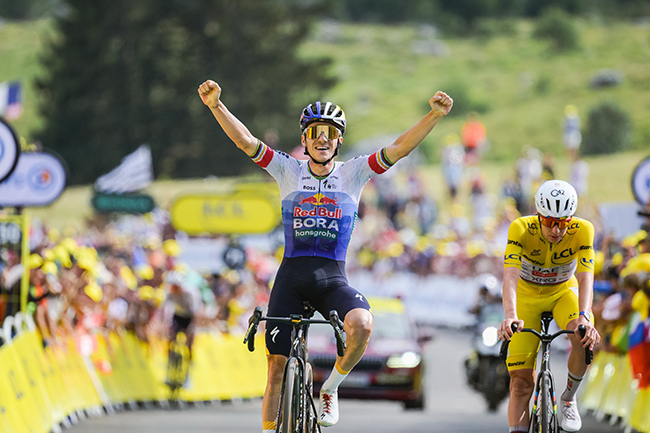
Remco Evenepoel beats Tadej Pogacar for the stage win.
Results:
183.9 kilometers raced at an average speed of 41.931 km/hr
| 1 | Remco Evenepoel | Red Bull-BORA-hansgrohe | 4hr 23min 9sec |
| 2 | Tadej Pogacar | UAE Team Emirates-XRG | s.t. |
| 3 | Isaac del Toro | UAE Team Emirates-XRG | @ 6sec |
| 4 | Paul Seixas | Decathlon CMA CGM Team | 0:58 |
| 5 | Florian Lipowitz | Red Bull-BORA-hansgrohe | s.t. |
| 6 | Lenny Martinez | Bahrain Victorious | 1:57 |
| 7 | Mattias Skjelmose | Lidl-Trek | s.t. |
| 8 | Juan Ayuso | Lidl-Trek | 2:00 |
| 9 | Adam Yates | UAE Team Emirates-XRG | s.t. |
| 10 | Quinn Simmons | Lidl-Trek | 2:16 |
GC after stage 15:
- GC leader: Tadej Pogacar (UAE Team Emirates-XRG)
- Mountains classification leader: Tadej Pogacar (UAE Team Emirates-XRG)
- Points classification leader: Mads Pedersen (Lidl-Trek)
- Best young rider: Isaac del Toro (UAE Team Emirates-XRG)
- Teams classification leader: Lidl-Trek
2,471.5 kilometers raced so far at an average speed of 44.378 km/hr
| 1 | Tadej Pogacar | UAE Team Emirates-XRG | 55hr 41min 31sec |
| 2 | Remco Evenepoel | Red Bull-BORA-hansgrohe | @ 5min 0sec |
| 3 | Isaac del Toro | UAE Team Emirates-XRG | 5:58 |
| 4 | Paul Seixas | Decathlon CMA CGM Team | 6:23 |
| 5 | Florian Lipowitz | Red Bull-BORA-hansgrohe | 6:48 |
| 6 | Juan Ayuso | Lidl-Trek | 7:28 |
| 7 | Mattias Skjelmose | Lidl-Trek | 9:38 |
| 8 | Lenny Martinez | Bahrain Victorious | 10:28 |
| 9 | Tom Pidcock | Pinarello-Q36.5 Pro Cycling Team | 10:59 |
| 10 | Jordan Jegat | Team TotalEnergies | 19:26 |
Content continues below the ads

Saturday, July 18: Stage 14, Mulhouse-Le Markstein Fellering, 155.3 km
Complete stage 14 results, stage story, photos, map & profile
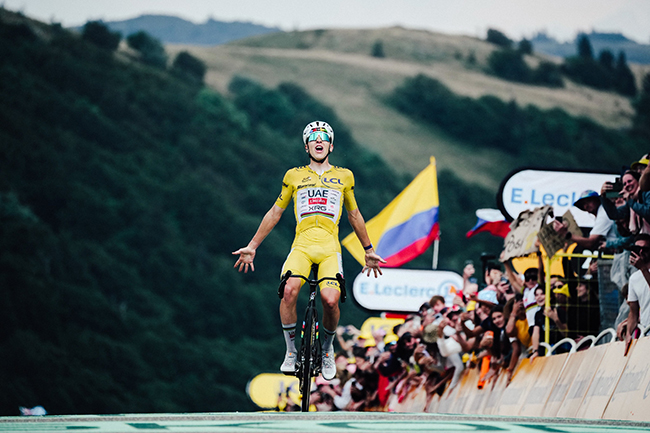
Again, Tadej Pogacar has left the best of the rest far behind. Photo: ASO/Thomas Maheux
Complete results:
155.3 kilometers raced at an average speed of 38.806 km/hr
| 1 | Tadej Pogacar | UAE Team Emirates-XRG | 4hr 0min 7sec |
| 2 | Isaac del Toro | UAE Team Emirates-XRG | @ 38sec |
| 3 | Paul Seixas | Decathlon CMA CGM Team | s.t. |
| 4 | Jonas Vingegaard | Team Visma | Lease a Bike | 0:44 |
| 5 | Remco Evenepoel | Red Bull-BORA-hansgrohe | 0:48 |
| 6 | Juan Ayuso | Lidl-Trek | 0:50 |
| 7 | Florian Lipowitz | Red Bull-BORA-hansgrohe | s.t. |
| 8 | Richard Carapaz | EF Education-EasyPost | 1:18 |
| 9 | Tobias Halland Johannessen | Uno-X Mobility | 1:40 |
| 10 | Mattias Skjelmose | Lidl-Trek | s.t. |
GC after stage 14:
- GC leader: Tadej Pogacar (UAE Team Emirates-XRG)
- Mountains classification leader: Tadej Pogacar (UAE Team Emirates-XRG)
- Points classification leader: Mads Pedersen (Lidl-Trek)
- Best young rider: Paul Seixas (Decathlon CMA CGM)
- Teams classification leader: Lidl-Trek
2,287.6 kilometers raced so far at an average speed of 44.586 km/hr
| 1 | Tadej Pogacar | UAE Team Emirates-XRG | 51hr 18min 28sec |
| 2 | Jonas Vingegaard | Team Visma | Lease a Bike | @ 4min 30sec |
| 3 | Remco Evenepoel | Red Bull-BORA-hansgrohe | 5:04 |
| 4 | Paul Seixas | Decathlon CMA CGM Team | 5:19 |
| 5 | Juan Ayuso | Lidl-Trek | 5:22 |
| 6 | Florian Lipowitz | Red Bull-BORA-hansgrohe | 5:44 |
| 7 | Isaac del Toro | UAE Team Emirates-XRG | 5:50 |
| 8 | Mattias Skjelmose | Lidl-Trek | 7:35 |
| 9 | Tom Pidcock | Pinarello-Q36.5 Pro Cycling Team | 7:59 |
| 10 | Lenny Martinez | Bahrain Victorious | 8:25 |
Friday, July 17: Stage 13, Dole-Belfort, 205.8 km
Complete stage 13 results, stage story, photos, map & profile
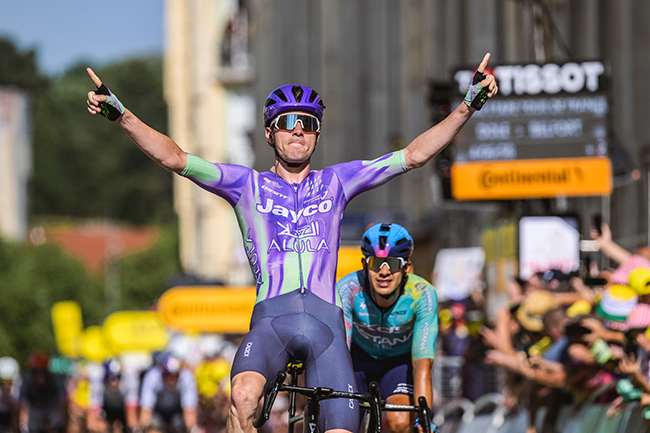
Mauro Schmid beats fellow breakaway rider Harold Tejada for the stage win.
Results:
205.8 kilometers raced at an average speed of 49.999 km/hr
| 1 | Mauro Schmid | Team Jayco-AlUla | 4hr 6min 58sec |
| 2 | Harold Tejada | XDS Astana Team | s.t. |
| 3 | Tom Pidcock | Pinarello-Q36.5 Pro Cycling Team | @ 2sec |
| 4 | Maxim Van Gils | Red Bull-BORA-hansgrohe | s.t. |
| 5 | Brandon McNulty | UAE Team Emirates-XRG | s.t. |
| 6 | Kévin Vauquelin | Netcompany INEOS Cycling Team | s.t. |
| 7 | Jordan Jegat | Team TotalEnergies | s.t. |
| 8 | Clément Braz Afonso | Groupama-FDJ United | s.t. |
| 9 | Tim Wellens | UAE Team Emirates-XRG | s.t. |
| 10 | Luke Plapp | Team Jayco-AlUla | 0:11 |
GC after stage 13:
- GC leader: Tadej Pogacar (UAE Team Emirates-XRG)
- Mountains classification leader: Tadej Pogacar (UAE Team Emirates-XRG)
- Points classification leader: Mads Pedersen (Lidl-Trek)
- Best young rider: Juan Ayuso (Lidl-Trek)
- Teams classification leader: Lidl-Trek
2,132.3 kilometers raced so far at an average speed of 45.072 km/hr
| 1 | Tadej Pogacar | UAE Team Emirates-XRG | 47hr 18min 31sec |
| 2 | Jonas Vingegaard | Team Visma | Lease a Bike | @ 3min 36sec |
| 3 | Remco Evenepoel | Red Bull-BORA-hansgrohe | 4:06 |
| 4 | Tom Pidcock | Pinarello-Q36.5 Pro Cycling Team | 4:19 |
| 5 | Juan Ayuso | Lidl-Trek | 4:22 |
| 6 | Paul Seixas | Decathlon CMA CGM Team | 4:35 |
| 7 | Florian Lipowitz | Red Bull-BORA-hansgrohe | 4:44 |
| 8 | Isaac del Toro | UAE Team Emirates-XRG | 5:08 |
| 9 | Mattias Skjelmose | Lidl-Trek | 5:45 |
| 10 | Lenny Martinez | Bahrain Victorious | 6:34 |
Thursday, July 16: Stage 12, Circuit Nevers Magny-Cours-Chalon-sur-Saône, 179.1 km
Complete stage 12 results, stage story, photos, map & profile
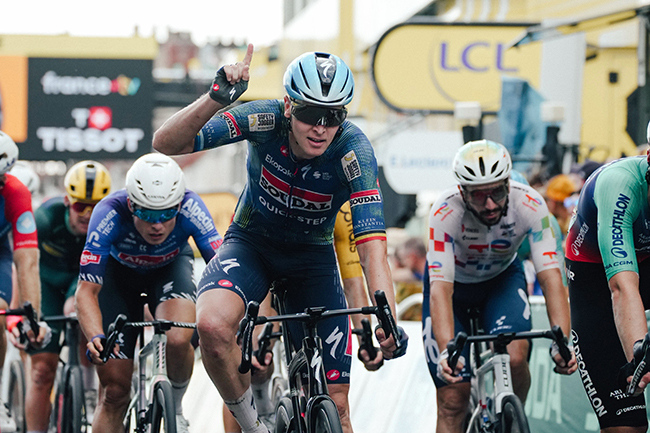
Tim Merlier wins stage twelve, his third stage win this Tour. Photo: ASO/Thomas Maheux
Results:
179.1 kilometers raced at an average speed of 49.095 km/hr
| 1 | Tim Merlier | Soudal Quick-Step | 3hr 38min 53sec |
| 2 | Olav Kooij | Decathlon CMA CGM Team | s.t. |
| 3 | Jasper Philipsen | Alpecin-Premier Tech | s.t. |
| 4 | Biniam Girmay | NSN Cycling Team | s.t. |
| 5 | Milan Fretin | Cofidis | s.t. |
| 6 | Anthony Turgis | Team TotalEnergies | s.t. |
| 7 | Max Kanter | XDS Astana Team | s.t. |
| 8 | Clément Russo | Groupama-FDJ United | s.t. |
| 9 | Mads Pedersen | Lidl-Trek | s.t. |
| 10 | Huub Artz | Lotto-Intermarché | s.t. |
GC after stage 12:
- GC leader: Tadej Pogacar (UAE Team Emirates-XRG)
- Mountains classification leader: Tadej Pogacar (UAE Team Emirates-XRG)
- Points classification leader: Mads Pedersen (Lidl-Trek)
- Best young rider: Juan Ayuso (Lidl-Trek)
- Teams classification leader: Lidl-Trek
1,926.5 kilometers raced so far at an average speed of 44.733 km/hr
| 1 | Tadej Pogacar | UAE Team Emirates-XRG | 43hr 4min 1sec |
| 2 | Jonas Vingegaard | Team Visma | Lease a Bike | @ 3min 36sec |
| 3 | Remco Evenepoel | Red Bull-BORA-hansgrohe | 4:06 |
| 4 | Juan Ayuso | Lidl-Trek | 4:22 |
| 5 | Paul Seixas | Decathlon CMA CGM Team | 4:35 |
| 6 | Florian Lipowitz | Red Bull-BORA-hansgrohe | 4:44 |
| 7 | Isaac del Toro | UAE Team Emirates-XRG | 5:08 |
| 8 | Mattias Skjelmose | Lidl-Trek | 5:45 |
| 9 | Lenny Martinez | Bahrain Victorious | 6:34 |
| 10 | Tom Pidcock | Pinarello-Q36.5 Pro Cycling Team | 11:49 |
Wednesday, July 15: Stage 11, Vichy-Nevers, 161.3 km
Stage 11 complete results, stage story, photos, map & profile
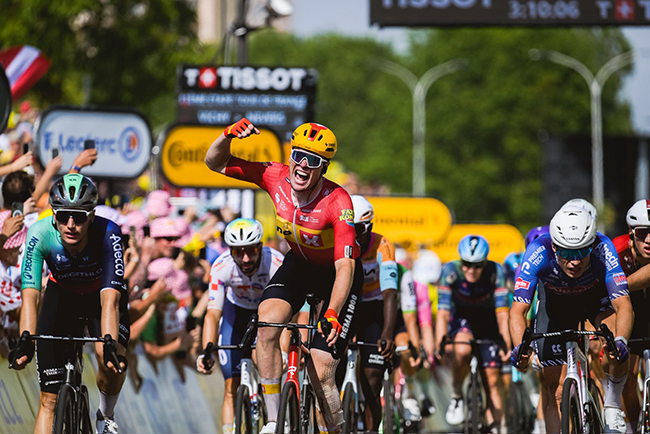
Soren Wærenskjold wins stage 11.
Results:
161.3 kilometers raced at an average speed of 50.910 km/hr (31.63 mph). Fastest stage in Tour history!
| 1 | Søren Wærenskjold | Uno-X Mobility | 3hr 10min 6sec |
| 2 | Olav Kooij | Decathlon CMA CGM Team | s.t. |
| 3 | Jasper Philipsen | Alpecin-Premier Tech | s.t. |
| 4 | Milan Fretin | Cofidis | s.t. |
| 5 | Huub Artz | Lotto-Intermarché | s.t. |
| 6 | Biniam Girmay | NSN Cycling Team | s.t. |
| 7 | Anthony Turgis | Team TotalEnergies | s.t. |
| 8 | Clément Russo | Groupama-FDJ United | s.t. |
| 9 | Fernando Gaviria | Caja Rural-Seguros RGA | s.t. |
| 10 | Pascal Ackermann | Team Jayco-AlUla | s.t. |
GC after stage 11:
- GC leader: Tadej Pogacar (UAE Team Emirates-XRG)
- Mountains classification leader: Tadej Pogacar (UAE Team Emirates-XRG)
- Points classification leader: Mads Pedersen (Lidl-Trek)
- Best young rider: Juan Ayuso (Lidl-Trek)
- Teams classification leader: Lidl-Trek
1,747.4 kilometers raced so far at an average speed of 44.329 km/hr
| 1 | Tadej Pogacar | UAE Team Emirates-XRG | 39hr 25min 8sec |
| 2 | Jonas Vingegaard | Team Visma | Lease a Bike | @ 3min 36sec |
| 3 | Remco Evenepoel | Red Bull-BORA-hansgrohe | 4:06 |
| 4 | Juan Ayuso | Lidl-Trek | 4:22 |
| 5 | Paul Seixas | Decathlon CMA CGM Team | 4:35 |
| 6 | Florian Lipowitz | Red Bull-BORA-hansgrohe | 4:44 |
| 7 | Isaac del Toro | UAE Team Emirates-XRG | 5:08 |
| 8 | Mattias Skjelmose | Lidl-Trek | 5:45 |
| 9 | Lenny Martinez | Bahrain Victorious | 6:34 |
Tuesday, July 14: Stage 10, Aurillac-Le Lioran, 166.6 km
Stage 10 complete results, stage story, photos, map & profile
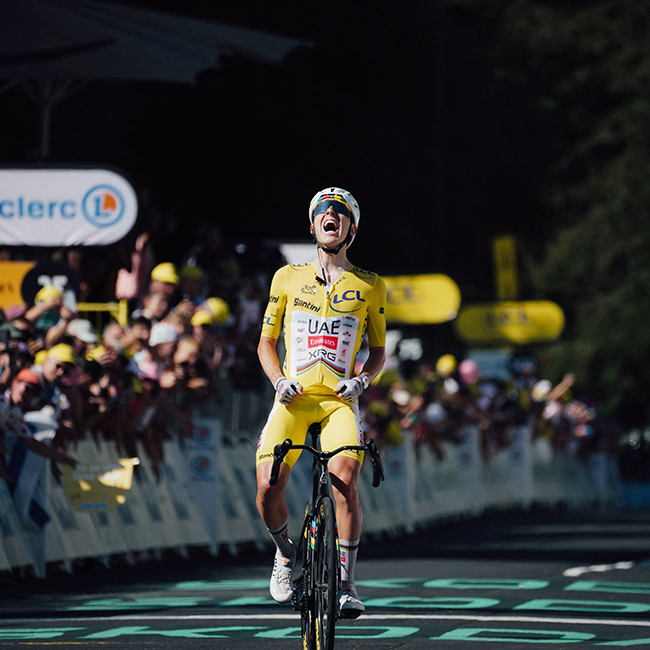
Tadej Pogacar wins stage ten.
Results:
166.6 kilometers raced at an average speed of 41.976 km/hr
| 1 | Tadej Pogacar | UAE Team Emirates-XRG | 3hr 58min 8sec |
| 2 | Remco Evenepoel | Red Bull-BORA-hansgrohe | @ 32sec |
| 3 | Paul Seixas | Decathlon CMA CGM Team | 0:34 |
| 4 | Florian Lipowitz | Red Bull-BORA-hansgrohe | s.t. |
| 5 | Juan Ayuso | Lidl-Trek | 0:38 |
| 6 | Mattias Skjelmose | Lidl-Trek | s.t. |
| 7 | Jonas Vingegaard | Team Visma | Lease a Bike | 0:44 |
| 8 | Isaac del Toro | UAE Team Emirates-XRG | 1:31 |
| 9 | Tom Pidcock | Pinarello-Q36.5 Pro Cycling Team | 1:59 |
| 10 | Lenny Martinez | Bahrain Victorious | 2:03 |
GC after stage 10:
- GC leader: Tadej Pogacar (UAE Team Emirates-XRG)
- Mountains classification leader: Tadej Pogacar (UAE Team Emirates-XRG)
- Points classification leader: Mads Pedersen (Lidl-Trek)
- Best young rider: Juan Ayuso (Lidl-Trek)
- Teams classification leader: Lidl-Trek
1,586.1 kilometers raced so far at an average speed of 43.754 km/hr
| 1 | Tadej Pogacar | UAE Team Emirates-XRG | 36hr 15min 2sec |
| 2 | Jonas Vingegaard | Team Visma | Lease a Bike | @ 3min 36sec |
| 3 | Remco Evenepoel | Red Bull-BORA-hansgrohe | 4:06 |
| 4 | Juan Ayuso | Lidl-Trek | 4:22 |
| 5 | Paul Seixas | Decathlon CMA CGM Team | 4:35 |
| 6 | Florian Lipowitz | Red Bull-BORA-hansgrohe | 4:44 |
| 7 | Isaac del Toro | UAE Team Emirates-XRG | 5:08 |
| 8 | Mattias Skjelmose | Lidl-Trek | 5:45 |
| 9 | Lenny Martinez | Bahrain Victorious | 6:34 |
| 10 | Tom Pidcock | Pinarello-Q36.5 Pro Cycling Team | 11:49 |
Monday, July 13: Rest Day 1
Sunday, July 12: Stage 9, Malemort-Ussel, 185.5 154.6 km
Complete stage 9 results, stage story, photos, map & profile
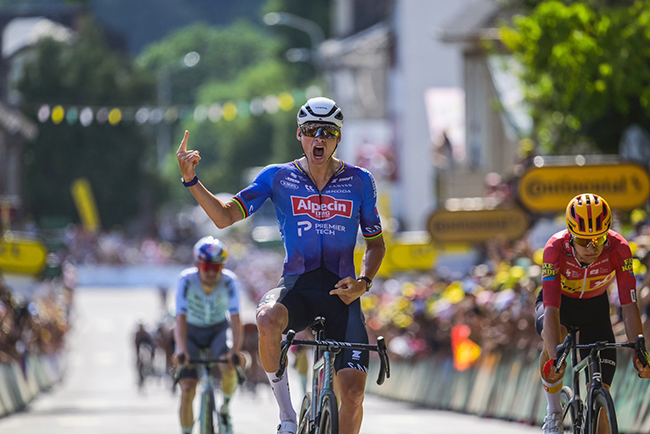
Mathieu van der Poel wins stage nine.
Results:
154.6 kilometers raced at an average speed of 44.268 km/hr
| 1 | Mathieu van der Poel | Alpecin-Premier Tech | 3hr 27min 51sec |
| 2 | Tobias Halland Johannessen | Uno-X Mobility | s.t. |
| 3 | Tom Pidcock | Pinarello-Q36.5 Pro Cycling Team | s.t. |
| 4 | Alex Baudin | EF Education-EasyPost | s.t. |
| 5 | Filippo Ganna | Netcompany INEOS Cycling Team | @ 6sec |
| 6 | Mads Pedersen | Lidl-Trek | s.t. |
| 7 | Michael Matthews | Team Jayco-AlUla | s.t. |
| 8 | Nicolas Breuillard | Team TotalEnergies | s.t. |
| 9 | Jordan Jegat | Team TotalEnergies | s.t. |
| 10 | Sean Quinn | EF Education-EasyPost | s.t. |
GC after stage 9:
- GC leader: Tadej Pogacar (UAE Team Emirates-XRG)
- Mountains classification leader: Tadej Pogacar (UAE Team Emirates-XRG)
- Points classification leader: Mads Pedersen (Lidl-Trek)
- Best young rider: Isaac del Toro (UAE Team Emirates-XRG)
- Teams classification leader: Lidl-Trek
1,420.5 kilometers raced so far at an average speed of 44.000 km/hr
| 1 | Tadej Pogacar | UAE Team Emirates-XRG | 32hr 17min 4sec |
| 2 | Jonas Vingegaard | Team Visma | Lease a Bike | @ 2min 42sec |
| 3 | Isaac del Toro | UAE Team Emirates-XRG | 3:27 |
| 4 | Remco Evenepoel | Red Bull-BORA-hansgrohe | 3:30 |
| 5 | Juan Ayuso | Lidl-Trek | 3:34 |
| 6 | Paul Seixas | Decathlon CMA CGM Team | 3:55 |
| 7 | Florian Lipowitz | Red Bull-BORA-hansgrohe | 4:00 |
| 8 | Lenny Martinez | Bahrain Victorious | 4:21 |
| 9 | Mattias Skjelmose | Lidl-Trek | 4:57 |
| 10 | Egan Bernal | Netcompany INEOS Cycling Team | 9:12 |
Saturday, July 11: Stage 8, Périgueux-Bergerac, 180.4 km
Complete stage 8 results, stage story, photos, map & profile
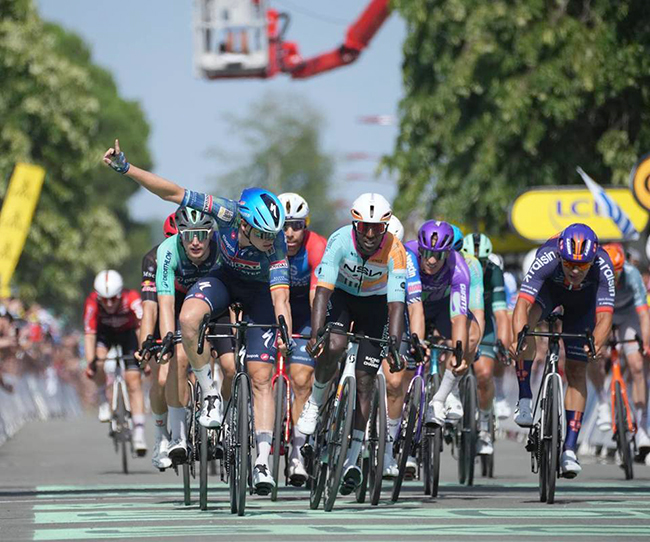
Tim Merlier beats Biniam Girmay for the stage win.
Results:
180.4 kilometers raced at an average speed of 46.488 km/hr.
| 1 | Tim Merlier | Soudal Quick-Step | 3hr 52min 50sec |
| 2 | Biniam Girmay | NSN Cycling Team | s.t. |
| 3 | Olav Kooij | Decathlon CMA CGM Team | s.t. |
| 4 | Jasper Philipsen | Alpecin-Premier Tech | s.t. |
| 5 | Pavel Bittner | Team Picnic PostNL | s.t. |
| 6 | Rick Pluimers | Tudor Pro Cycling Team | s.t. |
| 7 | Pascal Ackermann | Team Jayco-AlUla | s.t. |
| 8 | Clément Russo | Groupama-FDJ United | s.t. |
| 9 | Max Kanter | XDS Astana Team | s.t. |
| 10 | Milan Fretin | Cofidis | s.t. |
GC after stage 8:
- GC leader: Tadej Pogacar (UAE Team Emirates-XRG)
- Mountains classification leader: Tadej Pogacar (UAE Team Emirates-XRG)
- Points classification leader: Mads Pedersen (Lidl-Trek)
- Best young rider: Isaac del Toro (UAE Team Emirates-XRG)
- Teams classification leader: Lidl-Trek
1265.9 kilometers raced so far at an average speed of 43.927 km/hr
| 1 | Tadej Pogacar | UAE Team Emirates-XRG | 28hr 49min 7sec |
| 2 | Jonas Vingegaard | Team Visma | Lease a Bike | @ 2min 42sec |
| 3 | Isaac del Toro | UAE Team Emirates-XRG | 3:27 |
| 4 | Remco Evenepoel | Red Bull-BORA-hansgrohe | 3:30 |
| 5 | Juan Ayuso | Lidl-Trek | 3:34 |
| 6 | Paul Seixas | Decathlon CMA CGM Team | 3:55 |
| 7 | Florian Lipowitz | Red Bull-BORA-hansgrohe | 4:00 |
| 8 | Lenny Martinez | Bahrain Victorious | 4:21 |
| 9 | Mattias Skjelmose | Lidl-Trek | 4:57 |
| 10 | Mathias Vacek | Lidl-Trek | 7:10 |
Friday, July 10: Stage 7, Hagetmau-Bordeaux, 175.1 km
Complete stage 7 results, stage story, photos, map & profile
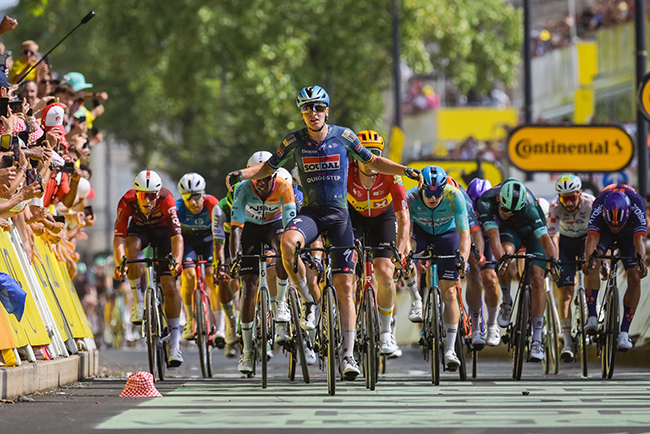
Tim Merlier wins stage seven. Photo: ASO/Charly Lopez
Results:
175.1 kilometers raced at an average speed of 46.832 km/hr
| 1 | Tim Merlier | Soudal Quick-Step | 3hr 44min 20sec |
| 2 | Søren Wærenskjold | Uno-X Mobility | s.t. |
| 3 | Biniam Girmay | NSN Cycling Team | s.t. |
| 4 | Max Kanter | XDS Astana Team | s.t. |
| 5 | Jasper Philipsen | Alpecin-Premier Tech | s.t. |
| 6 | Phil Bauhaus | Bahrain Victorious | s.t. |
| 7 | Huub Artz | Lotto-Intermarché | s.t. |
| 8 | Dorian Godon | Netcompany INEOS Cycling Team | s.t. |
| 9 | Mads Pedersen | Lidl-Trek | s.t. |
| 10 | Tom Van Asbroeck | NSN Cycling Team | s.t. |
GC after stage 7:
- GC leader: Tadej Pogacar (UAE Team Emirates-XRG)
- Mountains classification leader: Tadej Pogacar (UAE Team Emirates-XRG)
- Points classification leader: Mads Pedersen (Lidl-trek)
- Best young rider: Isaac del Toro (UAE Team Emirates-XRG)
- Teams classificaion leader: Lidl-Trek
1,085.5 kilometers raced so far at an average speed of 43.528 km/hr
| 1 | Tadej Pogacar | UAE Team Emirates-XRG | 24hr 56min 17sec |
| 2 | Jonas Vingegaard | Team Visma | Lease a Bike | @ 2min 42sec |
| 3 | Isaac del Toro | UAE Team Emirates-XRG | 3:27 |
| 4 | Remco Evenepoel | Red Bull-BORA-hansgrohe | 3:30 |
| 5 | Juan Ayuso | Lidl-Trek | 3:34 |
| 6 | Paul Seixas | Decathlon CMA CGM Team | 3:55 |
| 7 | Florian Lipowitz | Red Bull-BORA-hansgrohe | 4:00 |
| 8 | Lenny Martinez | Bahrain Victorious | 4:21 |
| 9 | Mattias Skjelmose | Lidl-Trek | 4:57 |
| 10 | Mathias Vacek | Lidl-Trek | 7:10 |
Thursday, July 9: Stage 6, Pau-Gavarnie-Gèdre, 186.2 km
Complete stage 6 results, stage story, photos, map & profiles
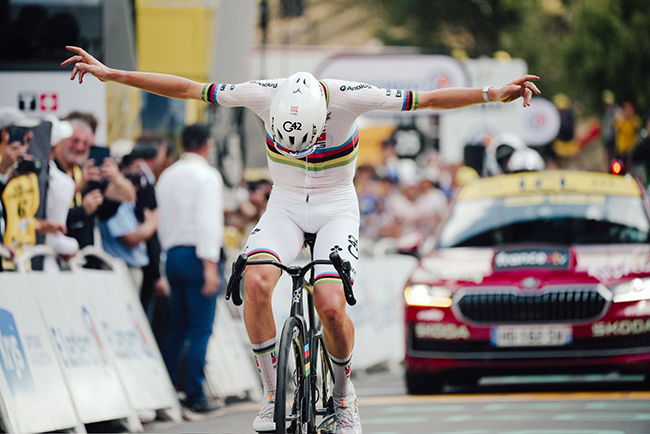
Tadej Pogacar wins stage six.
Results:
186.2 kilometers raced at an average speed of 41.056 km/hr
| 1 | Tadej Pogacar | UAE Team Emirates-XRG | 4hr 32min 7sec |
| 2 | Jonas Vingegaard | Team Visma | Lease a Bike | @ 2min 38sec |
| 3 | Isaac del Toro | UAE Team Emirates-XRG | 2:57 |
| 4 | Remco Evenepoel | Red Bull-BORA-hansgrohe | s.t. |
| 5 | Paul Seixas | Decathlon CMA CGM Team | s.t. |
| 6 | Florian Lipowitz | Red Bull-BORA-hansgrohe | s.t. |
| 7 | Juan Ayuso | Lidl-Trek | s.t. |
| 8 | Mattias Skjelmose | Lidl-Trek | s.t. |
| 9 | Lenny Martinez | Bahrain Victorious | 3:02 |
| 10 | Sepp Kuss | Team Visma | Lease a Bike | 3:06 |
GC after stage 6:
- GC leader: Tadej Pogacar (UAE Team Emirates-XRG)
- Mountains classification leader: Tadej Pogacar (UAE Team Emirates-XRG)
- Points classification leader: Mads Pedersen (Lidl-Trek)
- Best young rider: Isaac del Toro (UAE Team Emirates-XRG)
- Teams classification leader: Lidl-Trek
910.4 kilometers raced so far at an average speed of 42.945 km/hr
| 1 | Tadej Pogacar | UAE Team Emirates-XRG | 21hr 11min 57sec |
| 2 | Jonas Vingegaard | Team Visma | Lease a Bike | @ 2min 42sec |
| 3 | Isaac del Toro | UAE Team Emirates-XRG | 3:27 |
| 4 | Remco Evenepoel | Red Bull-BORA-hansgrohe | 3:30 |
| 5 | Juan Ayuso | Lidl-Trek | 3:34 |
| 6 | Paul Seixas | Decathlon CMA CGM Team | 3:55 |
| 7 | Florian Lipowitz | Red Bull-BORA-hansgrohe | 4:00 |
| 8 | Lenny Martinez | Bahrain Victorious | 4:21 |
| 9 | Mattias Skjelmose | Lidl-Trek | 4:57 |
| 10 | Mathias Vacek | Lidl-Trek | 7:10 |
Wednesday, July 8: Stage 5, Lannemezan-Pau, 158.3 km
Complete stage 5 results, stage story, photos, map & profile
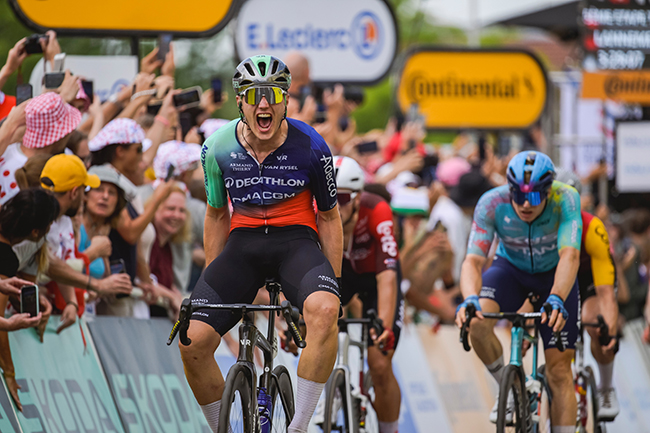
A very happy Olav Kooij wins stage five.
Results:
158.3 kilometers raced at an average speed of 45.420 km/hr
| 1 | Olav Kooij | Decathlon CMA CGM Team | 3hr 29min 7sec |
| 2 | Max Kanter | XDS Astana Team | s.t. |
| 3 | Tim Merlier | Soudal Quick-Step | s.t. |
| 4 | Huub Artz | Lotto-Intermarché | s.t. |
| 5 | Jasper Philipsen | Alpecin-Premier Tech | s.t. |
| 6 | Biniam Girmay | NSN Cycling Team | s.t. |
| 7 | Mads Pedersen | Lidl-Trek | s.t. |
| 8 | Milan Fretin | Cofidis | s.t. |
| 9 | Anthony Turgis | Team TotalEnergies | s.t. |
| 10 | Søren Wærenskjold | Uno-X Mobility | s.t. |
GC after stage 5:
- GC leader: Torstein Træen (Uno-X Mobility)
- Mountains classification leader: Alex Baudin (EF Education-EasyPost)
- Points classification leader: Mads Pedersen (Lidl-Trek)
- Best young rider: Mathias Vacek (Lidl-Trek)
- Teams classification leader: Lidl-Trek
724.2 kilometers raced so far at an average speed of 43.797 km/hr
| 1 | Torstein Træen | Uno-X Mobility | 16hr 32min 7sec |
| 2 | Sean Quinn | EF Education-EasyPost | @ 28sec |
| 3 | Mathias Vacek | Lidl-Trek | 3:50 |
| 4 | Tadej Pogacar | UAE Team Emirates-XRG | 7:53 |
| 5 | Jonas Vingegaard | Team Visma | Lease a Bike | s.t. |
| 6 | Ramses Debruyne | Alpecin-Premier Tech | 8:06 |
| 7 | Remco Evenepoel | Red Bull-BORA-hansgrohe | 8:16 |
| 8 | Isaac del Toro | UAE Team Emirates-XRG | 8:17 |
| 9 | Juan Ayuso | Lidl-Trek | 8:20 |
| 10 | Paul Seixas | Decathlon CMA CGM Team | 8:41 |
Content continues below the ads
Tuesday, July 7: Stage 4, Carcassonne-Foix, 181.9 km
Complete stage 4 results, stage story, photos, map & profile
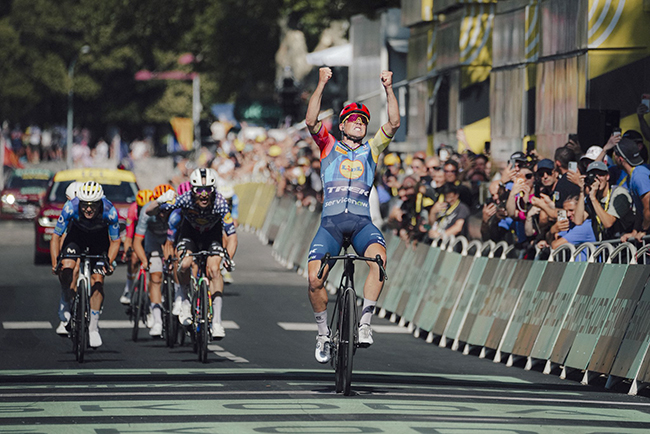
Mads Pedersen wins stage four.
Results:
181.9 kilometers raced at an average speed of 43.525 km/hr
| 1 | Mads Pedersen | Lidl-Trek | 4hr 10min 45sec |
| 2 | Quinn Simmons | Lidl-Trek | s.t. |
| 3 | Raúl García | Movistar Team | s.t. |
| 4 | Marco Frigo | NSN Cycling Team | s.t. |
| 5 | Ramses Debruyne | Alpecin-Premier Tech | s.t. |
| 6 | Kévin Vauquelin | Netcompany INEOS Cycling Team | s.t. |
| 7 | Sean Quinn | EF Education-EasyPost | s.t. |
| 8 | Torstein Træen | Uno-X Mobility | s.t. |
| 9 | Pablo Castrillo | Movistar Team | s.t. |
| 10 | Mathias Vacek | Lidl-Trek | s.t. |
GC after stage 4:
- GC leader: Torstein Træen (Uno-X Mobility)
- Mountains classification leader: Alex Baudin (EF Education-EasyPost)
- Points classification leader: Mads Pedersen (Lidl-Trek)
- Best young rider: Mathias Vacek (Lidl-Trek)
- Teams classification leader: Lidl-Trek
565.9 kilometers raced so far at an average speed of 43.377 km/hr
| 1 | Torstein Træen | Uno-X Mobility | 13hr 2min 46sec |
| 2 | Sean Quinn | EF Education-EasyPost | @ 28sec |
| 3 | Mathias Vacek | Lidl-Trek | 3:50 |
| 4 | Tadej Pogacar | UAE Team Emirates-XRG | 7:53 |
| 5 | Jonas Vingegaard | Team Visma | Lease a Bike | 7:53 |
| 6 | Ramses Debruyne | Alpecin-Premier Tech | 8:06 |
| 7 | Remco Evenepoel | Red Bull-BORA-hansgrohe | 8:16 |
| 8 | Isaac del Toro | UAE Team Emirates-XRG | 8:17 |
| 9 | Juan Ayuso | Lidl-Trek | 8:20 |
| 10 | Paul Seixas | Decathlon CMA CGM Team | 8:41 |
Monday, July 6: Stage 3, Granollers-Les Angles, 195.9 km
Complete stage 3 results, stage story, photos, map & profile
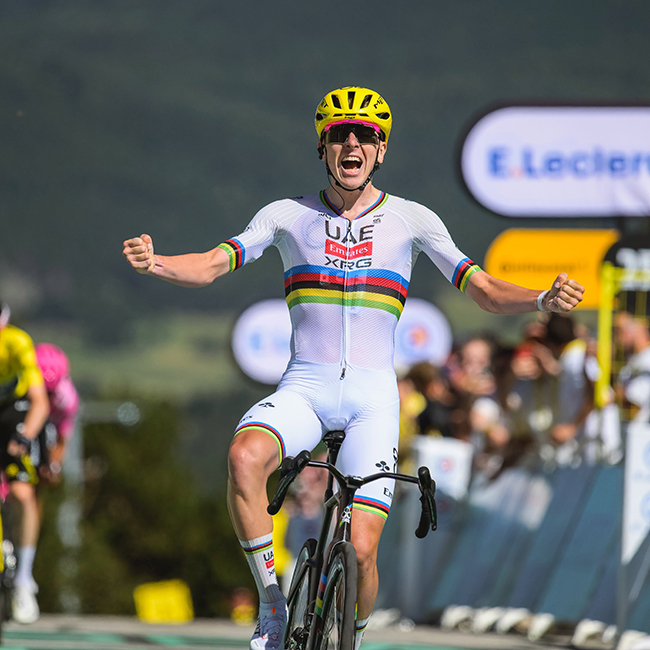
Tadej Pogacar wins stage three and becomes the new GC leader.
Results:
195.9 kilometers raced at an average speed of 41.216 km/hr
| 1 | Tadej Pogacar | UAE Team Emirates-XRG | 4hr 45min 11sec |
| 2 | Jonas Vingegaard | Team Visma | Lease a Bike | @ 2sec |
| 3 | Richard Carapaz | EF Education-EasyPost | s.t. |
| 4 | Paul Seixas | Decathlon CMA CGM Team | s.t. |
| 5 | Tobias Halland Johannessen | Uno-X Mobility | 0:04 |
| 6 | Lennert Van Eetvelt | Lotto-Intermarché | s.t. |
| 7 | Florian Lipowitz | Red Bull-BORA-hansgrohe | s.t. |
| 8 | Remco Evenepoel | Red Bull-BORA-hansgrohe | s.t. |
| 9 | Isaac del Toro | UAE Team Emirates-XRG | s.t. |
| 10 | Juan Ayuso | Lidl-Trek | s.t. |
GC after stage 3:
- GC leader: Tadej Pogacar (UAE Team Emirates-XRG)
- Mountains classification leader: Alex Baudin (EF Education-EasyPost)
- Points classification leader: Tadej Pogacar (UAE Team Emirates-XRG)
- Best young rider: Isaac del Toro (UAE Team Emirates-XRG)
- Teams classification leader: UAE Team Emirates-XRG
384 kilometers raced so far at an average speed of 43.726 km/hr
| 1 | Tadej Pogacar | UAE Team Emirates-XRG | 8hr 46min 55sec |
| 2 | Jonas Vingegaard | Team Visma | Lease a Bike | s.t. |
| 3 | Remco Evenepoel | Red Bull-BORA-hansgrohe | @ 23sec |
| 4 | Isaac del Toro | UAE Team Emirates-XRG | 0:24 |
| 5 | Juan Ayuso | Lidl-Trek | 0:27 |
| 6 | Paul Seixas | Decathlon CMA CGM Team | 0:48 |
| 7 | Florian Lipowitz | Red Bull-BORA-hansgrohe | 0:53 |
| 8 | Lenny Martinez | Bahrain Victorious | 1:09 |
| 9 | Tobias Halland Johannessen | Uno-X Mobility | 1:11 |
| 10 | Ilan Van Wilder | Soudal Quick-Step | 1:17 |
Sunday, July 5: Stage 2, Tarragone-Barcelona (Olympic Stadium), 168.5 km
Complete stage 2 results, stage story, photos, map & profile
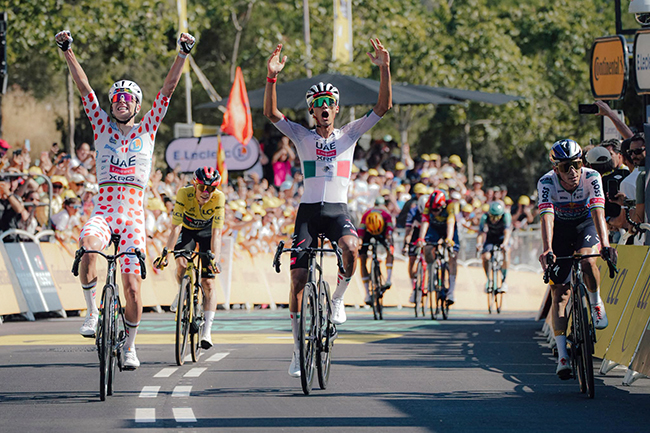
Isaac del Toro (right) wins the stage with Tadej Pogacar right with him. On the right, Remco Evenepoel was third. Jonas Vingegaard (in yellow, just behind them) remains the GC leader. Photo: ASO/Thomas Maheux
Results:
168.5 kilometers raced at an average speed of 45.951 km/hr
| 1 | Isaac del Toro | UAE Team Emirates-XRG | 3hr 40min 1sec |
| 2 | Tadej Pogacar | UAE Team Emirates-XRG | s.t. |
| 3 | Remco Evenepoel | Red Bull-BORA-hansgrohe | s.t. |
| 4 | Jonas Vingegaard | Team Visma | Lease a Bike | s.t. |
| 5 | Mattias Skjelmose | Lidl-Trek | @ 3sec |
| 6 | Tobias Halland Johannessen | Uno-X Mobility | s.t. |
| 7 | Romain Grégoire | Groupama-FDJ United | s.t. |
| 8 | Lenny Martinez | Bahrain Victorious | s.t. |
| 9 | Paul Seixas | Decathlon CMA CGM Team | s.t. |
| 10 | Tom Pidcock | Pinarello-Q36.5 Pro Cycling Team | s.t. |
GC after stage 2:
- GC leader: Jonas Vingegaard (Visma | Lease a Bike)
- Mountains classification leader: Alex Molenaar (Caja Rural-Seguros RGA)
- Points classification leader: Isaac del Toro (UAE Team Emirates-XRG)
- Best young rider: Isaac del Toro (UAE Team Emirates-XRG)
- Teams classification leader: UAE Team Emirates-XRG
188.1 kilometers raced so far at an average speed of 46.675 km/hr
| 1 | Jonas Vingegaard | Team Visma | Lease a Bike | 4hr 1min 48sec |
| 2 | Tadej Pogacar | UAE Team Emirates-XRG | @ 6sec |
| 3 | Remco Evenepoel | Red Bull-BORA-hansgrohe | 0:15 |
| 4 | Isaac del Toro | UAE Team Emirates-XRG | 0:16 |
| 5 | Juan Ayuso | Lidl-Trek | 0:19 |
| 6 | Paul Seixas | Decathlon CMA CGM Team | 0:42 |
| 7 | Romain Grégoire | Groupama-FDJ United | 0:44 |
| 8 | Florian Lipowitz | Red Bull-BORA-hansgrohe | 0:45 |
| 9 | Lenny Martinez | Bahrain Victorious | 0:53 |
| 10 | Tom Pidcock | Pinarello-Q36.5 Pro Cycling Team | 1:00 |
Saturday, July 4: Stage 1, Barcelona 19.6-kilometer team time trial
Stage 1 complete results, stage story, photos, map & profile
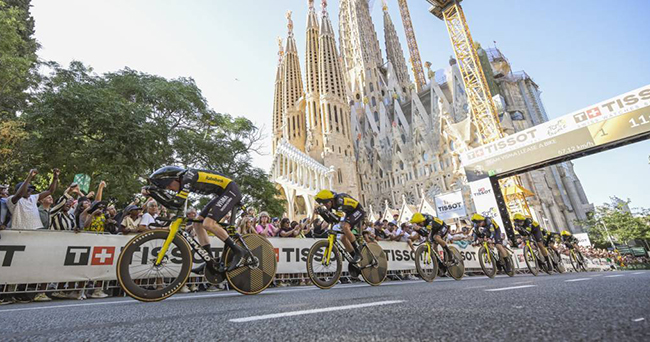
Team Visma | Lease a Bike on its way to winning the stage and putting Jonas Vingegaard in yellow. ASO/Charly Lopez photo
Results:
19.6 kilometers raced at an average speed of 53.950 km/hr
| 1 | TEAM VISMA | LEASE A BIKE | 21min 47.87sec |
| 2 | NETCOMPANY INEOS CYCLING TEAM | @ 8sec |
| 3 | UAE TEAM EMIRATES XRG | 00' 12'' |
| 4 | LIDL-TREK | 00' 16'' |
| 5 | RED BULL-BORA – HANSGROHE | 00' 19'' |
| 6 | DECATHLON CMA CGM TEAM | 00' 39'' |
| 7 | ALPECIN-PREMIER TECH | 00' 39'' |
| 8 | GROUPAMA-FDJ UNITED | 00' 41'' |
| 9 | BAHRAIN VICTORIOUS | 00' 47'' |
| 10 | TEAM JAYCO ALULA | 00' 51'' |
GC after stage 1:
- GC leader: Jonas Vingegaard (Visma | Lease a Bike)
- Mountains classification leader: Tadej Pogacar (UAE Team Emirates-XRG)
- Points classification leader: Egan Bernal (Netcompany INEOS)
- Best young rider: Juan Ayuso (Lidl-Trek)
- Teams classification leader: Netcompany INEOS
| 1 | Jonas Vingegaard | Team Visma | Lease a Bike | 21min 47sec |
| 2 | Filippo Ganna | Netcompany INEOS | @ 8sec |
| 3 | Tadej Pogacar | UAE Team Emirates-XRG | 0:12 |
| 4 | Juan Ayuso | Lidl-Trek | 0:16 |
| 5 | Remco Evenepoel | Red Bull-BORA-hansgrohe | 0:19 |
| 6 | Isaac del Toro | UAE Team Emirates-XRG | 0:26 |
| 7 | Davide Piganzoli | Team Visma | Lease a Bike | 0:28 |
| 8 | Florian Lipowitz | Red Bull-BORA-hansgrohe | 0:35 |
| 9 | Tobias Foss | Netcompany INEOS | 0:38 |
| 10 | Paul Seixas | Decathlon CMA CGM Team | 0:39 |