

Review of “Owen S. Kimble: ‘Old Kaintuck,’”
by Carson Torpey
Peter Joffre Nye reviews biography that revives the career of Major Taylor’s rival Owen Kimble
Chairman Bill's note: Author Peter Joffre Nye's latest work is his biography of Albert Champion, The Fast Times of Albert Champion: From Record-Setting Racer to Dashing Tycoon, An Untold Story of Speed, Success, and Betrayal (Prometheus Books). It is available in hardcover and Kindle eBook.
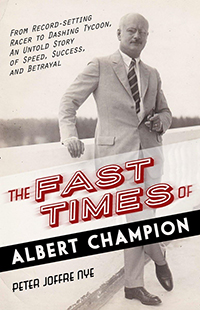
Champion (1878-1927) was an incredible man, as a bicycle racer he was winner of Paris-Roubaix and set more than a hundred world records. He went on to found both the Champion Spark Plug Company and General Motors Division AC Delco Systems.
Just click on the the cover picture on the right to get your copy of this terrific book.
Also on this site is Mr. Nye's story of one of cycling's toughest-ever racers, Reggie McNamara. McNamara won over 700 races and was one of the greatest-ever six-day racers. Oh, and there's more! Nye's story of Joseph Magnani, the Illinois rider who challenged Coppi and Bartali.
Enjoy!
Louisville’s track sprinter during the Golden Age of wheeling,
by T. Carson Torpey
By Peter Joffre Nye
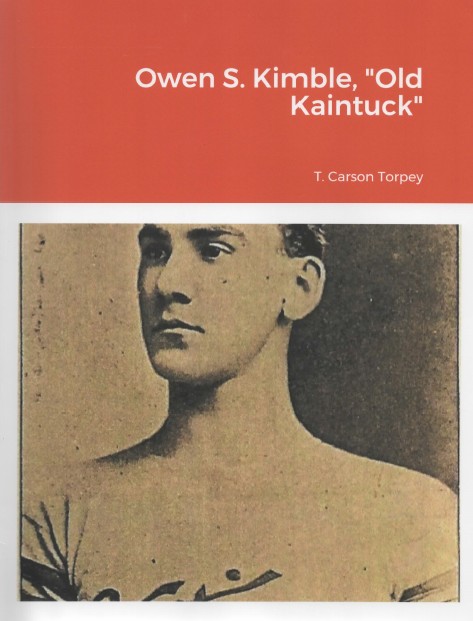
Copies of Owen S. Kimble, “Old Kaintuck,” for $25.00, includes postage, from Carson Torpey, 1506 Highland Avenue, Louisville, KY 40204.
Peter Joffre Nye writes:
Louisville, Kentucky is renowned as the hometown of legendary heavyweight boxing champion Muhammad Ali, Kentucky Fried Chicken founder Colonel Sanders, and Mary Travers of the iconic folk group Peter, Paul and Mary. An overlooked native son, Owen Kimble, raced bicycles as a star sprinter on tracks on both sides of the Atlantic around the turn of the twentieth century and is finally the subject of a new biography.
If Kimble’s name has surfaced in contemporary publications, he is usually mentioned as a nemesis of Marshall (Major) Taylor, the pioneer Black athlete in the predominately white sport who won the 1899 world professional sprint championship and three national titles. Kimble comes off as lesser talent. But Louisville author Carson Torpey, a former Kentucky state champion in road racing and time trials and retired bike shop owner, devoted ten years to time-traveling through vintage newspapers and cycling magazines surviving in digital form in his local library. His self-published biography makes the case that Kimble deserves recognition.
“I felt proud that Louisville had a top sprinter during those early years, and I wanted to tell his story,” Torpey told me in a phone interview. Major Taylor in his 1928 autobiography recounts white riders shoving him off tracks or boxing him in against the inside rail for a confederate to dash ahead and win, then split the prize money with collaborators. “Kimble never tried to take down Taylor like some white riders and always rode fair and square against him.”
Carson publishes a letter Kimble wrote in 1898 to a Louisville friend praising Taylor, unusual praise for a Southerner—and an opponent—in bedrock Jim Crow racial segregation. “Major Taylor is a wonder, and I believe he can beat any man living at miscellaneous distance races,” Kimble wrote. “He is lightning in a half-mile sprint, and can beat any of them in an hour or a fifty-mile race. Long and short distance champions are seldom in the same man.”








Content continues below the ads
Owen Schon Kimble was born in Louisville in 1876, the son of a riverboat pilot on the Ohio River flowing past Louisville. By age eighteen in 1894, Kimble worked as a clerk in a bike shop. The national economy had fallen into a deep depression after the New York stock exchange collapsed in the Panic of 1893: more than 15,000 companies failed, nearly 600 banks closed, and unemployment soared to 18 percent. Yet the emerging bicycle industry thrived. A half-dozen weekly cycling magazines loaded with ads were published in Chicago and New York City.
On spring and summer evenings men and women pedaled along Louisville streets. On Saturdays, roads were closed from horse traffic—before the dawn motor vehicles—for bicycle races that audiences.
Kimble, five feet eleven and 175 pounds, rose rapidly up the amateur ranks. In 1895 the Louisville Courier-Journal lauded him for winning forty-seven Class A races, sanctioned by the League of American Wheelmen, around the Commonwealth of Kentucky and neighboring Tennessee, Indiana, and Ohio.
In June 1896, he won the one-mile Louisville championship. The LAW presided as cycling’s governing body, initially for amateurs competing for merchandise prizes, sometimes including deeds to land parcels, diamond cufflinks, and a brace of horses. As the bicycle industry expanded and races proliferated, top riders demanded money prizes. The LAW begrudgingly created the Class B division for the cash men. On July 3 Kimble turned pro in Dayton’s Ohio State Meet. He rode as a member of the Outing Bicycle Team (when outing referred to the out of doors), sponsored by the Hay & Willlitts bike shop in Indianapolis. The brand Outing in stylish cursive script adorned the front and back of his wool jersey.
Content continues below the ads

Over the ensuing years, Kimble raced on assorted dirt, board, and cement tracks throughout the upper Midwest, north to Montreal and south to St. Augustine, Florida. Paying crowds filled grandstands and cheap bench seats. Racers sat with their backs low, hands gripping prototype steel drop handlebars, ready to fly on one-speed, nineteen-pound bicycles held by their trainer on the start line. At the crack of the starter’s pistol, trainers threw their man forward with such force that riders leaned at speed into the first turn. Most often they chased all-out to catch a tandem team of pacers pedaling the bejesus out of their machine to set a new track record.
Spectators born in the nineteenth century and accustomed to the metronome clip-clop of horses and city speed limits of ten miles an hour thrilled at watching cyclists cruising at 30 mph in events from one-third of a mile to five miles.
Torpey points out that racers traveled far and wide on trains. In just a week in one season, Kimble, his trainer Charles Ward, and cohorts competed in Buffalo on a Tuesday. Afterward the riders, trainers, friends, and newshounds climbed aboard special private trains provided by bicycle companies. Special cars enjoyed literary names, like the “Iolanthe,” after the Gilbert and Sullivan comic opera, and “Pickwick,” from Charles Dickens’s first novel.
Steam-powered locomotives hauled trains and riders 250 miles to Detroit for events on Friday and Saturday. Racers and their entourages sat swaying on lush, upholstered seats in the belly of passenger cars rumbling over steel rails at a top speed of 40 mph, punctuated by frequent stops to load the coal car and take on hundreds of gallons of water to create steam that powered the locomotive pulling passenger cars. the dining car with white linen tablecloths and polished silverware serving three meals daily, and comfortable Pullman sleeper cars.
The trip to Detroit would have taken much of the day. The next week took circuit riders to Kalamazoo, nearly 140 miles distant; to Peoria, Illinois 300 miles away; and 225 miles later to Racine, Wisconsin.
Content continues below the ads
The gentlemen of the Fourth Estate riffed on Kimble’s soft Southern accent and dubbed him, Old Kaintuck. He rode under contract for several bicycle companies. His name and image featured in trade publications promoting Moran & Wright Tires (predecessor to Uniroyal, Inc.) as well as the exotic Mexican Mustang Liniment.
Torpey picks Kimble’s two-mile victory from a field of thirty-one pros in the 1898 LAW national championships program in Indianapolis as one of his career highlights. Kimble occasionally edged Taylor to the line and, at one time or another, defeated all the other pros.
His reputation leapt across the Atlantic. In 1903 Paris journalist and promoter extraordinaire Robert Coquelle signed Kimble up for five events on the City of Light’s famed outdoor cement Buffalo Velodrome. Kimble sailed in February on the luxury ocean liner SS Kronprinz Wilhelm. In Paris he posed in his racing kit on his bike for photo journalist Jules Beau; the images remain in the France’s national library, Bibliothèque Nationale de France, and are reproduced in the book.
Coquelle kept Kimble busy traveling and racing all summer. Kimble capped his seven-month tour in the season finale, the aptly named Grand Prix Adieux (Big Prize Good-Bye), on the indoor board Velodrome d’Hiver (track of winter), near the Eiffel Tower. Parisians in smart suits and chic dresses flocked to watch Kimble ride against Thorvald Ellegaard of Denmark, fresh from winning his second Union Cycliste Internationale world sprint championship in Copenhagen, Major Taylor concluding his third Continental campaign, France’s beloved 1900 world champ Edmund Jacquelin, and the hardy Dutch national champion Harie Meyers. In the Grand Prix Adieux’s final of match, Kimble beat Ellegaard for victory, with Taylor a close third.
The Courier-Journal declared, “Owen Kimble Wins Big Race: Louisville Boy Beats Taylor, Ellegaard, Jacquelin and Meyers in Paris.” Upon returning to Louisville in November, Kimble retired from racing.
The national economy had recovered, the bicycle industry went into steep decline, cycling magazines folded, and track racing consolidated in the Northeast. Kimble hung up his wheels to work day jobs as a salesman for tobacco companies followed by wholesale groceries. He died in 1953, age seventy-seven, of cardiovascular complications.
Torpey includes a paragraph from Taylor’s autobiography, in which Taylor called Kimble one of his most formidable opponents. “The least slip on my part in any of the races between Kimble and I meant victory for Kimble; that’s how closely we were matched.”
This biography serves as a welcome tile in the mosaic of early American cycling history, covering the era when domestic racing produced six UCI world champions in eleven years.
Copies of Owen S. Kimble, “Old Kaintuck,” for $25.00, includes postage, from Carson Torpey, 1506 Highland Avenue, Louisville, KY 40204.
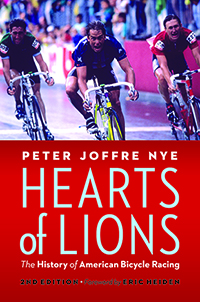
Peter Joffre Nye is a prize-winning journalist and author who has contributed to The Washington Post, Humanities Magazine, and dozens of other publications. His latest book is the updated second edition of Hearts of Lions: The History of American Bicycle Racing.