
David Stanley
It Is About the Money;
The economics of cycling prize money.
David Stanley is an experienced cycling writer. His work has appeared in Velo, Velo-news.com, Road, Peloton, and the late, lamented Bicycle Guide (my favorite all-time cycling magazine). Here's his Facebook page. He is also a highly regarded voice artist with many audiobooks to his credit, including McGann Publishing's The Story of the Tour de France and Cycling Heroes.

David L. Stanley
 David L. Stanley's masterful telling of his bout with skin cancer Melanoma: It Started with a Freckle is available in print, Kindle eBook and audiobook versions, just click on the Amazon link on the right.
David L. Stanley writes:
It is About the Money; the economics of cycling prize money.
Trigger Warning: If you’re a person who says things like “These athletes today, they’re so pampered, why back in my day…” or “You call that music? And they make how much every concert?” or “These salaries today are crazy, nobody is worth that much money” or “These players/racers/athletes today, they should be honored and thankful they let them ride the race/play the game…” just stop reading now. Go away and go shout at some clouds. Thank-you.

Mathieu van der Poel celebrates his 2025 Paris-Roubaix win. Sirotti photo
The numbers I cite below are from a wide variety of vetted sources. As a cycling journo who is deeply invested in all things sport, I subscribe to several economics of sport newsletters that do the leg work. I do not use AI. Its numbers are not even close to accurate.
What Pauline Ferrand-Prévôt and Mathieu van der Poel accomplished over the weekend of April 12-13, 2025 was magnificent. Two tremendous Paris-Roubaix victories over equally skilled opponents, the détente they reached with the cobblestones, as no ever truly defeats the pavé bleu of Northern France—these were wins that had us cheering from our seats. A race that dates to 1896, a win in the Queen of the Classics gets your name on a metallic tag on one of the ancient showers at the Roubaix velodrome, a 12 kg cobblestone trophy, and a place among the legends of the sport.
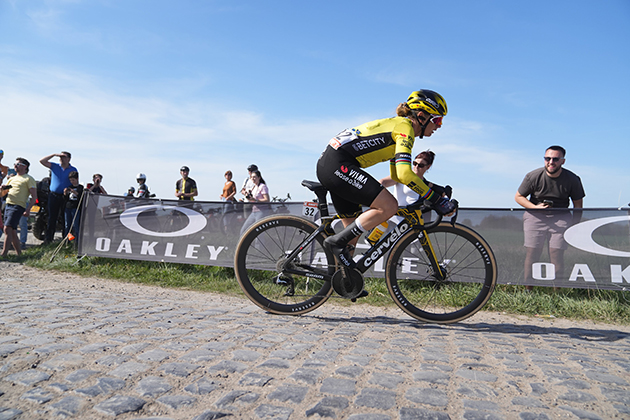
Pauline Ferrand-Prévôt has left all the other riders behind and is on her way to a solo win in the 2025 Paris-Roubaix. Sirotti photo
For those hours of suffering and excellence, €20,000 went to Ferrand-Prévôt and MvdP pocketed €30,000. All told, there was €91,000 on offer for the men and €49,000 for Paris-Roubaix Femmes. Yes, that is the correct number of zeros. Not only is there a sizeable gender disparity, the dollars involved are laughable when compared to other events of similar stature. As I write this, there are $1.13 US to the Euro. A total of $158,000 dollars in total money.
Both winners of the NYC Marathon receive $100,000. The second place money is $60,000 each. The Masters golf tournament (and if you want to argue about the relative value of the athleticism on display between these different events, you too should also visit getoffmylawn.com) is a 4-day event, and one of golf’s four Majors. This storied event has been around since 1934 at Augusta National in Georgia (and no, I’m not interested in their well-deserved reputation for racism and misogyny either. Well, I am, very much so, but not here). They offer $21,000,000 – 21 million dollars in total. $4.2 million to the winner. 20th place garners a $273,000 check, and if you miss the Day Two cut which winnows the field by half for the closing two rounds, you still pocket $25,000 for your work.
The legendary Wimbledon fortnight was first held in 1877 at the All-England Lawn Tennis Club (AELTC). There, each winner receives $2.7 million from a pot of $25 million dollars. These athletes are not on salary. But that’s deeper than it appears.
Mathieu van der Poel is a salaried athlete. His Alpecin–Deceuninck team pays him around $4.4 million US to race. Pauline Ferrand-Prévôt’s salary, when she signed with Visma-Lease a Bike, was never announced. It is rumored, on several sites, to be in the neighborhood of $1.2 million.









Content continues below the ads
If you are a pro who rides for a top-tier cycling team, you have near-zero financial responsibility for your team trainers, mechanics, physios, dieticians, coaches, security, and the hierarchy that manages your logistics. But do not forget that cycling tradition mandates that prize money be shared amongst the team. All those folks up there, plus your teammates on the road, received a piece of MvdP’s €30,000.
For athletes like Rory McIlroy and Roger Federer, those “Team Roger” expenses eat up a chunk of winnings. Next time you watch a tennis major, peek into the players’ box. All those folks (and like cycling, top players require a sizeable retinue) draw their salaries from their player’s winnings and endorsements. Their travel? Picked up by The Star Player. Don’t cry, though, as Roger Federer made $8 million from Rolex alone. Likewise, shed no tears for Rory McIlroy. Between winnings, salaries from various companies, and his endorsements, he will pocket around $80-85 million dollars this year.
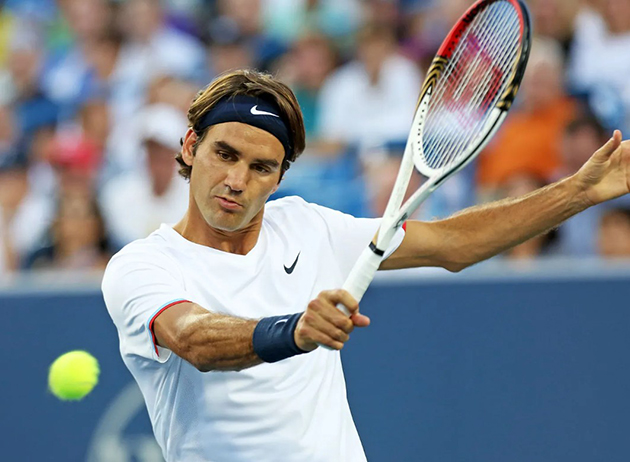
Roger Federer in 2012. Nick Laham photo
Where is all this money for sport coming from? And why doesn’t cycling benefit?
First off, ticket sales matter. Now, we have to generalize a bit because there are too many permutations to crunch numbers accurately without the benefit of a Cray computer. So, too, with sponsorship.
The Masters. The tourney allows about 40,000 patrons (always patrons, never fans - the only term the Masters allows media to use) to cross their hallowed gates daily. There are 5 days available; the Wednesday practice round and the four competitive rounds Thursday-Sunday. A four day pass costs $450, $150 per day pass, and yes, there is a lottery. That’s a total of 200,000 guests. The Masters has perhaps as much as $90 million in pocket before they even begin to look at the millions in sponsorship money. ATT, IBM, Mercedes, Delta, UPS, and Rolex kick in $10 million each for the privilege that associates their products with the Masters. On the other hand, at the concession stands, you can buy the storied pimento cheese sandwich, a soft drink, and a bag of chips for under ten dollars.
Over at the All-England Lawn Tennis Club, tickets run from $200-350 US for Centre Court for each day of competition. Wimbledon has a total of 19 courts on site, out of their 55 courts, that are used for the Championships. On average, it is estimated that about 550,000 people pass through the turnstiles at SW19 each year. That tallies perhaps as high as $133 Million in tickets. The AELTC does not make their sponsorships amounts available but you have to guess they are commensurate with the Masters sponsorships.
It’s important to remember that these are both highly labor-intensive sites. They are large, they are grass, they have demanding memberships, and consequently, labor costs are high. The AELTC does say their regular staff is around 1,300 permanent employees plus an additional 5,000 staffers for the tourney.
Content continues below the ads

Let’s talk about TV rights. The Masters does not charge CBS or ESPN any money for the domestic television rights to their tourney. Instead, the Masters collects $0 from its media deals, and the networks agree to air a very limited number of commercials. Masters sponsors, including IBM, Mercedes-Benz, and AT&T, cover the cost of production. The Masters could potentially make $125 million annually for its domestic TV rights but they have chosen to control the media image going out to the world instead.
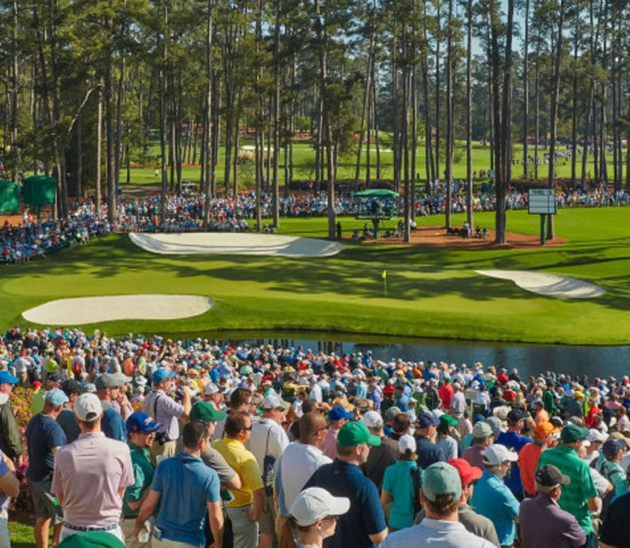
The Masters golf tournament.
At The Wimbledon Championships, Disney-US paid a total of $630 million for the rights to broadcast Wimbledon from 2024 to 2035, meaning $52.5 million per year. At the Tour de France, NBC/Peacock and the Amaury Sports Organization (ASO), the firm that owns many races including Paris-Roubaix, do not disclose their deal. We do know that for the right to broadcast the British Open Golf championship, NBC Sports pays the Royal and Ancient Golf Club of St. Andrews, the sovereigns who stage The Open, $50 million per year.
As you can see, the money around pro sport is a murky pond.
What’s the ASO sponsorship situation? It’s complicated. ASO owns a lot of stuff. They own the lion’s share of pro cycling, sailing events, motorsports, and the Paris Marathon. What makes this difficult to parse is they are a private firm with no obligation to share figures.
On the cycling side, here’s what we know. Flo-Bike, Shimano, and LCL are significant sponsors. LCL spends $12 million across all ASO events. It is thought that this $12 million represents about 15% of ASO’s total annual sponsorship. This might seem like a lot of money, until you learn that ASO has 132 days of top pro bike racing alone on their public schedule every year. Skoda Auto pays $4 million to sponsor the TdF’s maillot vert, and provides a fleet of 310 cars across 17 main events.
ASO produces the Paris-Dakar Rally. They also stage La Tour de France à la Voile, an annual yachting race around the coast of France. Inaugurated in 1978, it links the English Channel to the French Riviera and is held in July. The race visits ten harbors along the French coast. It includes single day coastal stages as well as intensive regattas at the various ports. The boats are transported by trucks midway through the race from stages held in the Atlantic Ocean to those in the Mediterranean Sea. Even with sailing specific sponsors on-board, this must be a very expensive event to produce.
Their expenses to stage all these events, and hence, the ASO net, are not known. It is believed that the Tour de France represents about 53% of their annual income. ASO, it is also believed, had income of $640 million in 2023.
When you examine the large number of events staged by ASO, they don’t have an immense pot of cash to share with the riders of their events. These events are all highly labor intensive. They take place in far-flung areas where logistics are often difficult. ASO is in a very expensive and very cool business.
Content continues below the ads
The Big Question – Why aren’t pro cycling’s athletes paid prize money commensurate with their peers in other sports?
My Answer – It’s complicated.
1) ASO is spread very thin. They control the marketplace. They own almost all the major cycling events. As with many conglomerates, I am certain that some events they deem prestigious are significant money losers, but those losses are covered by monies generated at other events.
2) Cycling events are complicated beasts. They have extraordinary logistical issues, spread out from one day to three week periods that generate a lot of expense, even with reasonable sponsorships.
3) No tickets. If ASO had the same $133,000,000 in the bank earmarked for cycling as Wimbledon does, we’d begin to see acceptable prize money for our athletes.
The Big Answer. Cycling is not good, not good at all, at aspirational image marketing. People across the globe wanted to Be Like Mike in 1991 when he signed his then record-breaking $13.5 million/10 years deal with Gatorade. That’s the equivalent of $32 million today. Mike’s money was spread out over 10 years. Mookie Betts, the outstanding outfielder for the LA Dodgers, makes $32 million every year. Where’s that money come from? Image marketing of Mookie and the Dodgers.
We all wanted to tee it up like Tiger. And Rory. We all want the class of Roger Federer and the fire of Rafael Nadal and Serena Williams. Who doesn’t want the swagger of Lewis Hamilton?
We have those athletes. We have Demi Vollering. We have Mathieu van der Poel. We have Tadej Pogačar. We have Annemiek van Vleuten. Everyone of them, the equal of any athlete in other sport you can name. They are massive talents, excellent interviews, attractive people (yes, that matters, it’s not just about results), quality humans – they should be at the forefront of every ad agency’s WANT list for their next campaign. What happens when we see more projects like that of Tadej’s $250,000 Richard Mille watch splashed all over the TV and media?

Annemiek van Vleuten wins the 2022 World Road Championship. Sirotti photo
Agencies up their buys for cycling events and cycling media and cycling endorsements because marketing and media all play follow-the leader. ASO ups their prices for TV/Media rights, and that rising tide lifts the prize money boats. I read European media. Thanks to streaming, I watch Euro TV. I can’t wait to see this happen.
Maybe ASO could start with Gatorade. Gatorade pays the NFL between $45 and $50 million per year, plus tens of millions of dollars in free product to the 32 teams.
You see, it is about the money. $4 million is a nice income for MvdP. I’d love to make one-quarter of that. So would you. But we are not the very best in the world at what we do in a profession that is in the glare of the world’s sporting social media spotlight. In the world sport market, he’s worth many times that. Properly marketed, that is. That is where the cycling prize money conundrum begins and ends.
Here's the dirty secret. We all complain about the difficulty in seeing our sport on TV. Why? Because dollar signs matter to TV execs; dollars and eyeballs. When cyclists start earning seven figure paychecks for a day’s work, and those checks will come, I promise, when pro cycling athletes are marketed properly, that’s when TV execs will queue up to sign mid-12 figure checks for the rights to broadcast our sport.
Market our athletes. When it does, our athletes will begin to be paid what they are worth. Hey, ASO, when that tide starts to rise, don’t be afraid to ask for the money. Big Money. You have an extraordinary product. Men’s and women’s cycling is in its greatest Golden Era ever. Don’t give it away.
N'oubliez pas, pas de cadeaux!
David Stanley, like nearly all of us, has spent his life working and playing outdoors. He got a case of Melanoma as a result. Here's his telling of his beating that disease. And when you go out, please put on sunscreen.