


Bill McGann's Why Your Bike Is Made in Asia: My Career in Bicycles as I Watched Two Continents Squander an Industry
Reviewed by Peter Joffre Nye
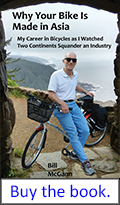
Formats: Print, Kindle eBook & Adudiobook.
Suggested price. retail print version: $16.95, Kindle eBook: $3.99
Get the book:
Third Street Books, McMinnville, OR: Print version
Amazon.com: print, Kindle eBook or Audiobook or click on the link on the right.
About Peter Joffre Nye. Rennaisance man Peter Joffre Nye has written two of the best cycling books you'll ever read:
Hearts of Lions: The History of American Bicycle Racing and
Plus, his articles have appeared in more than 100 publications, including the Washington Post, USA Today , and Sports Illustrated. Several have been turned into books and one became the basis of a documentary.









Content continues below the ads

Mr. Nye writes:
 Russian novelist Vladimir Nabokov captured in his memoir how everyday customs, the names of streets, even some cities, disappear over generations when he told a friend, “The years are passing my dear, and presently nobody will know what you and I know.”
Former California bike shop proprietor and importer of upscale Italian racing bicycles and components Bill McGann tells in his memoir, Why Your Bike Is Made in Asia, how American and European bicycle and components manufacturers that had created the industry on both sides of the Atlantic in the late nineteenth century and dominated it through the twentieth century have surrendered to Asian successors.
McGann entered the two-wheel trade on June 1, 1974. He opened Bill’s Bike Shop in the City of Camarillo, on a Pacific coastal plain west of Los Angeles. He offered a modest selection of ten-speed French Gitanes, a century-old marque named gypsy woman; and Maserati bicycles from Italy, manufactured by a member of the famed Maserati family renowned for low-slung Maserati Grand Prix racecars. Predictably, French bikes came equipped with France’s Simplex front and rear derailleurs (gear changers) and other French parts; Maseratis had the shinier and more expensive Italian Campagnolo equipment. French and Italian components ruled the market for as long as McGann and his customers were aware.
What he lacked in business savvy at age twenty-two he made up by servicing his products for customers and working long hours. He had two cross-town rivals. A sporting goods store catered to a broad audience, from Adidas shoes and apparel to Rawlings baseball gloves and bats to Chicago-made Schwinn bikes. His other competitor was the Camarillo Bicycle Center. It displayed a large inventory of glistening imported lightweight bikes from Europe and Great Britain, although the bestselling bikes were Nishiki Olympics from Japan. McGann confesses he heaped scorn on the Nishiki brand while conceding the orange Nishikis were a good buy and their Japanese derailleurs were cutting-edge. Late that year, he attended the Camarillo Bicycle Center’s bankruptcy auction.
Bill’s Bike Shop opened when the business’s balance of power started changing, unnoticed at first. In 1972 the Schwinn Bicycle Company, a brand as familiar nationwide as Coca-Cola and considered the paragon of bicycles, imported Panasonic and Bridgestone bikes from Japan. The Japanese bikes were sold with Schwinn Approved decals stuck on the frames, to make up for Schwinn’s own production shortfalls. McGann writes: “Schwinn was saying, in effect, the magic of the made-in-Chicago Schwinn quality didn’t really exist.”
The family-owned company, founded in 1895 in Chicago by German immigrant Ignaz [spelling correct] Schwinn, had rejuvenated the industry in the early 1930s, in defiance of the Great Depression, with the first diamond frame redesign and balloon-tired wheels. By the 1970s the grown grandsons in charge relied on clapped-out production machinery and inferior paint on frames. In 1992 the company filed for bankruptcy; the Schwinn family lost control in the business restructuring. (A documentary, “No Hands: The Wild Ride of the Schwinn Bicycle Company,” produced by Unfeatured Films and narrated by Lance Armstrong, is set for release in 2026.)
McGann’s Euro-centric taste relaxed later when a sales rep sold him an order for Japanese-imported Centurion ten-speed bikes. He saw them as excellent machines, priced less than lower-quality European bikes. For a time, he filled his store with Centurions. Customers flocked to purchase them and boosted cash flow—a trend in shops nationwide.
He provides a solid overview about the original European tinkerers improving bicycles and components over decades. Especially the succession of French inventors of derailleurs, which changed road racing forever. In 1914 Jean Baptiste (Joanny) Panel developed a three-speed rear derailleur for bicycles he manufactured in St. Étienne, in south-central France, under the brand Le Chemineau, The Tramp, a wink to the hugely popular persona of silent-screen Hollywood comedian star Charlie Chaplin.
Derailleurs were breakthrough technology. For the first time, cyclists could shift the chain propelling the bicycle, from one rear-wheel sprocket to another while continuing to pedal in the ideal cadence of 75 to 90 rpms up hills and down as well as through headwinds and tail winds. Riders took a hand off the handlebars to move a small lever fitted on the right side of the downtube. The lever pulled a cable running to the back chain stay, where the derailleur attached to the frame, and moved the chain over sprockets. Derailleurs seemed as magical as special seven-league boots in European folklore. When someone pulled on those special boots, each stride took them seven leagues, about 21 miles, thus enabling someone to go superhumanly fast.
Content continues below the ads

Derailleurs caught on with tourists right away. The Paris newspaper editor and director of the Tour de France, Henri Desgrange, disparaged derailleurs as something for old men—in their forties, in his estimation. He banned racers from using them in the Tour de France. Professional and amateur racers competed on one-speed bikes until the 1936 Berlin Olympics, when the International Olympic Committee and the Union Cycliste Internationale replaced the longstanding 100-kilometer (62.5 miles) individual time trial, with riders going off from a standing start, one by one in two-minute intervals, with the mass start road race common today. In 1937, Desgrange finally allowed riders to use three-speed rear derailleurs in Le Tour.
By the late 1940s, French and Italian inventers added a second front chain ring, thus offering six speed derailleurs. Then came four rear sprockets in the 1950s for eight-speed derailleurs, followed by ten-speed derailleurs were available in the 1960s.
In 1950s Japan, while the nation was rebuilding after massive destruction during World War II, a former bicycle manufacturer named Shozaburo Shimano studied European derailleurs and British three-speed Sturmey-Archer rear hubs. Shimano created his own low-cost versions. In 1963 he shipped three-speed hubs to America for Columbia bicycles sold in Western Auto franchise stores with automobile parts, lawn mowers, and household appliances. The Japanese entrepreneur had cracked the low end of America’s bicycle market.
Shimano’s grown sons took over the company after his death and developed world-class hubs, cranksets, brakes, and derailleurs. In 1974 the Shimano company supplied derailleurs, complete with “Schwinn Approved” labels. The Japanese company then shook-up European stalwarts when it became title sponsor of one of the Continent’s most competitive professional teams, the Flandria-Shimano-Carpenter squad. More Japanese companies followed in sponsoring top European pro teams, including Toshiba, Panasonic, and Nissan.
Shimano kept improving derailleurs. In 1984 came game-changing indexed shifting that made faster and more accurate gear changes. Derailleurs had relied on shift levers staying in place with friction washers. Riders moved the lever by feel, moving the chain from one cog to the next. Shimano’s innovation moved precisely, with a satisfying click as the chain punctually shifted gears. Shimano’s products took more market share and contributed to Simplex declaring bankruptcy in 1985.
Andy Hampsten of Grand Forks, North Dakota rocked the cycling world in 1988 with victory of Italy’s three-week 2,220-mile Giro d’Italia, the first American to win the Italian grand tour. He rode with new Shimano derailleurs with gear shifters in handlebar brake levers so that he kept his hands on the handlebars. Shimano derailleurs overtook Campagnolo’s decades-long lead in prestige and sales.
Content continues below the ads
McGann guides readers through the hard-nosed, money-oriented business driving competition. Young companies obsessed with quality control and product reliability overtook complacent businesses. In the 1970s, the Giant Manufacturing Company in Taiwan, an island country in the South China Sea, competed with other Taiwan manufacturers to take over manufacturing bicycle frames from established American and European companies. McGann explains that Japan became an expensive place for frame making, which gave incentive for challengers to move production to mainland China and Taiwan. After the year 2000, he cites, “China was making more than two-thirds of Planet Earth’s bicycles.”
Some new American businesses gate-crashed the parts industry. Michael Sinyard of San Jose had been a big fan of Italian cycling. To fund a trip to Europe in 1974, he sold his Volkswagen bus, similar to Steve Jobs selling his VW bus to buy parts for the first Apple computer. Sinyard established Specialized Bicycle Imports. Under his company’s motto, “Innovate or die,” he built the first mountain bike Stump Jumper and became an industrial leader.
Stan Day, a weekend triathlete in the 1980s, created derailleur shifters in the handlebar grips of road bikes to shift while keeping hands on the handlebars. His shifting mechanism appealed to mountain bike riders. In 1987 Stan Day and three partners cofounded the SRAM Corporation, in a century-old building in central Chicago. He and his partners expanded SRAM by acquiring a range of specialty companies including Zipp carbon fiber wheels manufactured in Indianapolis, RockShox front and rear suspension systems made in Colorado Springs, and Velocio apparel for men and women manufactured in Londonberry, New Hampshire.
What happened with the bicycle-building industry migrating from Europe and the United States to Asia parallels the fate of the character Mike Campbell in Hemingway’s novel, The Sun Also Rises. When Campbell is asked how he had become bankrupt after he received a sizeable inheritance, he replies, “Two ways. Gradually, and then suddenly.” McGann gives us a compelling narrative of the seismic transformation. After his long passion for Italian racing bicycles, he rides a Mongoose commuter bike made in Taiwan, complete with panier bags over the rear wheel.
(Peter Joffre Nye is a prize-winning author, journalist, and magazine editor. His latest book is the updated second edition of Hearts of Lions: The History of American Bicycle Racing - University of Nebraska Press).